
Table of Contents
PON Router Features_UG_1910020947
About This Guide
This guide is a complement of Quick Installation Guide. The Quick Installation Guide instructs you on quick internet setup, and this guide provides details of each function and shows you the way to configure these functions appropriate to your needs.
Note: Features available in the router may vary by model and software version. Router availability may also vary by region or ISP. All images, steps, and descriptions in this guide are only examples and may not reflect your actual Router experience.
Conventions
In this guide the following conventions are used:
|
Convention |
Description |
|---|---|
|
Underline |
Underlined words or phrases are hyperlinks. You can click to redirect to a website or a specific section. |
|
Bold |
Contents to be emphasized and texts on the web page are in bold, including the menus, items, buttons and so on. |
|
> |
The menu structures to show the path to load the corresponding page. For example, Settings > System Tools > Firmware Upgrade means the Firmware Upgrade page is under the System Tools menu that is located in the Settings tab. |
|
Note: |
Ignoring this type of note might result in a malfunction or damage to the device. |
|
Tip: |
Indicates important information that helps you make better use of your device. |
More Info
The latest software, management app and utility can be found at Download Center at https://www.tp-link.com/support/download.
The Quick Installation Guide can be found where you find this guide or inside the package of the router.
Specifications can be found on the product page at https://www.tp-link.com.
TP-Link Community is provided for you to discuss our products and share knowledge at https://community.tp-link.com.
Our Technical Support contact information can be found at the Contact Technical Support page at https://www.tp-link.com/support.
Log In to Your GPON Router
With a web-based utility, it is easy to configure and manage the router. The web-based utility can be used on any Windows, Mac OS or UNIX OS with a Web browser, such as Microsoft Internet Explorer, Mozilla Firefox or Apple Safari.
Follow the steps below to log in to your router.
1 Set up the TCP/IP Protocol in Obtain an IP address automatically mode on your computer.
2 Visit http://tplinkmodem.net or http://192.168.1.1, and create a login password for secure management purposes. Then click Save to log in.
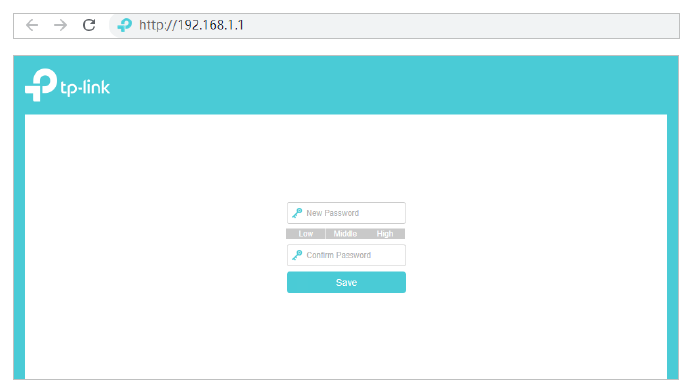
Note: If the login window does not appear, please refer to the FAQ Section.
Set Up Internet Connection
This chapter introduces how to connect your GPON router to the internet. The GPON router is equipped with a web-based Quick Setup wizard. It has necessary ISP information built in, automates many of the steps and verifies that those steps have been successfully completed. Furthermore, you can also set up an IPv6 connection if your ISP provides IPv6 service.
It contains the following sections:
-
Use Quick Setup Wizard
-
Quick Setup Via TP-Link Aginet App
-
Manually Set Up Your Internet Connection
-
Test Internet Connectivity
-
Set Up an IPv6 Internet Connection
-
IPv6 Tunnel
Use Quick Setup Wizard
The Quick Setup Wizard will guide you to set up your router.
Tips: If you need the IPv6 internet connection, please refer to the section of Set Up an IPv6 Internet Connection.
Follow the steps below to set up your GPON router.
-
Visit http://tplinkmodem.net or http://192.168.1.1, and log in with the password you set for the GPON router.

-
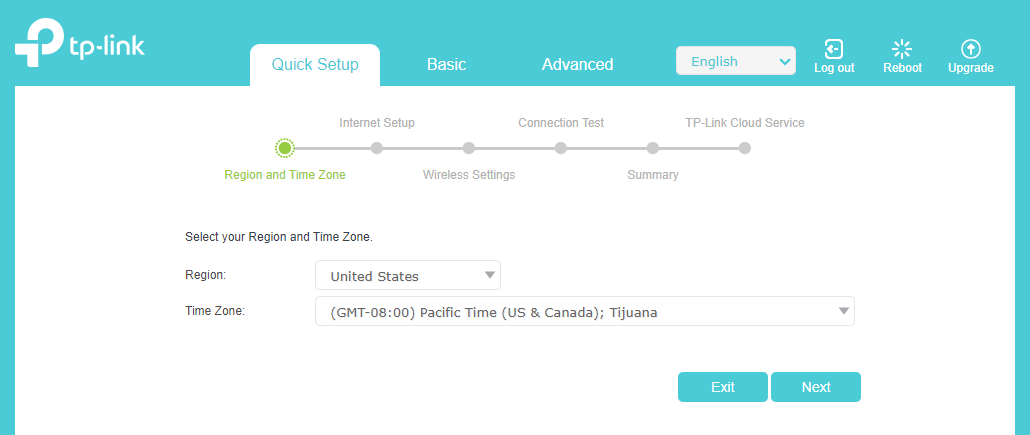
Follow the step-by-step instructions to complete Quick Setup configuration or go to Quick Setup for configuration to connect your router to the internet. Then follow the step-by-step instructions to connect your router to the internet.
-
To enjoy a more complete service from TP-Link (remote management, TP-Link DDNS, and more.), log in with your TP-Link ID or click Sign Up Now to get one. Then follow the instructions to bind the cloud router to your TP-Link ID.
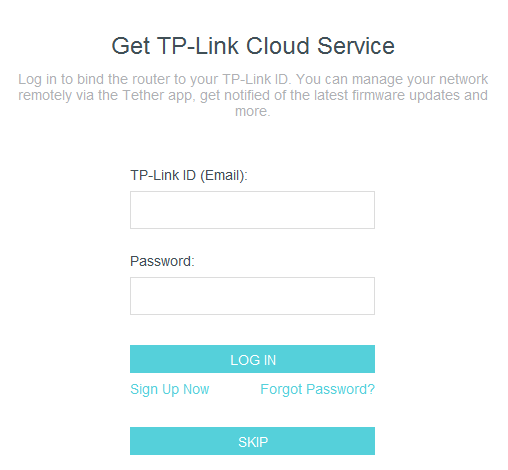
Note:
To learn more about the TP-Link Cloud service, please refer to the TP-Link Cloud Service section.
If you do not want to register a TP-Link ID now, you may click Skip to proceed.
If you have changed the preset wireless network name (SSID) and wireless password during the Quick Setup process, all your wireless devices must use the new SSID and password to connect to the router.
Quick Setup Via TP-Link Aginet App
The Aginet app runs on iOS and Android devices, such as smartphones and tablets.
1. Launch the Apple App Store or Google Play store and search “TP-Link Aginet” or simply scan the QR code to download and install the app.

2. Launch the Aginet app and log in with your TP-Link ID.
Note: If you don’t have a TP-Link ID, create one first.
3. Tap the Create a Network button and select how you will connect your device to the internet. Follow the steps to complete the setup and connect to the internet.
4. Connect your devices to the newly configured wireless networks of the router and enjoy the internet!
Manually Set Up Your Internet Connection
Set Up Internet Connection in GPON Router Mode
1. Visit http://tplinkmodem.net or http://192.168.1.1, and log in with the password you set for the GPON router.
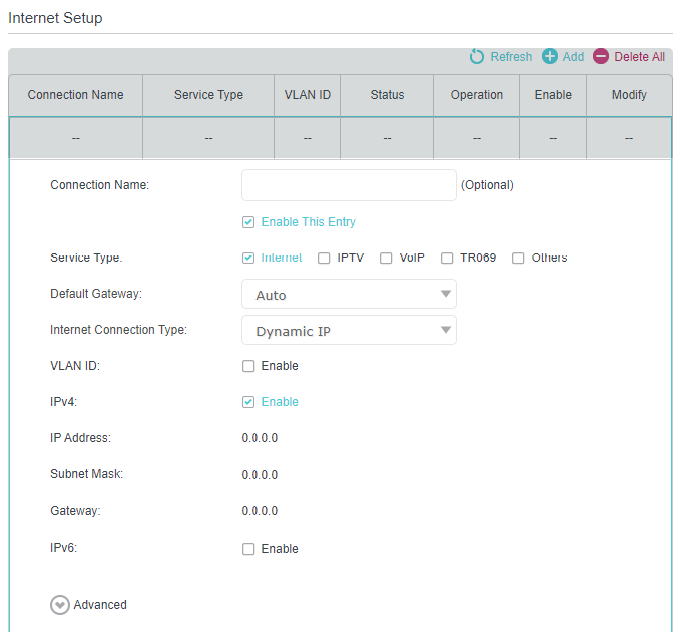
2. Go to Advanced > Network > GPON WAN page, click Add. Enter the information provided by your ISP.
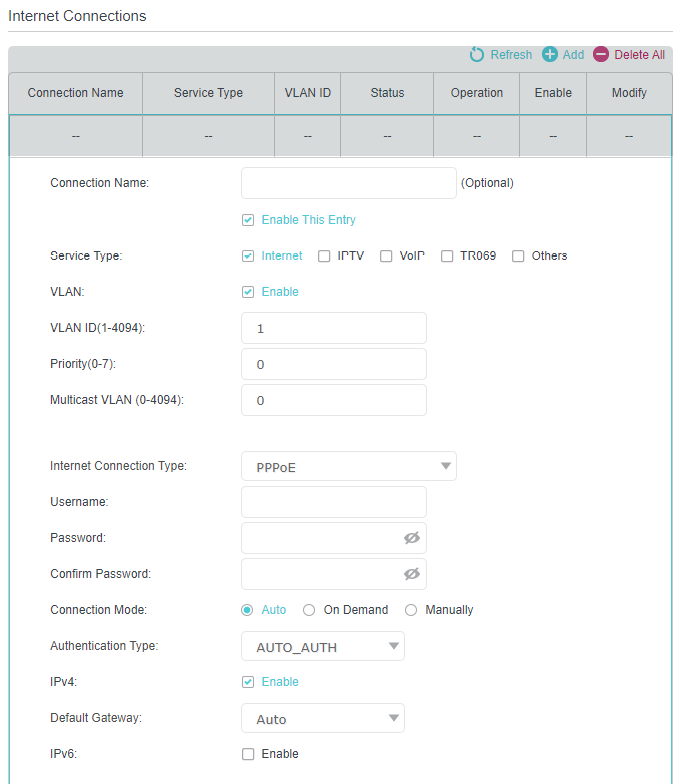
3. Click OK to make the settings effective, and you can refer to Test Internet Connectivity to test the Internet connection.
Tips: You can view and edit all Internet connections on Advanced > Network >DSLWAN page.
Set Up Internet Connection in Wireless Router Mode
1. Visit http://tplinkmodem.net or http://192.168.1.1, and log in with the password you set for the GPON router.
2. Go to Advanced > Network > EWAN page, enable EWAN Connection.
3. Confirm the information provided by your ISP and click OK to connect to the internet.
Test Internet Connectivity
After manually setting up the Internet connection, you need to test the Internet connectivity. The GPON router provides a diagnostic tool to help you locate the malfunction.
1. Visit http://tplinkmodem.net or http://192.168.1.1, and log in with the password you set for the GPON router.
2. Go to Advanced > System Tools > Diagnostics page.
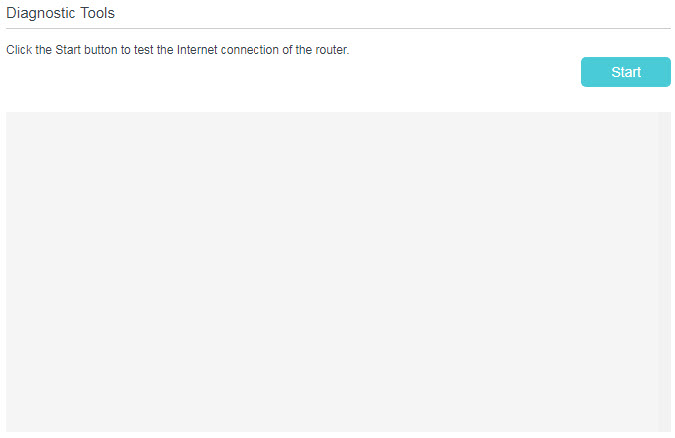
3 Click Start to test the Internet connectivity and you will see the test result in the gray box.
Set Up an IPv6 Internet Connection
Set Up Internet Connection in GPON Router Mode
If your ISP has provided a fiber line that supports IPv6 connection as well as some detailed IPv6 parameters, you can manually set up an IPv6 connection.
If your ISP provides an IPv4-only connection or IPv6 tunnel service, permit IPv6 connection by referring to IPv6 Tunnel.
Follow the steps below to set up an IPv6 connection:
1 Make sure you have set up an IPv4 connection before setting up an IPv6 connection.
2 Visit http://tplinkmodem.net or http://192.168.1.1, and log in with the password you set for the GPON router.
3 Go to Advanced > Network > GPON WAN page.
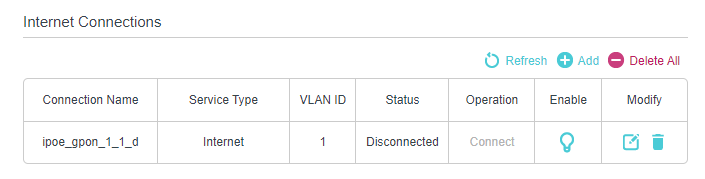
4 Select your WAN Interface Name (Status should be Connected) and click the Edit icon.
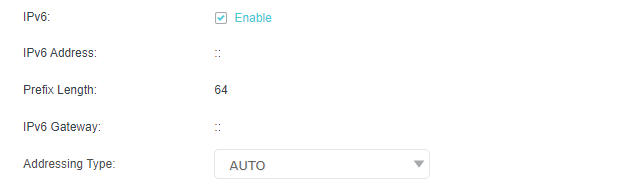
5 Scroll down the page, enable IPv6, and configure the IPv6 parameters.
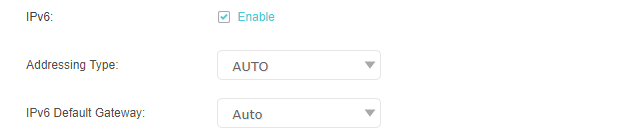
Addressing Type: Consult your ISP for the addressing type, AUTO, DHCPv6, or SLAAC. SLAAC is the most commonly used addressing type.
Note: If your ISP has provided the IPv6 address, click Advanced to reveal more settings. Check to use IPv6 specified by ISP and enter the parameters provided by your ISP.
6 Click OK to make the settings effective. Now IPv6 service is available for yournetwork.
Set Up Internet Connection in Wireless Router Mode
In Wireless Router Mode, you can also permit IPv6 connection by setting up an IPv6 connection or the IPv6 tunnel just as in the GPON Router Mode.
1 Make sure you have set up an IPv4 connection before setting up an IPv6 connection.
2 Visit http://tplinkmodem.net or http://192.168.1.1, and log in with the password you set for the GPON router.
3 Go to Advanced > Network > EWAN page.
4 Scroll down the page, enable IPv6, and configure the IPv6 parameters.
5 Click OK to make the settings effective. Now IPv6 service is available for your network.
IPv6 Tunnel
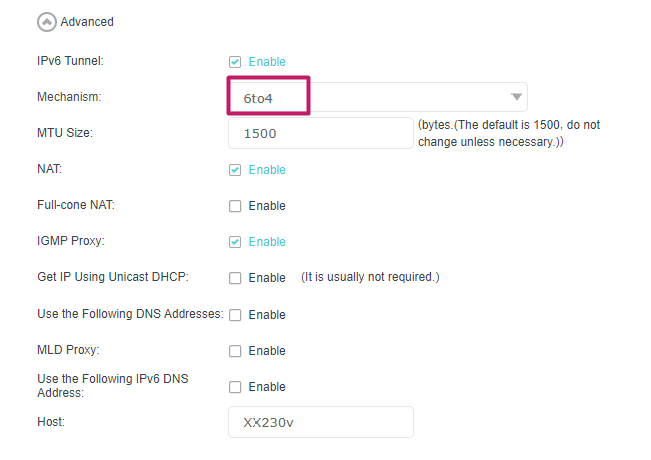
IPv6 Tunnel is a transition mechanism that enables IPv6-only hosts to reach IPv4 services or vice versa and allows isolated IPv6 hosts and networks to reach each other over IPv4-only infrastructure before IPv6 completely supplants IPv4. It is a temporary solution for networks that do not support native dual-stack, where both IPv6 and IPv4 run independently.
1 Visit http://tplinkmodem.net or http://192.168.1.1, and log in with the password you set for the GPON router.
2 Go to Advanced > Network > EWAN.
3 Click Add and enable IPv6 and Click Advanced to view more advanced settings.
4 Select the checkbox to enable IPv6 Tunnel.
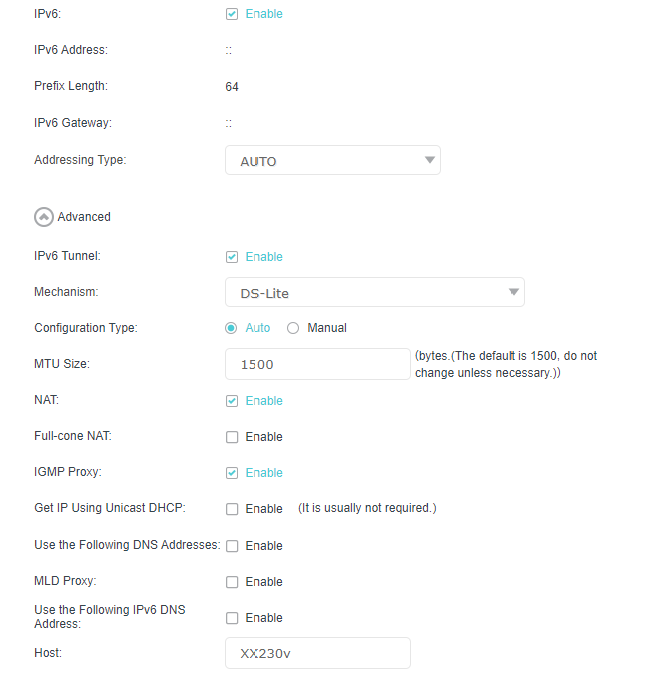
Tips: Please check the IPv6 tunnel settings each time while reconfiguring WAN connection, as WAN connection configuration may take effect on tunnel settings.
5 Fill in information as required by different tunneling mechanisms.
1 ) DS-Lite: Fill in blanks and click OK. Select this tunneling mechanism if your ISP uses DS-Lite deployment for assigning address.
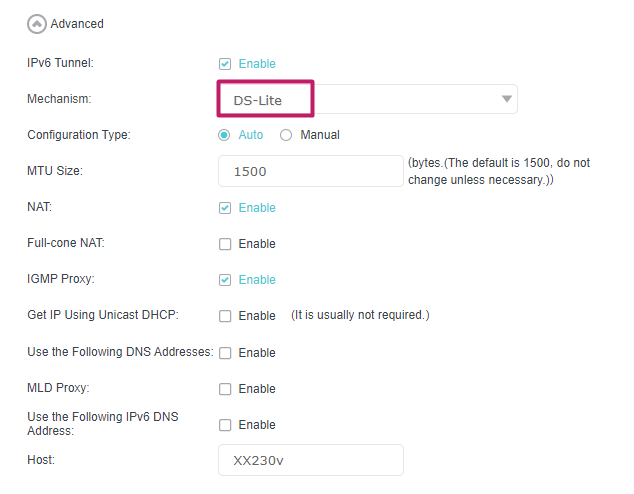
2 ) 6rd: Fill in blanks and click OK. Select this tunneling mechanism if your ISP uses 6rd deployment for assigning address.
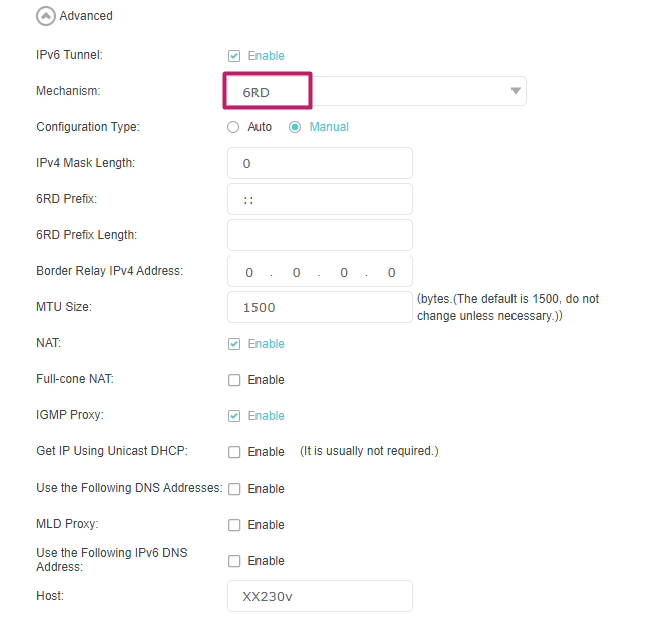
3 ) 6to4: Fill in blanks and click OK. Select this tunneling mechanism if your ISP uses 6to4 deployment for assigning address.
Setup Your Network via TP-Link Aginet App
This chapter guides you on how to setup your router and mesh device via TP-Link Aginet app, as well as regulatory information. Features available in Aginet app may vary by model and software version. Aginet app availability may also vary by region or ISP. All images, steps, and descriptions in this guide are only examples and may not reflect your actual mesh experience.
Set Up Your Router
The intuitive Aginet app guides you through an easy setup process that gets each unit up and all your routers connected.
Follow the steps below to set up your router.
1 Download and install the Aginet app. Scan the QR code below or go to Google Play or the App Store to download the Aginet app. Install the app on your Android or iOS smartphone or tablet.

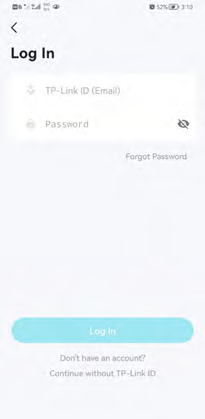
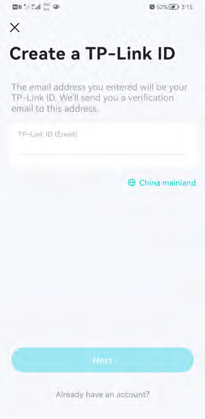
2 Log in or sign up with TP-Link ID. Open the Aginet app. Use your TP-Link ID to log in. If you don’t have a TP-Link ID, tap Don’t have an account? and sign up first.
Note: If you forgot your login password, tap Forgot Password. The Aginet app will guide you through the rest.
3 Plug in and power on router. Power off your modem. Connect your router to the modem and power them both on. If you don’t have a modem, connect the Ethernet outlet directly to your router.
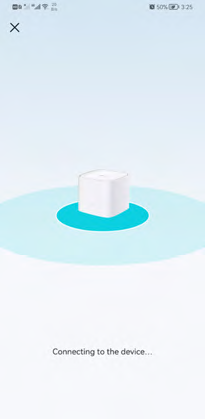
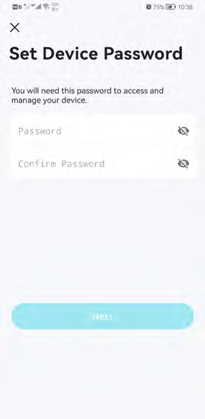
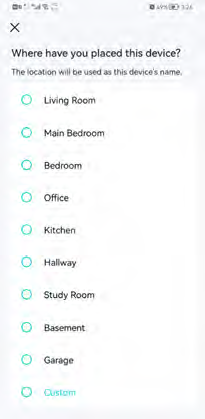
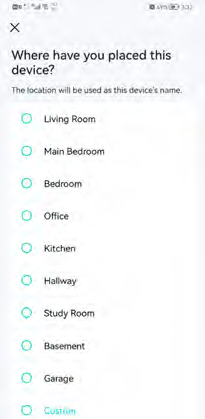
4 Select a location. Select a location for this router. If its location is not listed, you can create a new one by choosing Custom. This will be the name of your router.
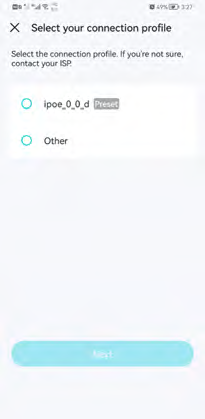
5 Set up internet connection. Select the internet connection type and enter the information. If you are not sure, contact your internet service provider.
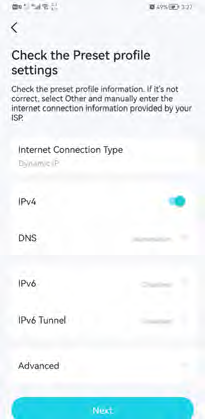
6 Create your Wi-Fi network. Set a network name and a password. These will be the name and password you use to connect your routers to Wi-Fi.
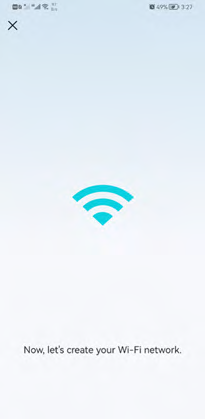
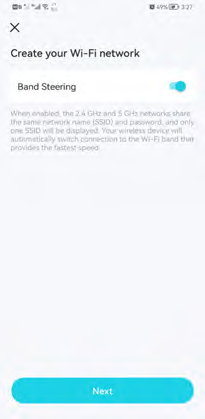
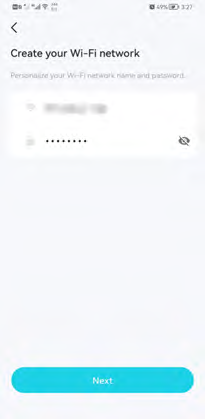
7 Connect to your Wi-Fi network. Connect your phone/tablet to the router’s Wi-Fi.
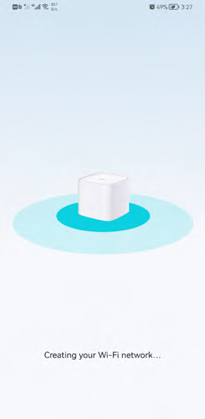
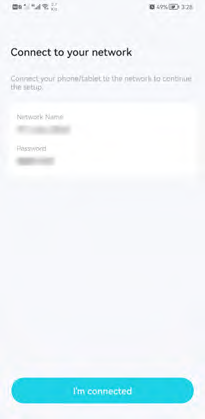
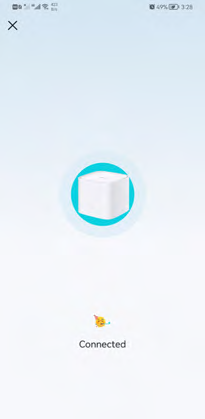
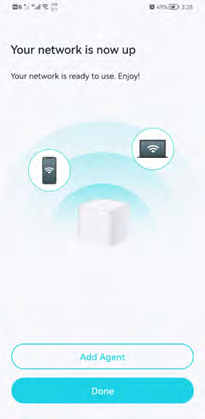
8 Setup complete. Your network is now up. Connect all devices to the network. You can also Add Agent to expand the Wi-Fi coverage.
Dashboard
After you successfully set up your mesh network, you will see the dashboard of the Aginet app. Here you can get an overview of the network status, create family profiles, and customize your home network and set up various advanced features.
1 Tap  to get an overview of the network status.
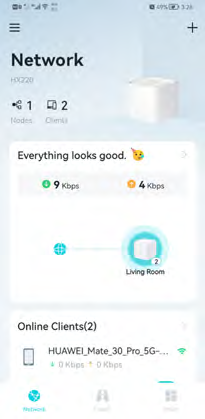
2 Tap  to create family profiles.
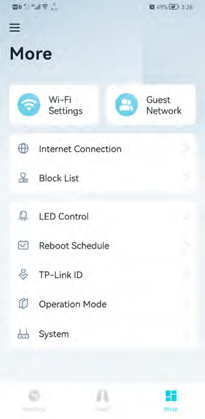
3 Tap  for more features.
Add More Mesh Devices
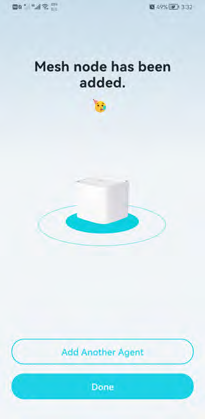
After creating a mesh network, you can add more mesh devices to the network to expand the Wi-Fi coverage and manage them easily on your Aginet app.
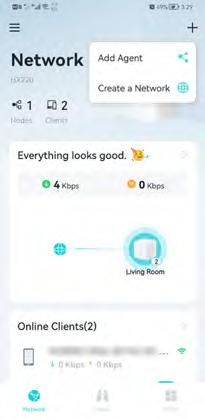
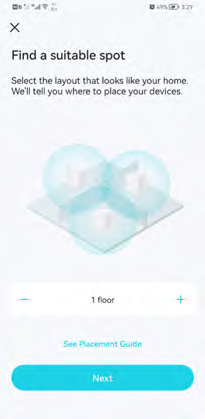
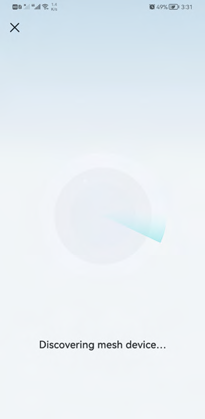
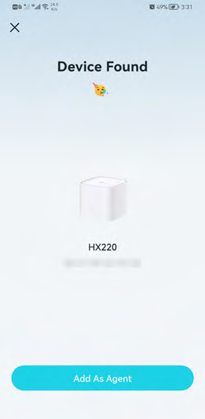
1 In Network, tap + > Add Agent. Then select the Mesh Device.
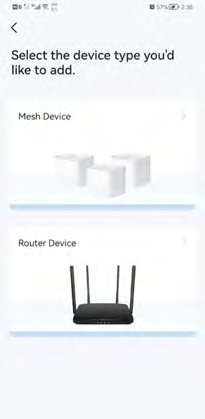
2 Follow app instructions to complete the setup.

Check Mesh Device Status
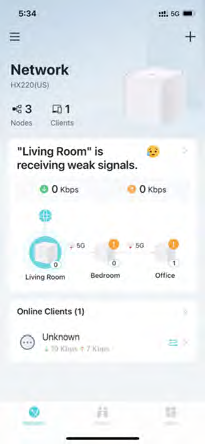
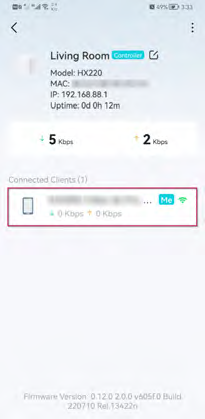
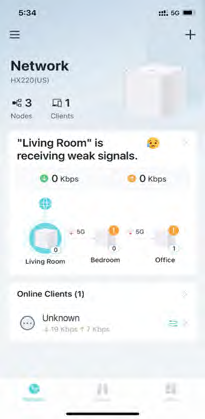
In Network, you can check the working status (online/offline) of all the mesh devices, check the details (speed/mesh device’s IP address & MAC address/connected clients) of each mesh device, change the mesh device’s location/name, and more.
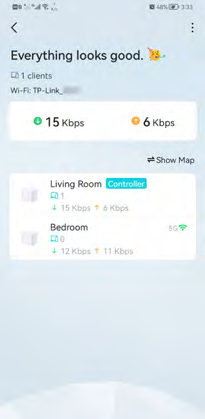
1 Tap  to check all mesh devices’ status.
2 Tap a mesh device to check more details.
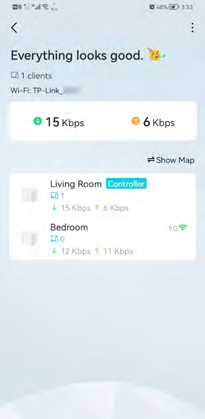
3 Check download/upload speed of the mesh device.
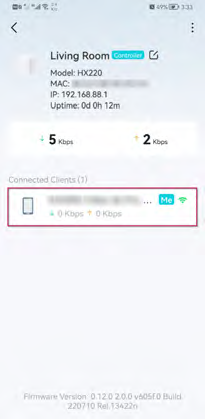
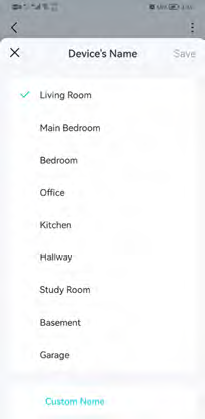
4 Tap the Edit icon and change or customize the location/name of the mesh device.
5 Check the clients connected to the mesh device.
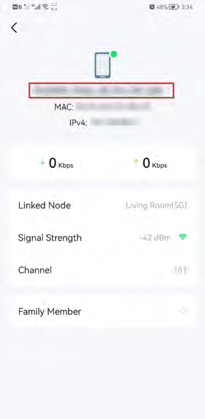
6 Tap the client’s name. Change or customize client’s information.
Remove/Reboot Mesh Devices
You can reset your mesh device to factory default settings or reboot your mesh device to clear cache and enhance running performance easily in the Aginet app. Follow the steps below.
Note:
Rebooting your mesh device will keep the current settings on it.
Removing your mesh device will reset it to factory default settings and you will need to set up your mesh device again. You can also press and hold the Reset button for at least 5 second to quickly reset your mesh device to factory default settings.
In Network, tap  . Select a mesh device.
Tap  to remove or reboot the mesh device.
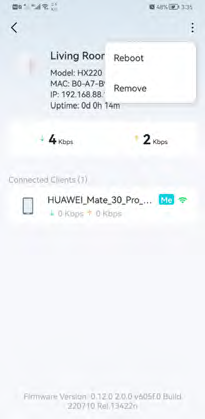
Note:If the LED light of mesh device does not turn flashing blue after tapping Remove, press and hold the Reset button for at least 5 second to reset it.
Manage Connected Devices
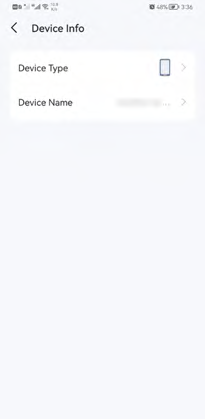
In Network, you can mange your connected devices easily, such as changing the device name and type.
1 Tap a connected device to check the details (e.g. real-time upload and download speeds, device name/profile, etc.).
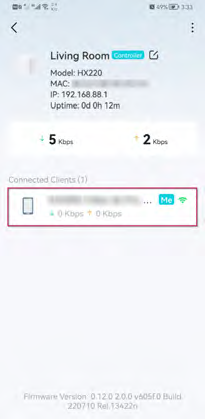
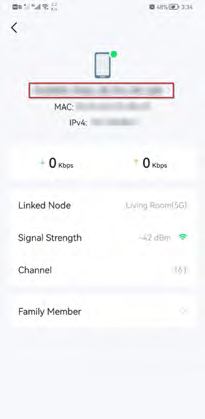
2 Change the Device Type and Device Name as needed.
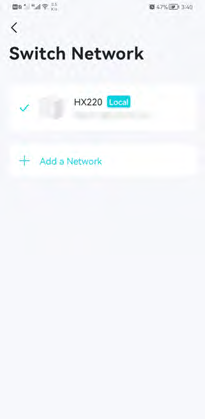
Create a New Network
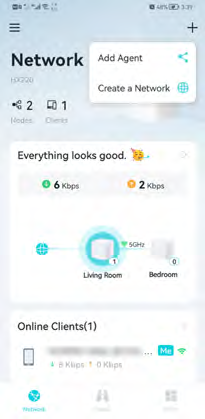
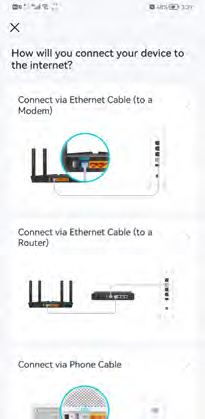
In the Aginet app, you can create different mesh networks with your TP-Link ID and manage them conveniently from the Aginet app with one account. You can also help family or friends manage their networks with your Aginet app. Two methods are provided as below to create a new network.
Method 1. Create a new network from the Overview page
1 Tap + > Create a Network.
2 Then follow app instructions to complete the setup.
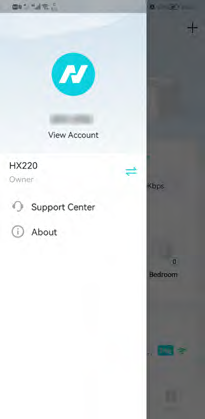
Method 2. Create a new network from the Menu page
1 Tap  to open the menu. Tap
  > Add a Network.
2 Then follow app instructions to complete the setup.
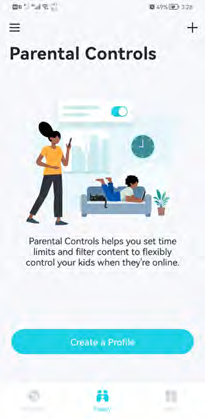
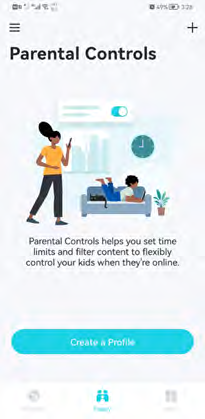
Parental Controls
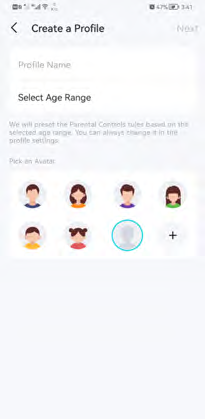
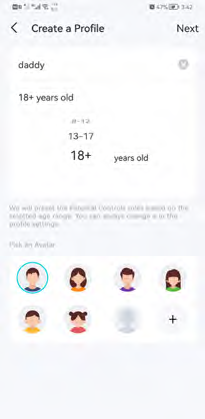
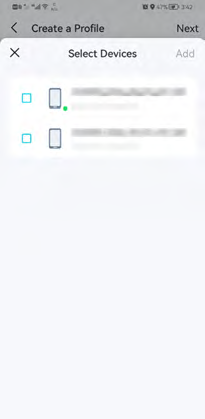
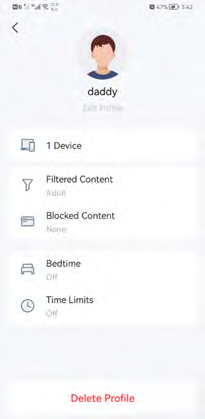
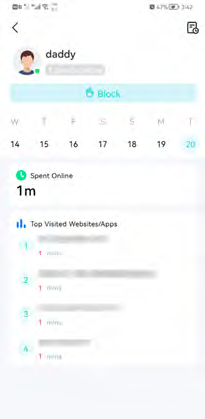
Parental Controls helps you set time limits and filter content to flexibly control your kids when they’re online.
1 In Family, tap Create a Profile.
2 Then follow app instructions to complete the setup.
Wi-Fi Settings
You can change the network name and password of your main network at any time and share the network easily with family and friends.
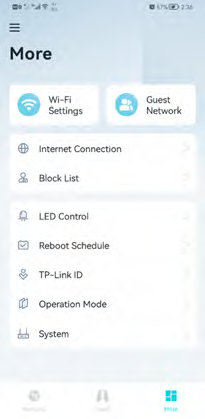
1 In More, Tap Wi-Fi Settings.
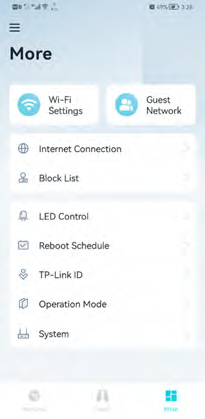
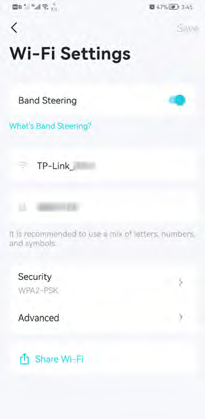
2 Manage main network (e.g. change your main network’s Wi-Fi name and password, hide the network from Wi-Fi list, etc.).
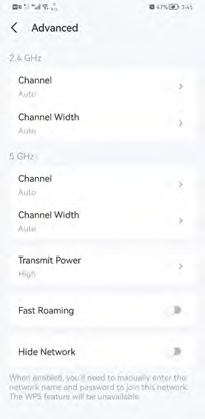
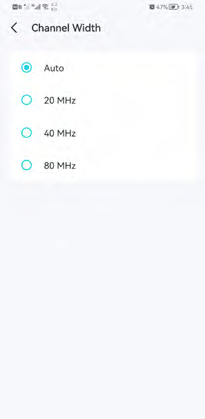
3 Tap Advanced. For better Wi-Fi performance, set the channel width for 2.4GHz / 5GHz / 6GHz Wi-Fi as needed. (It is recommended to use the default settings.)
Guest Network
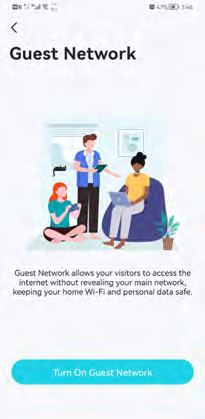
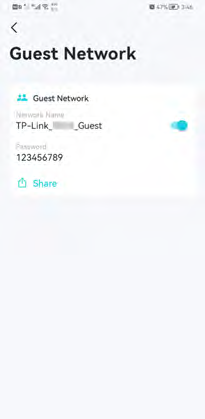
You can create and share a separate network for guests to guarantee the security and privacy of your main network.
1 In More, Tap Guest Network.
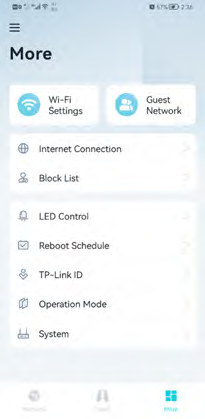
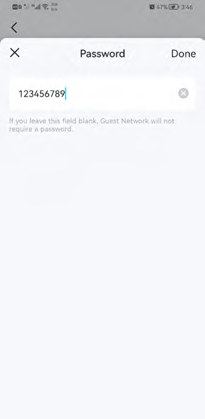
2 Set a Wi-Fi name and password for the guest network.
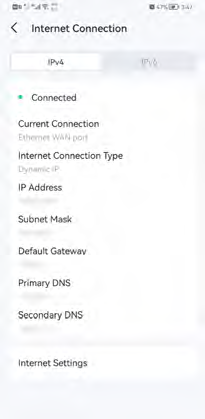
Internet Connection
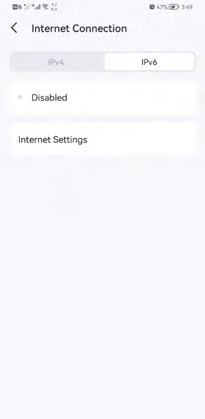
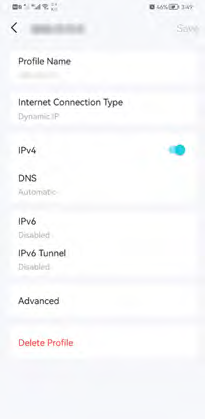
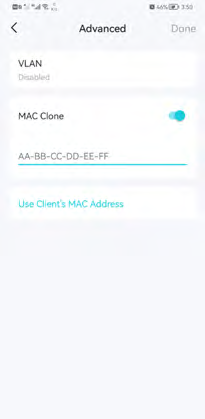
In Internet Connection, You can modify WAN settings (IPv4 & IPv6), enable MAC Clone mode.
1 In More, Tap Internet Connection.
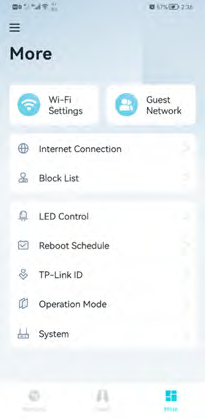
2 View IPv4 details or change the internet connection type.
3 Enable IPv6 to set up an IPv6 internet connection.
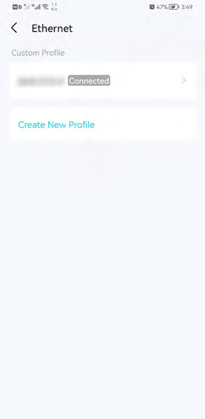
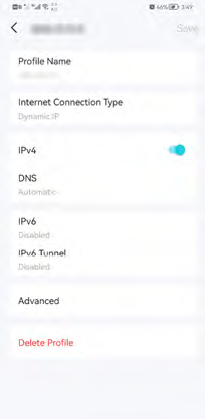
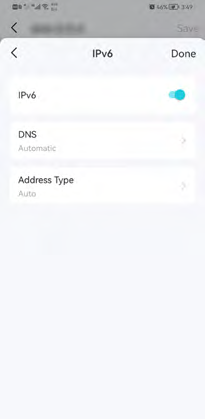
4 Tap Advanced and enable MAC Clone as needed.
Tip: For more about MAC Clone, refer to https://www.tp-link.com/support/faq/2925/
Block List
Add devices to the block list to prevent the devices from accessing your network, ensuring the safety of your personal information shared in the network.
1 In More, Tap Block List.
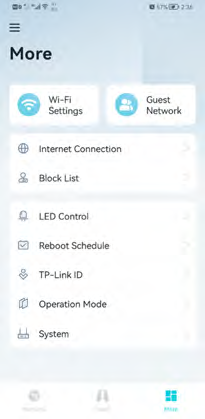
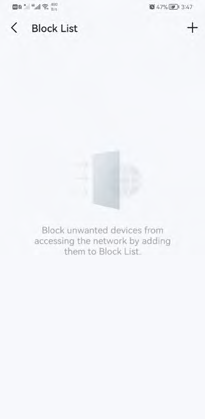
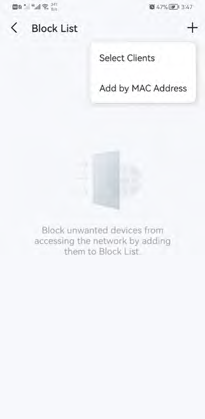
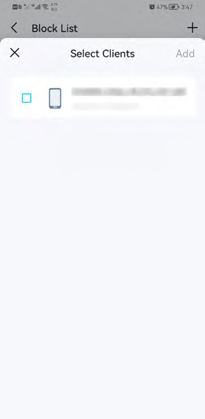
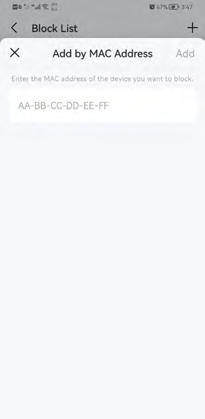
2 Tap + and add clients or other devices to the block list.
Upgrade Your Router
TP-Link is dedicated to improving product features and providing a better customer experience. An up-to-date firmware provides better and more stable network performance. Always update your router to the latest firmware version when prompted in the Aginet app.
1 In More, Tap System and Firmware Update.
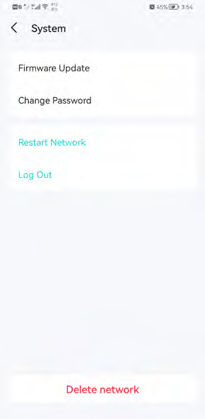
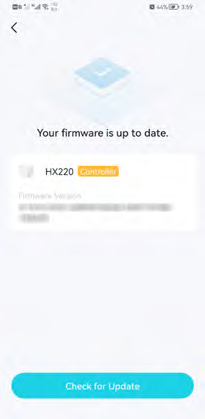
2 Download and install the firmware (if any) and follow app instructions to update your router to the latest version.
Advanced Features
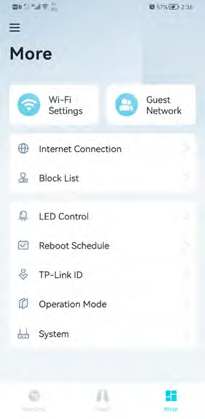
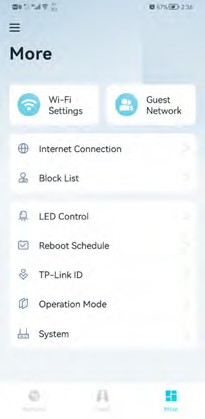
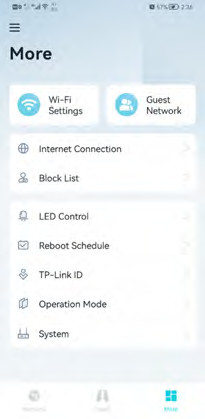
Additional features are available under the Advanced menu. You can control mesh device’s LED, enable reboot schedule, bind your TP-Link ID, change the operation mode, configure system settings.
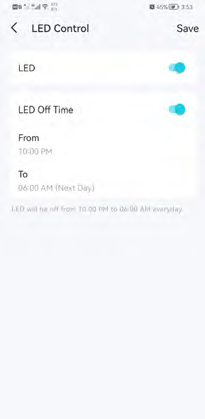
1 In More, Tap LED Control.
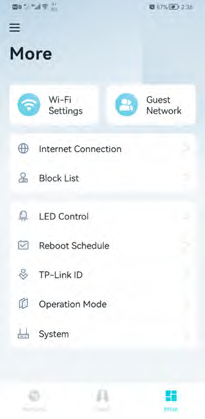
2 Toggle off LED to turn off the light on mesh device. Configure the LED Off Time to turn off the LED light at bedtime only.
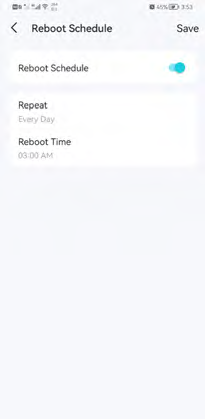
3 Enable Reboot Schedule as needed.
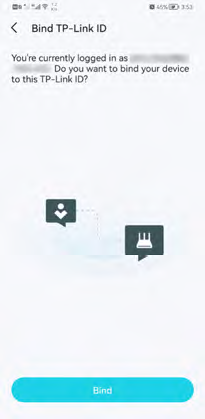
4 Bind your TP-Link ID.
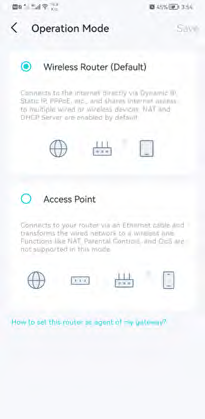
5 Change the Operation Mode as needed.
VoIP
This chapter guides you on how to make telephone calls via Internet. You may not be able to configure VoIP when using certain models, please contact your ISP for support.
-
Connecting the Telephone
-
Entering Telephone Information
-
Telephone Book
-
Telephony Devices Management
-
Call Log
-
Digit Map
-
Call Blocks
-
Call Forwarding
-
Voice Mail Settings
Connecting the Telephone
Connect your telephone to the TAE ports on the side panel or RJ11 ports on the rearpanel. Please note that you can only connect to two ports (one to a Phone 1 and the other to a Phone 2) at most.
Entering Telephone Information
Before using telephony services, you should first enter your telephone information provided by your telephony service provider.
Follow the steps below to enter information:
1 Visit http://tplinkmodem.net or http://192.168.1.1, and log in with the password you set for the GPON router.
2 Go to Advanced > Telephony > Telephone Number to open the configuration page. Click Add and you will see the following screen.
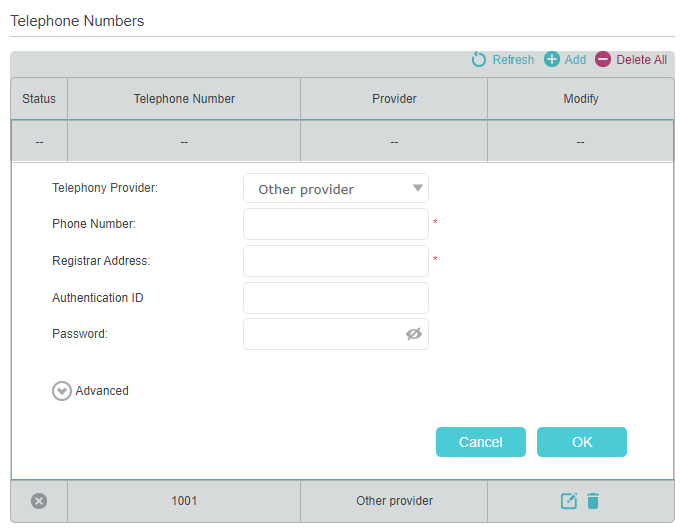
3 Enter the necessary information as required, and click OK to make the settings effective.
- Phone Number: The number you use to dial and answer.
- Registrar Address: Usually a domain name, if not, an IP address.
- Authentication ID and Password: Not necessary information, but if you have, fill them in.
- Advanced: Click to have more configuration.
To have more configuration on telephony settings
Click Advanced under Advanced Settings to configure more telephony settings.
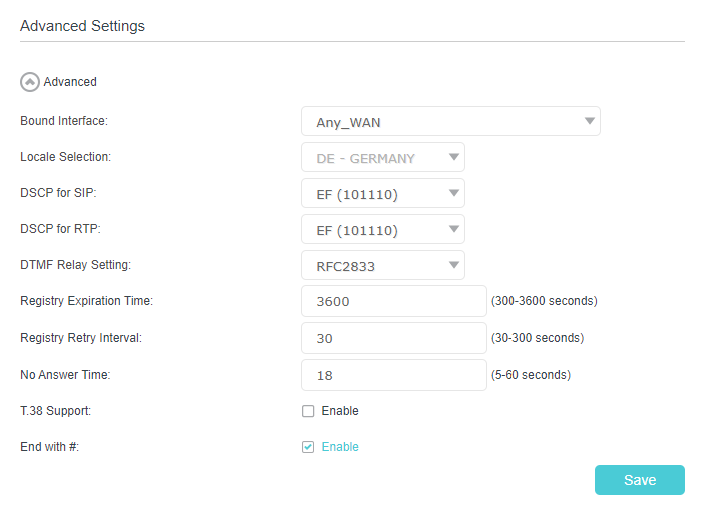
- Bound Interface: Bound Interface decides where to send/receive the VoIP traffic. An easy way to select the interface is to check the location of the SIP (Session Initiation Protocol) server. If it locates somewhere on the Internet then select Any_WAN. If it is on the local network, select LAN.
- Locale Selection: Select a country where you are located. The GPON router is embedded with some default parameters according to different countries such as ring tones. Usually you can keep the default value.
- DSCP for SIP/RTP: DSCP (Differentiated Services Code Point) is the first 6 bits in the ToS byte. DSCP marking allows users to assign specific application traffic to be executed in priority by the next Router based on the DSCP value. Select DSCP for the SIP (Session Initiation Protocol) and RTP (Real-time Transport Protocol) respectively. If you are unsure, please always keep the default value.
- DTMF Relay Setting: DTMF is Dual Tone Multi Frequency. Options available are SIP-Info, RFC2833, and In-band. If you are unsure which one to choose, please always keep the default value.
-
SIP INFO: If it is selected, the GPON router will capture the DTMF tone and transfer it into SIP form. Then it will be sent to the remote end with SIP message.
-
RFC2833: If it is selected, the GPON router will capture the keypad number you pressed and transfer it into digital form then send to the other side; the receiver will generate the tone according to the digital form it receives. This function is very useful when the network traffic congestion occurs and it still can remain the accuracy of DTMF tone.
- In-band: If it is selected, the GPON router will send the DTMF tone as audio directly when you press the keypad on the phone.
- Registry Expiration Time: Expiration time for the registration message sending. Registration Retry Interval: Set the time duration for your SIP Registrar server to keep your registration record. Before the time expires, the GPON Router will send another register request to SIP Registrar again. If you are unsure of it, please always keep the default value.
- No answer Time: Set a time period, after which the caller is told that the call is not answered and he or she can leave a message if the voice mail function is enabled.
- T.38 support: Select the checkbox to enable this function. T 38 specifies a protocol for transmitting a fax across IP network in real time. It allows the transfer of fax documents in real-time between two standard Group 3 facsimile terminals over the Internet or other networks using IP protocols. It will only function when both sites support this feature and are enabled.
- End with: Select the checkbox to use the pound sign (#) as an end-of-dialing.
When the Status column change to  , your telephone information is successfully registered. At this time, you can pick up your phone, dial the number, and call via Internet!
Telephone Book
You can store all contacts on your GPON router, have a telephone book, set speed dial number for some contacts and enable emergency calls.
Telephone Book
Follow the steps below to have a telephone book on the GPON router.
1 Visit http://tplinkmodem.net or http://192.168.1.1, and log in with the password you set for the GPON router.
2 Go to Advanced > Telephony > Telephone Book. Click Add to enter a new contact’s information.
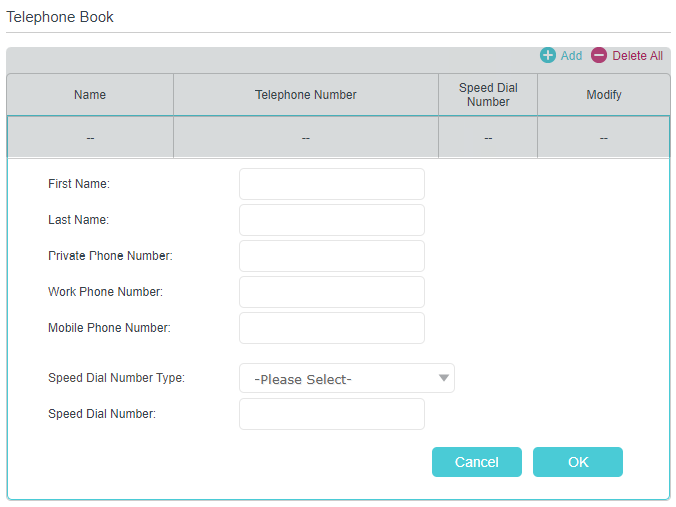
3 You can set speed dial number for certain numbers. Speed dial function allows you to reach the desired party by dialing the reduced number of keys rather than a long phone number.
4 Click OK to save the settings.
Emergency Calls
I want to: Make my telephone automatically call a specific contact when the handset is picked up but no operation is done within a period of time. In this way the old, the kids, the patient or the pregnant in house are able to send signals for help when emergencies occur.
How can I do that?
1 Visit http://tplinkmodem.net or http://192.168.1.1, and log in with the password you set for the GPON router.
2 Go to Advanced > Telephony > Telephone Book.
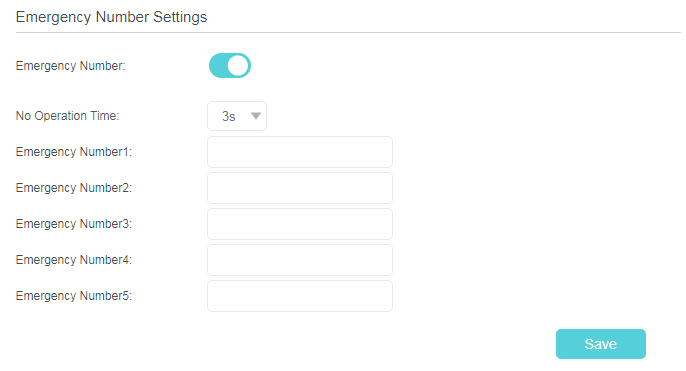
3 Enable Emergency Number.
4 No Operation Time: Set how long should the telephone wait before the first number is automatically dialed).
5 Emergency Number: Set the number to be automatically reached. If more than one number is set, the GPON router will automatically call the next one if the previous is not answered.
6 Click Save to make the settings effective.
Done!
From now on, if you pick up your phone but do not dial within the no operation time, your phone will automatically call the emergency number!
Telephony Devices Management
I want to: Bind different telephony devices with different incoming and outgoing call numbers, because I have more than one telephone number and telephony device and I don’t want all telephones ring at the same time when a number is called.
How can I do that?
1 Visit http://tplinkmodem.net or http://192.168.1.1, and log in with the password you set for the GPON router.
2 Go to Advanced > Telephony > Telephony Devices.
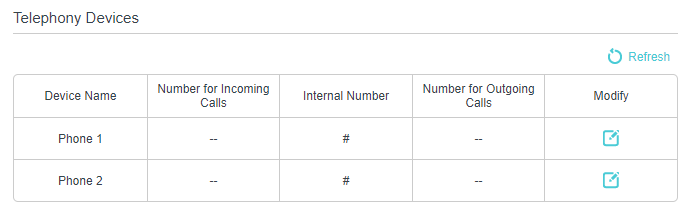
3 Click the Edit icon to manage your telephony devices.
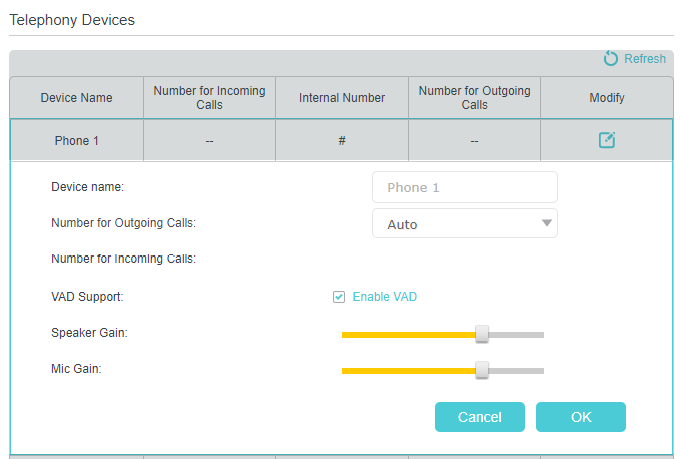
4 Device Name: Name the telephone device here.
5 Number for Outgoing Calls: Assign an outgoing number for this phone.
6 Number for Incoming Calls: Tick the incoming number for this phone.
7 VAD Support: VAD (Voice Activation Detection) prevents transmitting the silence packets to consume the bandwidth. It is also known as Silence Suppression, a software application that ensures bandwidth when voice activity is activated.
8 Adjust the Speaker Gain slider to control the speaker sound.
9 Adjust the Mic Gain slider to control the speaker sound of microphone.
10 Click Save to make the settings effective.
Done!
Now your telephony devices are bound to different incoming call numbers and outgoing call numbers.
Tips: Internal number showed on the table are used to make calls between telephony devices connected to the same GPON router. It is preset and cannot be changed.
Call Log
I want to: Have a call list recording detailed information of incoming calls and outgoing calls on your GPON router.
How can I do that?
1 Visit http://tplinkmodem.net or http://192.168.1.1, and log in with the password you set for the GPON router.
2 Go to Advanced > Telephony > Call Log.
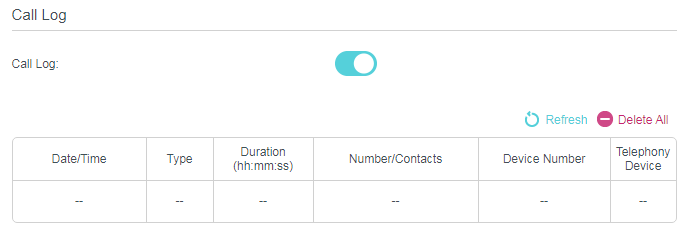
3 Enable Call Log.
Done!
From now on, all calls in and out are recorded here. If you’ve already had a telephone book, name of the contact would be shown on the call list.
Digit Map
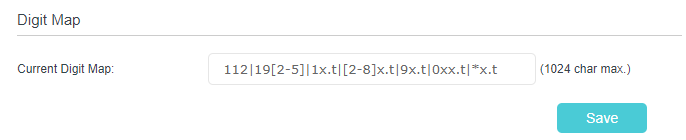
A digit map can be used to match digits to control numbers from being dialed. A number can only be dialed out when the sequence of its digits matches the digit map.
1 Visit http://tplinkmodem.net or http://192.168.1.1, and log in with the password you set for the GPON router.
2 Go to Advanced > Telephony > Digit Map. Enter a digit map rule by referring to the example settings.
3 Save the settings. Now, only the numbers matching the digit map can be dialed out.
Call Blocks
When you do not want calls to be received or dialed, use call block functions. This part consists of three functions: Do Not Disturb, Block Certain Calls and Prevent from Dialing.
Do Not Disturb
I want to: Have no telephone ring at a certain period of time.
How can I do that?
1 Visit http://tplinkmodem.net or http://192.168.1.1, and log in with the password you set for the GPON router.
2 Go to Advanced > Telephony > DND & Call Blocking.
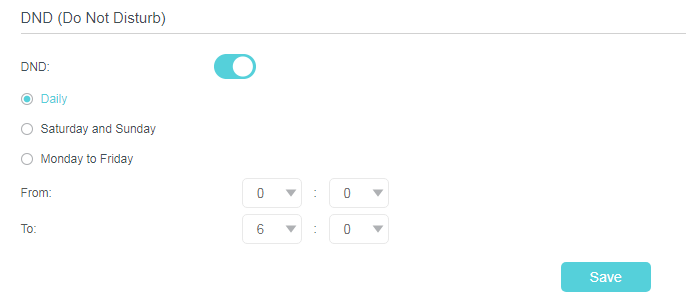
3 Enable DND.
4 Set the day(s) when DND is enabled.
5 Click Save to make the settings effective.
Done!
Now, within this period of time, no telephone will ring, but all incoming calls would be recorded in call log. Enjoy your peaceful time and when you are back, check the call log to see what was missed.
Blocking Certain Calls
I want to: Block certain calls, for example, the anonymous calls, or calls from the annoying salesmen.
How can I do that?
1 Visit http://tplinkmodem.net or http://192.168.1.1, and log in with the password you set for the GPON router.
2 Go to Advanced > Telephony > DND & Call Blocking.
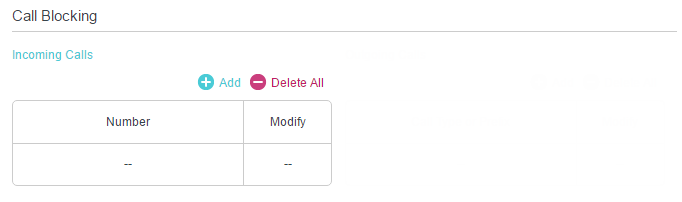
3 Click Add under Incoming Calls.
4 Select Specific Number and enter the telephone number that you want to block in the Number field, or Anonymous Number to block all unknown calls.
5 Click OK to make the settings effective.
Done!
Now your GPON router will automatically callout matching to your dial plan.
Prevent from Dialing
I want to: Prevent my GPON router from dialing a certain type of numbers. For example, it costs a lot to call a mobile phone via my telephone number, so I don’t want anyone to call a mobile phone using my number.
How can I do that?
1 Visit http://tplinkmodem.net or http://192.168.1.1, and log in with the password you set for the GPON router.
2 Go to Advanced > Telephony > DND & Call Blocking.
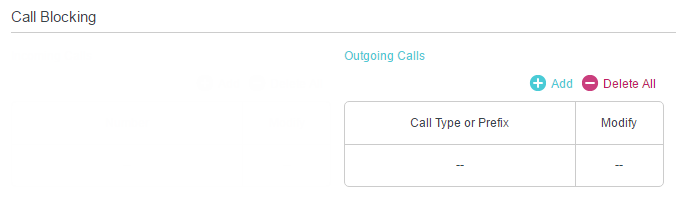
3 Click Add under Outgoing Calls.
4 Select a Call Type from the drop-down list that you want to block. If Call with Specific Number Prefix is selected, add a telephone number prefix in the Number Prefix field.
5 Click OK to make the settings effective.
Done!
Now your GPON router will prevent all mobile phone from being dialed.
In addition: Number type may vary according to your circumstances. You can also set prefix by choosing Calls with Specific Number Prefix. When a prefix is set, all numbers with this prefix is prevented from being called.
Call Forwarding
Call Forwarding allows you to redirect incoming calls to a designated phone number.
1 Visit http://tplinkmodem.net or http://192.168.1.1, and log in with the password you set for the GPON router.
2 Go to Advanced > Telephony > Call Forwarding. Click Add to enter a new contact’s information.
3 Select a call type to be forwarded.
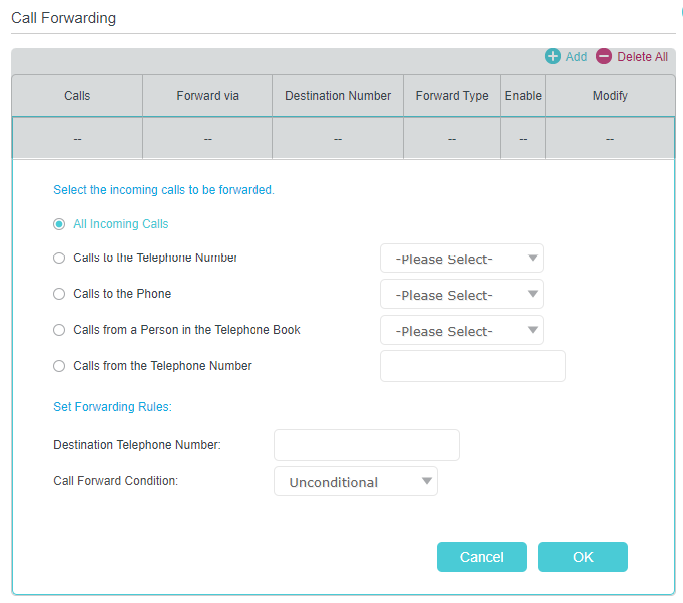
- All Incoming Calls: If this option is selected, all incoming calls will be forwarded.
- Calls to the Telephone Number: If this option is selected, select a telephone number from the list. Any incoming calls to this number will be forwarded.
- Calls to the Phone: If this option is selected, select a telephony device from the list. Any incoming calls to this device will be forwarded.
- Calls from a Person in the Telephone Book: If this option is selected, select a contact from the list. Any incoming calls from this contact will be forwarded.
- Calls from the Telephone Number: If this option is selected, enter a specific telephone number. Any incoming calls from this number will be forwarded.
4 Enter a Destination Telephone Number that incoming calls will be redirected to.
5 Select Forward the Calls via from the drop-down list.
6 Select the Call Forward Condition:
- Unconditional: All incoming calls will be redirected to the designated telephone number whether the receiver is busy or not.
- No Answer: Incoming calls that are not answered for the specified time period will be redirected to the designated telephone number.
7 Click OK.
Note: If you want to disable this entry, click the Bulb icon.
Voice Mail Settings
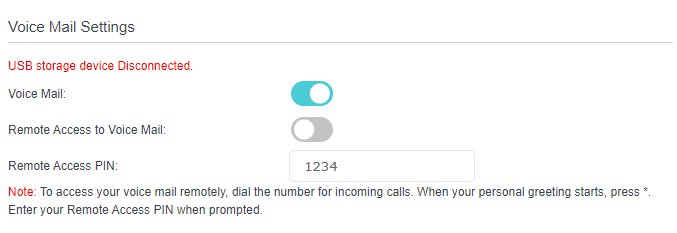
Voice Mail allows callers to leave voice messages on an external USB storage device with the appropriate configuration files when calls are not answered. To use this function, plug the USB storage device into the USB port on the router.
1 Visit http://tplinkmodem.net or http://192.168.1.1, and log in with the password you set for the GPON router.
2 Go to Advanced > Telephony > Voice Mail. Toggle On to enable Voice Mail.

3 Select the Greeting for Voice Mail to use either the default or your custom greeting for the voice mail. You can click the Play icon to play the greeting.
Note: Pick up the phone (analog phone or DECT handset) and dial *30 to record a personalized greeting for your voice mail.

4 Enter a value in seconds in the Voice Mail Duration field to limit the length of each voice mail.

5 (Optional) If you want to listen to your voice mails remotely, toggle On to enable Remote Access to Voice Mail and create a PIN in the Remote Access PIN field.
Note: To access your voice mail remotely, dial the number for incoming calls. When your personal greeting starts, press *. Enter your Remote Access PIN when prompted.
Customize Your Network Settings
This chapter introduces how to change the default settings or adjust the basic configuration of the GPON router using the web management page.
It contains the following sections:
-
Configure LAN Settings
-
Configure IPv6 LAN Settings
-
Configure GPON Settings
-
Set Up a Dynamic DNS Service Account
-
Create Static Routes
-
RIP Settings
-
Specify Wireless Settings
-
Schedule Your Wireless Function
-
Use WPS for Wireless Connection
Configure LAN Settings
Change the LAN IP Address
The GPON router is preset with a default LAN IP 192.168.1.1, which you can use to log in to its web management page. The LAN IP address together with the Subnet Mask also defines the subnet that the connected devices are on. If the IP address conflicts with another device in your local network or your network requires a specific IP subnet, you can change it.
Follow the steps below to change your IP address.
1 Visit http://tplinkmodem.net or http://192.168.1.1, and log in with the password you set for the GPON router.
2 Go to Advanced > Network > LAN Settings page and select IPv4.
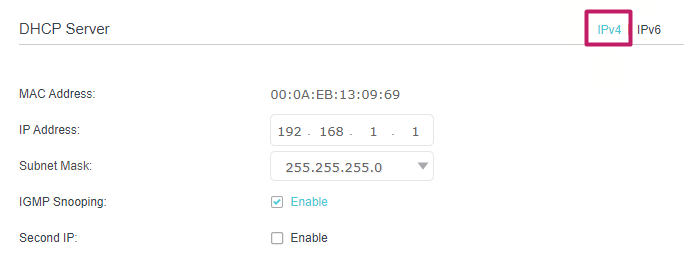
3 Enter a new IP Address appropriate to your needs.
4 Select the Subnet Mask from the drop-down list. The subnet mask together with the IP address identifies the local IP subnet.
5 Keep IGMP Snooping enabled by default. IGMP snooping is the process of listening to IGMP (Internet Group Management Protocol) network traffic. The function prevents hosts on a local network from receiving traffic for a multicast group they have not explicitly joined.
6 You can configure the router’s Second IP and Subnet Mask for LAN interface through which you can also access the web management page.
7 Keep the rest settings as the default settings.
8 Click Save to make the settings effective.
Use the Router as a DHCP Server
You can configure the router to act as a DHCP server to assign IP addresses to its clients. To use the DHCP server function of the router, you must configure all computers on the LAN to obtain an IP Address automatically.
Follow the steps below to configure DHCP server.
1 Visit http://tplinkmodem.net or http://192.168.1.1, and log in with the password you set for the GPON router.
2 Go to Advanced > Network > LAN Settings page and select IPv4.
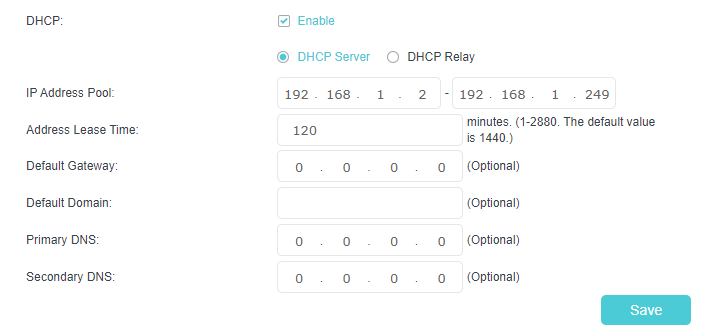
3 Enable DHCP function and select DHCP Server.
4 Specify the IP Address Pool, the start address and end address must be on the same subnet with LAN IP. The router will assign addresses within this specified range to its clients. It is from 192.168.1.2 to 192.168.1.249 by default.
5 Enter a time duration in the Address Lease Time field. The Address Lease Time is the amount of time in which a DHCP client can lease its current dynamic IP address assigned by the router. After the dynamic IP address expires, the user will be automatically assigned a new dynamic IP address.
6 Keep the rest settings as the default settings and click Save.
Note:
-
The router can be configured to work as a DHCP Relay. A DHCP relay is a computer that forwards DHCP data between computers that request IP addresses and the DHCP server that assigns the addresses. Each of the device’s interfaces can be configured as a DHCP relay. If it is enabled, the DHCP requests from local PCs will be forwarded to the DHCP server that runs on WAN side.
- You can also appoint IP addresses within a specified range to devices of the same type by using Condition Pool feature. For example, you can assign IP addresses within the range (192.168.0.50 to192.168.0.80) to Camera devices, thus facilitating the network management. Enable DHCP feature and configure the parameters according to your situation on the Advanced > Network > LAN Settings page.
Reserve LAN IP Addresses
You can view and add a reserved address for a client. When you specify an IP address for a device on the LAN, that device will always receive the same IP address each time when it accesses the DHCP server. If there are some devices in the LAN that require permanent IP addresses, please configure Address Reservation on the router for the purpose.
Follow the steps below to reserve an IP address for your devices.
1 Visit http://tplinkmodem.net or http://192.168.1.1, and log in with the password you set for the GPON router.
2 Go to Advanced > Network > LAN Settings page, and select IPv4.
3 Scroll down to the Address Reservation section, and click Add to add an address reservation entry for your device.
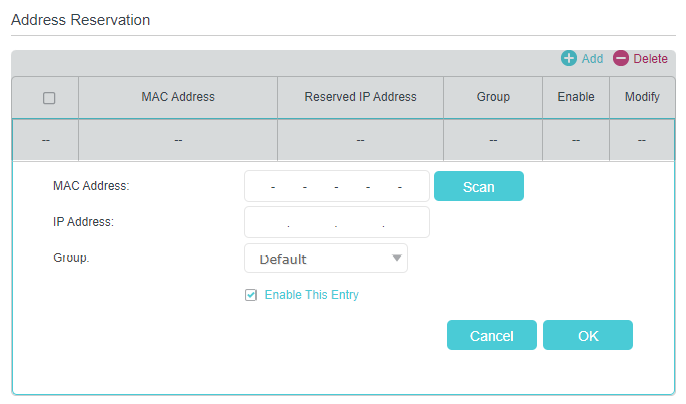
4 Enter the MAC Address of the device for which you want to reserve IP address.
5 Specify the IP address which will be reserved by the router.
6 Select the Enable This Entry check box and click OK to make the settings effective.
Configure IPv6 LAN Settings
Based on the IPv6 protocol, the router provides two ways to assign IPv6 LAN addresses:
-
Configure the RADVD (Router Advertisement Daemon) address type
- Configure the DHCPv6 Server address type
Configure the RADVD Address Type
1 Visit http://tplinkmodem.net or http://192.168.1.1, and log in with the password you set for the GPON router.
2 Go to Advanced > Network > LAN Settings.
3 Select IPv6 to configure IPv6 LAN parameters.
1) Select RADVD as the address type to make the router assign IPv6 address prefixes to hosts.
Note: Do not select the Enable RDNSS and Enable ULA Prefix check boxes unless required by your ISP. Otherwise you may not be able to access the IPv6 network. For more information about RDNSS and ULA Prefix, contact our technical support.
2) Keep Site Prefix Type as the default setting Delegated. If your ISP has provided a specific IPv6 site prefix, select Static and enter the prefix.
3) Keep WAN Connection as the default settings.
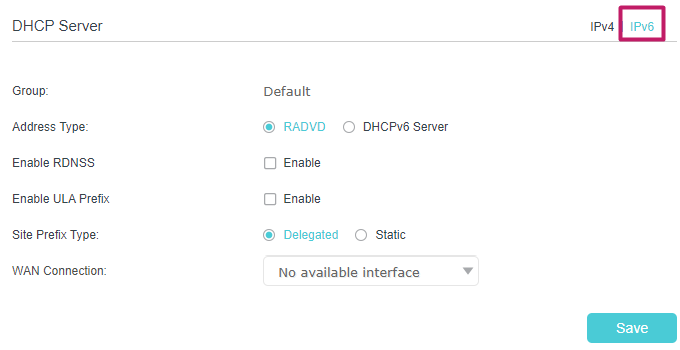
4 Click Save to make the settings effective.
Configure the DHCPv6 Server Address Type
1 Visit http://tplinkmodem.net or http://192.168.1.1, and log in with the password you set for the GPON router.
2 Go to Advanced > Network > LAN Settings.
3 Select IPv6 to configure IPv6 LAN parameters.
1 ) Select DHCPv6 Server as the address type to make the router assign IPv6 addresses to hosts.
2 ) Specify the Starting/Ending IPv6 Address for the IPv6 suffixes. The router will generate IPv6 addresses within the specified range.
3 ) Keep Address Lease Time as the default setting.
4 ) Keep Site Prefix Type as the default value Delegated. If your ISP has provided a specific IPv6 site prefix, select Static and enter the prefix.
5 ) Keep WAN Connection as the default setting.
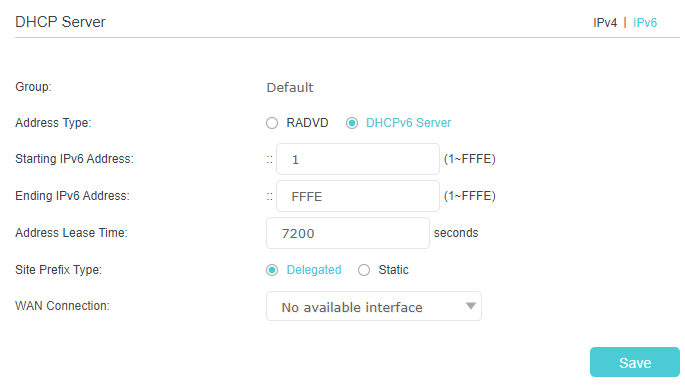
4 Click Save to make the settings effective.
Configure GPON Settings
Follow the steps below to change your IP address.
1 Visit http://tplinkmodem.net or http://192.168.1.1, and log in with the password you set for the GPON router.
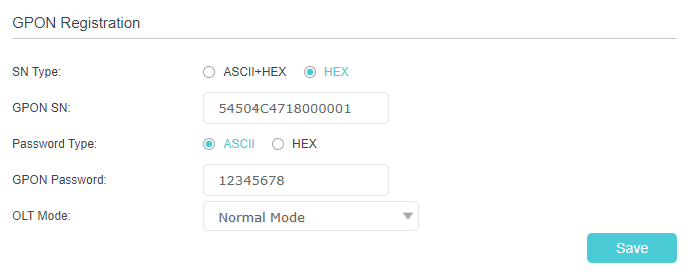
2 Go to Advanced > Network > GPON Settings page.
3 Select a ASCII+HEX/HEX from the SN Type checkbox. Select a ASCII/HEX from the Password Type checkbox. Do not change the default settings unless necessary.
Set Up a Dynamic DNS Service Account
Most ISPs (Internet service providers) assign a dynamic IP address to the router and you can use this IP address to access your router remotely. However, the IP address can change any time and you don’t know when it changes. In this case, you might need the DDNS (Dynamic Domain Name Server) feature on the router to allow you and your friends to access your router and local servers (FTP, HTTP, etc.) using domain name, in no need of checking and remembering the IP address.
Note: DDNS does not work if the ISP assigns a private WAN IP address (such as 192.168.1.x) to the router.
To set up DDNS, please follow the instructions below:
1 Visit http://tplinkmodem.net or http://192.168.1.1, and log in with the password you set for the GPON router.
2 Go to Advanced > Network > Dynamic DNS.
3 Select the Service Provider (TP-Link/Dyndns/NO-IP).
4 Log in with your DDNS account, select a service provider. Enter the username, password and domain name of the account (such as lisa.ddns.net).
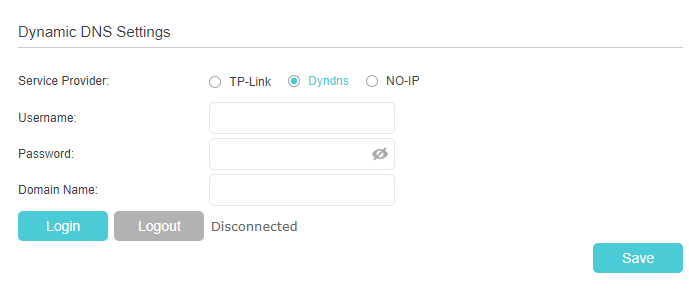
5 Click Log in and Save.
Tips: If you want to use a new DDNS account, please log out first, then log in with the new account.
Create Static Routes
A static route is a pre-determined path that network information must travel to reach a specific host or network. Data from one point to another will always follow the same path regardless of other considerations. Normal internet usage does not require this setting to be configured.
I want to:
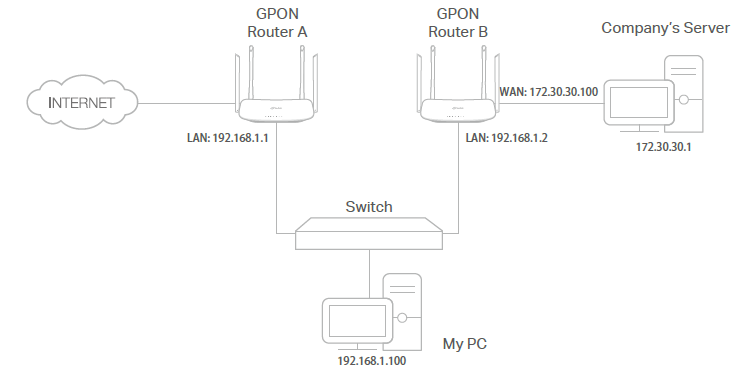
Visit multiple networks and multiple servers at the same time. For example, in a small office, my PC can surf the internet through GPON Router A, but I also want to visit my company’s network. Now I have a switch and another GPON Router B. I connect the devices as shown in the following image so that the physical connection between my PC and my company’s server is established. To surf the internet and visit my company’s network at the same time, I need to configure the static routing.
How can I do that?
1 Make sure the routers use different LAN IP addresses on the same subnet. Disable GPON Router B’s DHCP function.
2 Visit http://tplinkmodem.net or http://192.168.1.1, and log in with the password you set for the GPON Router A.
3 Go to Advanced > Network > Static Routing. Select your current WAN Interface and click Save.
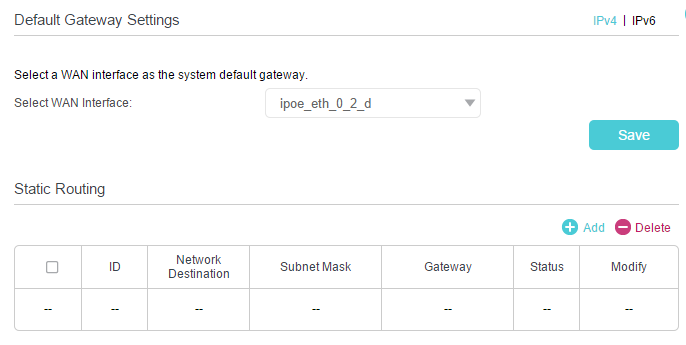
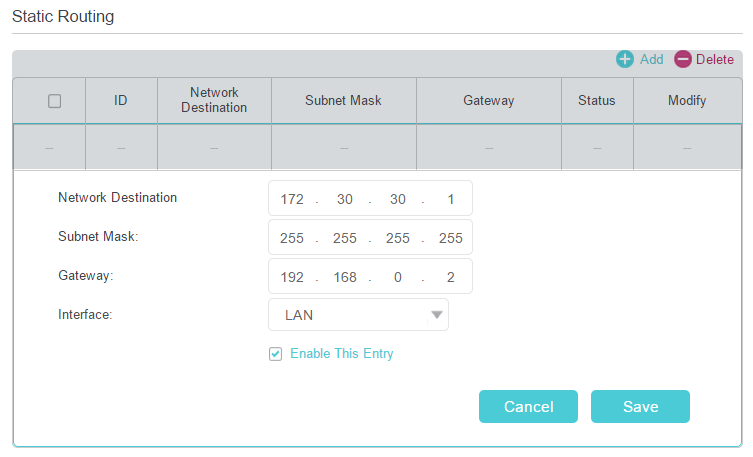
4 Click Add to add a new static routing entry. Finish the settings according to the following explanations:
-
Network Destination: The destination IP address that you want to assign to a static route. This IP address cannot be on the same subnet with the WAN IP or LAN IP of the Router A. In the example, the IP address of the company network is the destination IP address, so here we enter 172.30.30.1.
-
Subnet Mask: Determines the destination network with the destination IP address. If the destination is a single IP address, enter 255.255.255.255; otherwise, enter the subnet mask of the corresponding network IP. In the example, the destination network is a single IP, so here we enter 255.255.255.255.
-
Gateway: The IP address of the gateway device to which the data packets will be sent. This IP address must be on the same subnet with the router’s IP which sends out the data. In the example, the data packets will be sent to the LAN port of Router B and then to the Server, so the default gateway should be 192.168.1.2.
- Interface: Determined by the port (WAN/LAN) that sends out the data packets. In the example, the data is sent to the gateway through the LAN port of Router A, so LAN should be selected.
5 Select the Enable This Entry check box to enable this entry.
6 Click Save to make the settings effective.
Done!
Open a web browser on your PC. Enter the company server’s IP address to visit the company network.
RIP Settings
To activate RIP for the WAN interface, select the desired RIP version and operation and place a check in the ‘Enabled’ checkbox. To stop RIP on the WAN Interface, uncheck the ‘Enabled’ checkbox. Click the ‘Save’ button to start/stop RIP and save the configuration.
1 Visit http://tplinkmodem.net or http://192.168.1.1, and log in with the password you set for the GPON router.
2 Go to Advanced > Network > RIP Settings.
3 Configure RIP settings.
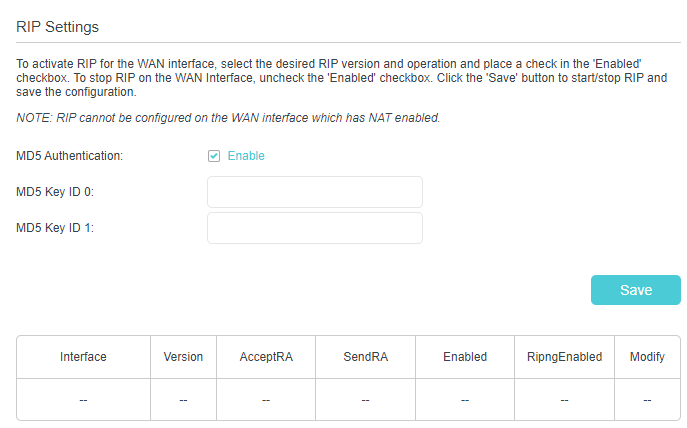
-
MD5 Authentication - Enable MD5 Authentication to enhance the rip RA packets security.
-
MD5 Key ID 0 - Setting the MD5 Key ID 0 value.
-
MD5 Key ID 1 - Setting the MD5 Key ID 1 value.
-
Interface - The WAN interface name of the RIP rule table’s entry used in.
-
Version - The RIP version (RIPv1/RIPv2) of the RIP rule table’s entry used.
-
AcceptRA - Enable it to make the RIP rule entry can accept the Router Advertisement.
-
SendRA - Enable it to make the RIP rule entry can send the Router Advertisement.
-
Enabled - Enable it to make the RIP rule entry active for IPv4.
-
RipngEnabled - Enable it to make the RIP rule entry active for IPv6, which is also known as Ripng.
-
Modify - Click here to modify the RIP rule entry.
Specify Wireless Settings
Change Basic Wireless Settings
The GPON router’s wireless network name (SSID) and password, and security option are preset in the factory. The preset SSID and password can be found on the product label. You can customize the wireless settings according to your needs.
Visit http://tplinkmodem.net or http://192.168.1.1, and log in with the password you set for the GPON router.
-
To enable or disable the wireless function:
1 Go to Basic > Wireless.
2 The wireless radio is enabled by default. If you want to disable the wireless function of the router, just clear the Enable check boxes. In this case, all the wireless settings will be invalid.
-
To change the wireless network name (SSID) and wireless password:
1 Go to Basic > Wireless.
2 Enter a new SSID (32 characters at most) in the Network Name (SSID) field and a new password in the Password field and click Save. The SSID and password are case-sensitive.
Note: If you use a wireless device to change the wireless settings, you will be disconnected after the new settings are effective. Please write down the new SSID and password for future use.
-
To hide SSID:
1 Go to Basic > Wireless.
2 Select Hide SSID, and your SSID will not be broadcast. Your SSID won’t display on your wireless devices when you scan for local wireless networks and you need to manually join the network.
-
To change the mode or channel:
1 Go to Advanced > Wireless > Wireless Settings.
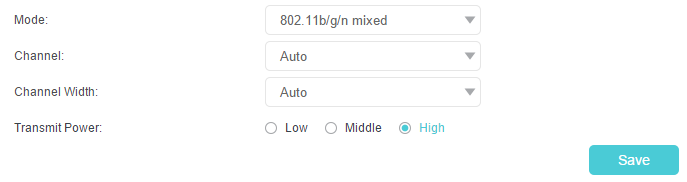
2 Select the wireless network mode or channel and click Save to make the settings effective.
Mode: Select the desired transmission mode.
-
802.11b/g/n mixed: Select if you are using a mix of 802.11b, 11g, and 11n wireless clients.
-
802.11b/g/n/ax mixed: Select if you are using a mix of 802.11b, 11g, 11n and 11ax wireless clients.
-
802.11a/n/ac mixed: Select if you are using a mix of 802.11a, 11n, and 11ac wireless clients.
-
802.11a/n/ac/ax mixed: Select if you are using a mix of 802.11a, 11n, 11ac and 11ax wireless clients.
Note: When 802.11n only mode is selected, only 802.11n wireless stations can connect to the router. It is strongly
recommended that you select 802.11b/g/n mixed (for 2.4GHz) and 802.1 a/n/ac/ax mixed (for 5GHz), and all of 802.11a, 802.11b, 802.11g, 802.11n, 802.11ac, and 802.11ax wireless stations can connect to the router.
Channel: Select the channel you want to use from the drop-down list. This field determines which operating frequency will be used. It is not necessary to change the wireless channel unless you notice interference problems with another nearby access point.
Channel Width: Select the channel width from the drop-down list. The default setting is Auto, which can adjust the channel width for your clients automatically.
Transmit Power: Select Low, Middle, or High to specify the data transmit power. The default and recommended setting is High.
-
To change the security option:
1 Go to Advanced > Wireless > Wireless Settings.
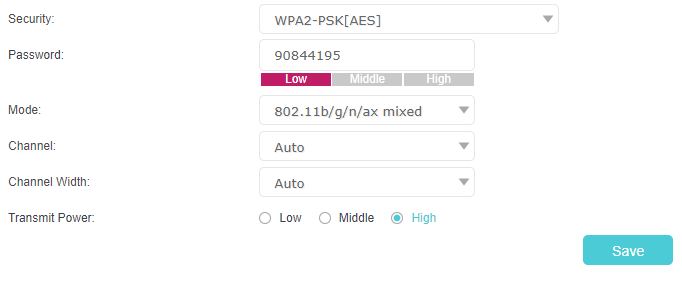
2 Select an option from the Security drop-down list and configure the related parameters. The router provides four options, No Security, WPA-PSK[TKIP]+WPA2- PSK[AES], WPA2-PSK[AES], WPA2-PSK[AES]+WPA3-Personal. WPA3 uses the newest standard and the security level is the highest. We recommend you don’t change the default settings unless necessary.
3 Click Save to make the settings effective.
-
To enable network roaming:
Network roaming helps devices choose better AP based on actual conditions to balance network demands.
1. Go to Advanced > Wireless > Wireless Settings.
2. Locate the Band Steering section, select the Enable check box to make the settings effective.
Advanced Wireless Settings
Advanced wireless settings are for those who want more network controls. You can follow the instructions below to configure your router.
1 Visit http://tplinkmodem.net or http://192.168.1.1, and log in with the password you set for the GPON router.
2 Go to Advanced > Wireless > Advanced Settings.
-
To change basic advanced settings:
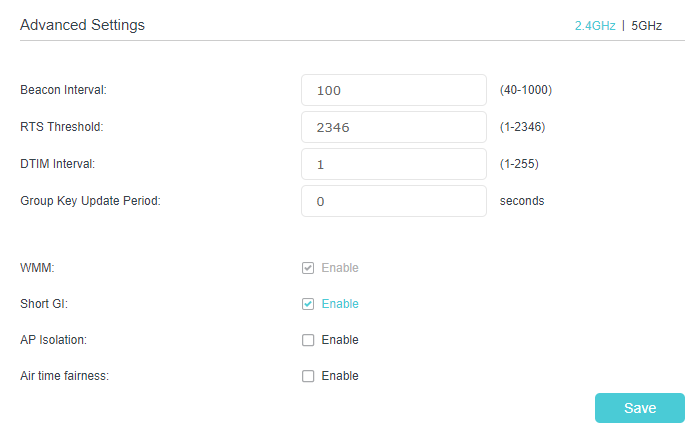
Locate the Advanced Settings section and configure the advanced settings according to the explanation below, and then click Save.
-
Beacon Interval: Enter a value between 40 and 1000 in milliseconds to determine the duration between which beacon packets are broadcast by the router to synchronize the wireless network. The default is 100 milliseconds.
-
RTS Threshold: Enter a value between 1 and 2347 to determine the packet size of data transmission through the router. By default, the RTS (Request to Send) Threshold size is 2347. If the packet size is greater than the preset threshold, the router sends Request to Send frames to a particular receiving station and negotiates the sending of a data frame, or else the packet will be sent immediately.
-
DTIM Interval: Enter a value between 1 and 255 to determine the interval of the Delivery Traffic Indication Message (DTIM). 1 indicates the DTIM Interval is the same as Beacon Interval.
-
Group Key Update Period: Enter the number of seconds to control the time interval for the encryption key automatic renewal. The default is 0, indicating no key renewal.
-
WMM: This feature guarantees the packets with high-priority messages being transmitted preferentially. WMM is enabled compulsively under 802.11n or 802.11ac mode.
-
Short GI: This feature is enabled by default and recommended to increase the data capacity by reducing the Guard Interval (GI) time.
-
AP Isolation: Select this check box to enable the AP Isolation feature that allows you to confine and restrict all wireless devices on your network from interacting with each other, but still able to access the internet.
-
Air time fairness: Select this checkbox to enable the Airtime Fairness(ATF) feature that allows you to optimize the throughput of each flow. The ATF traffic scheduler uses the per-destination airtime targets to balance airtime usage across flow destinations.
Note: If you are not familiar with the settings mentioned above, it’s strongly recommended that you keep the provided default settings; otherwise it may result in lower wireless network performance.
-
-
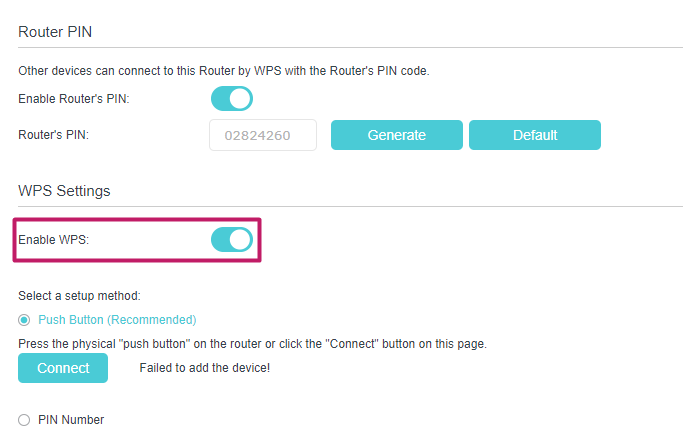
To enable or disable WPS function:
WPS (Wi-Fi Protected Setup) provides you with an easier approach to set up a security- protected Wi-Fi connection. This function is enabled by default, but if you do not need this function, clear the WPS Enable check box.
1 Visit http://tplinkmodem.net or http://192.168.1.1, and log in with the password you set for the GPON router.
2 Go to Advanced > Wireless > WPS.
-
To create multi-SSID network:
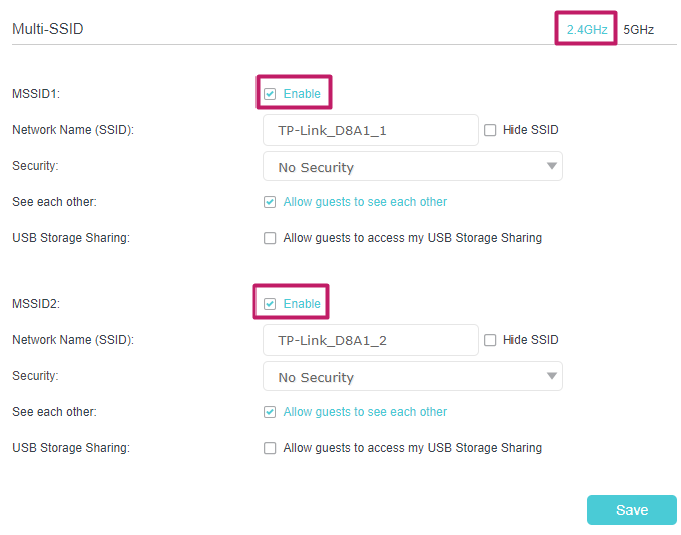
The router supports additional up to three multi-SSID wireless networks for client access in each wireless band. You can specify the access and security settings to ensure network security and privacy according to your situation.
1 Visit http://tplinkmodem.net or http://192.168.1.1, and log in with the password you set for the GPON router.
2 Go to Advanced > Wireless > Multi-SSID
-
1) Locate the Multi-SSID section, and enable 2.4GHz or 5GHz to open the corresponding setup page.
-
2) Select the Enable MSSID 1 or 2 check box(es) to enable the corresponding multi-SSID network.
-
3) Enter a new Network Name (SSID) or use the default name, this field is case sensitive. Don‘t select Hide SSID unless you want your guests to manually input the SSID for Wi-Fi access.
-
4) Select the Security option for the multi-SSID network, WPA/WPA2 Personal is recommended, and you can set a password for the network.
If you want to allow the clients in your Multi-SSID network to communicate with each other via methods such as Network Neighborhood and Ping, select the Allow Guests to See Each Other check box.
If you want to allow the clients in your Multi-SSID network to access your router’s USB storage sharing via methods such as Network Neighborhood and FTP, select the Allow Guests to Access My USB Storage Sharing check box.
-
5) Repeat step 1) to step 4) to set other wireless networks if needed, and click Save to make the settings effective.
-
View Wireless Information
-
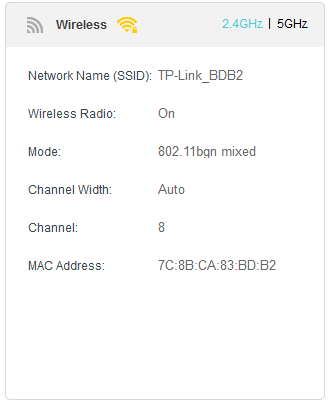
To view the detailed wireless network settings:
1 Visit http://tplinkmodem.net or http://192.168.1.1, and log in with the password you set for the GPON router.
2 Go to Advanced > Status page. You will find the Wireless panel.
3 Click 2.4GHz or 5GHz to view the wireless details.
Tips: You can also see the wireless details by clicking the router icon on Basic> Network Map.
-
To view the detailed information of the connected wireless clients:
1 Visit http://tplinkmodem.net or http://192.168.1.1, and log in with the password you set for the GPON router.
2 Go to Advanced > Wireless > Statistics page.
3 You can view the detailed information of the wireless clients, including its connection type and security option as well as the packets transmitted.
Tips: You can also see the wireless details by clicking the wireless clients icon on Basic > Network Map.
Schedule Your Wireless Function
You can automatically turn off your wireless networks when you do not need the wireless connection.
1 Visit http://tplinkmodem.net or http://192.168.1.1, and log in with the password you set for the GPON router.
2 Go to Advanced > Wireless > Wireless Schedule.
3 Enable the Wireless Schedule function.
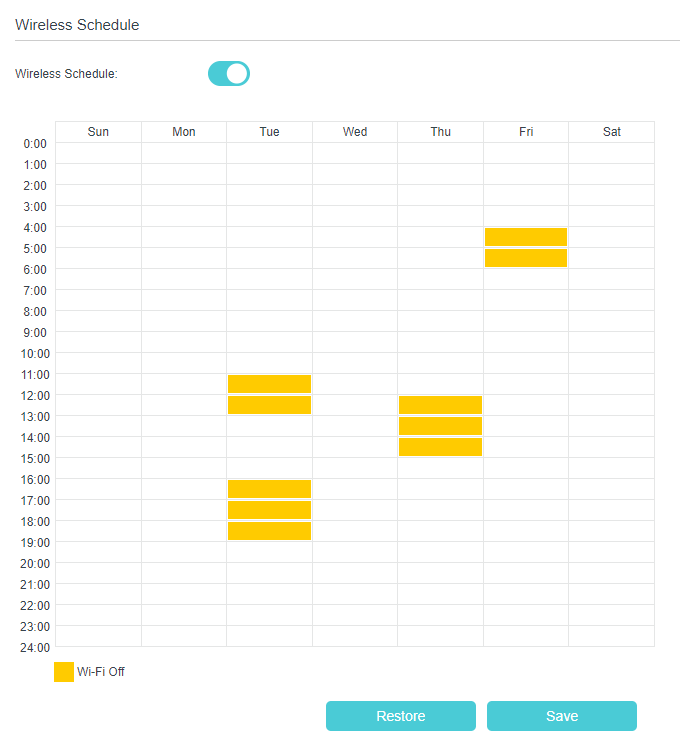
4 Click Add to set the Wireless Off Time, and click Save to make the settings effective.
Note:
- Make sure that the time of the router is correct before using this function. For details, refer to Set System Time.
- The wireless LED will turn off if the corresponding wireless network is disabled.
- The wireless network will be automatically turned on after the time period you set.
Use WPS for Wireless Connection
You can use WPS (Wi-Fi Protected Setup) to add a new wireless device to your existing network quickly and easily.
Method 1: Use the WPS button
Use this method if your client device has a WPS button.
1 Press the WiFi/WPS button of the router.
2 Press the WPS button of the client device directly.
3 The WPS LED flashes for about 2 minutes during the WPS process.
4 When the WPS LED is on, the client device has successfully connected to the router.
Method 2: Use the “Connect” button on the web management page
Use this method if your client device has a WPS button.
1 Visit http://tplinkmodem.net or http://192.168.1.1, and log in with the password you set for the GPON router.
2 Go to Advanced > Wireless > WPS page.
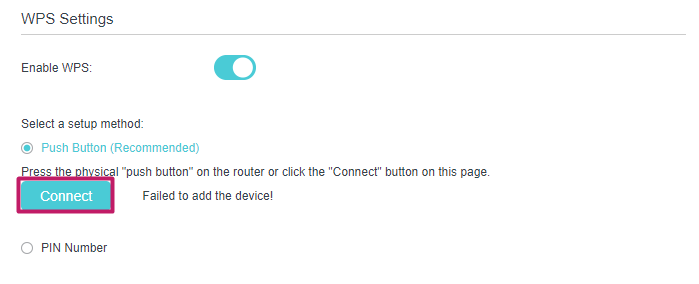
3 Click Connect on the page.
4 Press the WPS button of the client device directly.
5 The WPS LED of the router flashes for about 2 minutes during the WPS process.
6 When the WPS LED is on, the client device has successfully connected to the router.
Method 3: Enter the router’s PIN on your client device
Use this method if your client device asks for the router’s PIN.
1 Visit http://tplinkmodem.net or http://192.168.1.1, and log in with the password you set for the GPON router.
2 Go to Advanced > Wireless > WPS, and enable Router’s PIN.
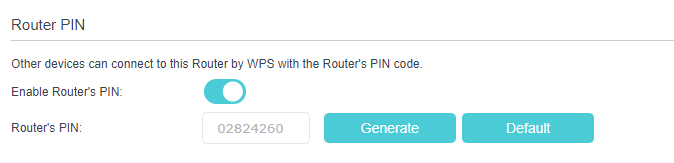
3 Take a note of the current PIN of the router. You can also click the Generate button to get a new PIN.
4 Enter the router’s PIN on the client device. (The default PIN is also printed on the label of the router.)
5 The WPS LED flashes for about 2 minutes during the WPS process.
6 When the WPS LED is on, the client device has successfully connected to the router.
Note:
- The WPS LED on the router will light on for five minutes if the device has been successfully added to the network.
- The WPS function cannot be configured if the wireless function of the router is disabled. Please make sure the wireless function is enabled before configuring WPS.
Method 4: Enter the client device’s PIN on the router
1 Visit http://tplinkmodem.net or http://192.168.1.1, and log in with the password you set for the GPON router.
2 Go to Advanced > Wireless > WPS, and click PIN Number.
3 Enter the Client’s PIN.
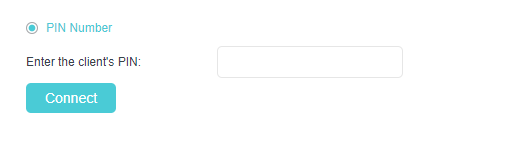
4 Then click the Connect button.
5 Device has been added successfully! or the similar information will appear on the web page, which means the client device has successfully connected to the router.
Multi-SSID
Multi-SSID function allows you to provide Wi-Fi access for your visitors without disclosing your main network. When you have guests in your house, apartment, or workplace, you can create a multi-SSID wireless network for them. In addition, you can customize the network settings to ensure your network security and privacy.
To create a multi-SSID network:
1 Visit http://tplinkmodem.net or http://192.168.1.1, and log in with the password you set for the GPON router.
2 Go to Basic > Multi-SSID or Advanced > Wireless > Multi-SSID.
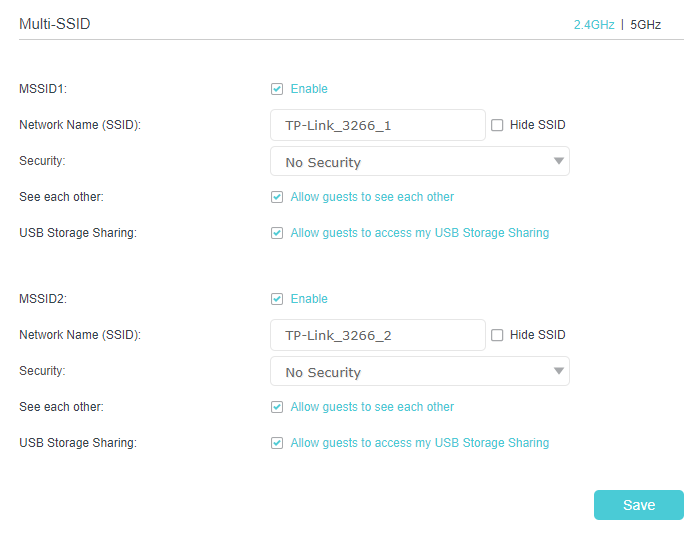
3 Create the multi-SSID network as needed.
-
) Select the Enable check box to create the corresponding multi-SSID network.
You can create three multi-SSID wireless networks at most.
-
) Enter a new Network Name (SSID) or use the default name, this field is case- sensitive. Don‘t select Hide SSID unless you want your guests to manually input the SSID for Wi-Fi access.
-
) Select the Security option for the multi-SSID wireless network, WPA/WPA2/ WPA3 Personal (Recommended) is recommended, and you can set a password for the network.
4 Click Save to make the settings effective. Now your guests can access your multi- SSID wireless network using the SSID and password specified.
TP-Link Cloud Service
TP-Link Cloud service provides a better way to manage your cloud devices. Log in to your GPON router with a TP-Link ID, and you can easily monitor and manage your home network when you are out and about via the Aginet app. To ensure that your GPON router stays new and gets better over time, the TP-Link Cloud will notify you when an important firmware upgrade is available. Surely you can also manage multiple TP-Link Cloud devices with a single TP-Link ID.
This chapter introduces how to register a new TP-Link ID, bind or unbind TP-Link IDs to manage your GPON router, and the Aginet app with which you can manage your home network no matter where you may find yourself.
It contains the following sections:
-
Register a TP-Link ID
-
Change Your TP-Link ID Information
-
Manage the User TP-Link IDs
- Manage the GPON Router via the TP-Link Aginet App
Register a TP-Link ID
If you have skipped the registration during the Quick Setup process, you can:
1 Visit http://tplinkmodem.net or http://192.168.1.1, and log in with the password you set for the GPON router.
2 Go to Basic > TP-Link Cloud.
3 Click Sign Up and follow the instructions to register a TP-Link ID.
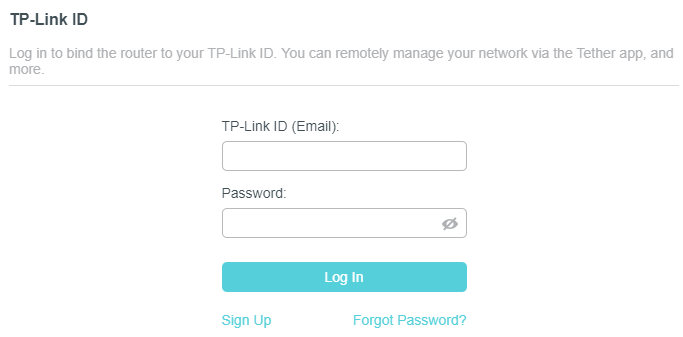
4 After activating your TP-Link ID, come back to the TP-Link Cloud page to log in. The TP-Link ID used to log in to the router for the first time will be automatically bound as an Admin.
Note:
- To learn more about the Admin and User TP-Link ID, refer to Manage the User TP-Link IDs.
- Once you have registered a TP-Link ID on the web management page, you can only register another TP-Link ID via the Aginet APP. Please refer to Manage the GPON Router via the TP-Link Aginet App to install the app.
- If you want to unbind the admin TP-Link ID from your router, please go to Basic > TP-Link Cloud, an click Unbind in the Device Information section.
Change Your TP-Link ID Information
Follow the steps below to change your email address and password of your TP-Link ID as needed.
1 Visit http://tplinkmodem.net or http://192.168.1.1, and log in with your TP-Link ID.
2 Go to Basic > TP-Link Cloud, and focus on the Account Information section.
-
To change your email address:
-
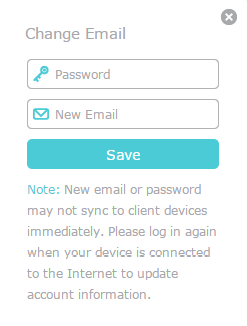
Click the Edit icon behind the Email.
-
Enter the password of your TP-Link ID, then a new email address. And click Save.
-
-
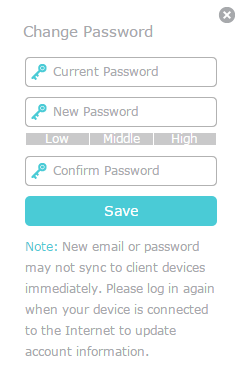
To change your password:
-
Click he Edit icon behind the Password.
-
Enter the current password, then a new password twice. And click Save.
Manage the User TP-Link IDs
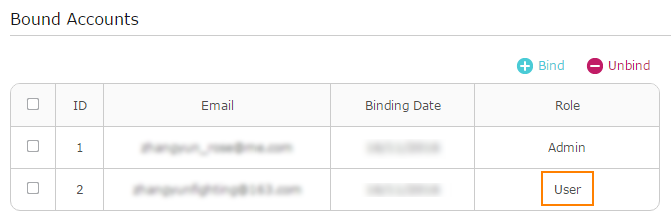
The TP-Link ID used to log in to the GPON router for the first time will be automatically bound as the Admin account. An admin account can add or remove other TP-Link IDs to or from the same router as Users. All accounts can monitor and manage the router locally or remotely, but user accounts cannot:
-
Reset the GPON router to its factory default settings either on the web management page or in the Aginet app.
- Add/remove other TP-Link IDs to/from the GPON router.
Add TP-Link ID to Manage the GPON Router
1 Visit http://tplinkmodem.net or http://192.168.1.1, and log in with your TP-Link ID.
2 Go to Basic > TP-Link Cloud, and focus on the Bound Accounts section.
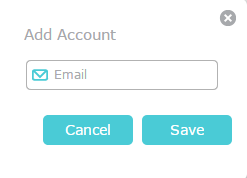
3 Click +Bind , enter another TP-Link ID as needed and click Save.
Note: If you need another TP-Link ID, please register a new one via the Aginet app. Refer to Manage the GPON Router via the TP-Link Aginet App to install the app and register a new TP-Link ID.
4 The new TP-Link ID will be displayed in the Bound Accounts table as a User.
Remove TP-Link ID(s) from Managing the GPON Router
1 Visit http://tplinkmodem.net or http://192.168.1.1, and log in with your TP-Link ID.
2 Go to Basic > TP-Link Cloud, and focus on the Bound Accounts section.
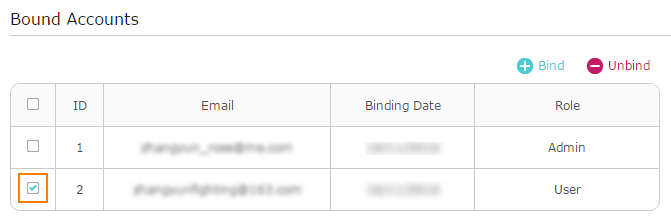
3 Tick the checkbox(es) of the TP-Link ID(s) you want to remove and click Unbind.
Manage the GPON Router via the TP-Link Aginet App
The Aginet app runs on iOS and Android devices, such as smartphones and tablets.
1. Launch the Apple App Store or Google Play store and search “TP-Link Aginet” or simply scan the QR code to download and install the app.

2 Launch the Aginet app and log in with your TP-Link ID.
Note: If you don’t have a TP-Link ID, create one first.
3. Connect your device to the GPON router’s wireless network.
4. Go back to the Aginet app, select the model of your router and log in with the password you set for the router.
5. Manage your router as needed.
Note: If you need to remotely access your router from your smart devices, you need to:
• Log in with your TP-Link ID. If you don’t have one, refer to Register a TP-Link ID.
• Make sure your smartphone or tablet can access the internet with cellular data or a Wi-Fi network.
USB Settings
This chapter describes how to use the USB ports to share files and media from the USB storage devices over your home network locally, or remotely through the internet.
The GPON router supports USB external flash drives and hard drives.
It contains the following sections:
- Access the USB Storage Device
- Media Sharing
- 3G/4G Settings
Access the USB Storage Device
Insert your USB storage device into the GPON router’s USB port and then access files stored there locally or remotely.
 Tips:
Tips:
- If you use USB hubs, make sure no more than 4 devices are connected to the GPON router.
- If the USB storage device requires using bundled external power, make sure the external power has been connected.
- If you use a USB hard drive, make sure its file system is FAT32, exFat, NTFS or HFS+.
- Before you physically disconnect a USB device from the GPON router, safely remove it to avoid data damage: Go to Advanced
> USB Sharing > USB Storage Device and click Remove.
Access the USB Device Locally:
Insert your USB storage device into the GPON router’s USB port and then refer to the following table to access files stored on your USB storage device.
|
Windows computer |
Method 1: Go to Computer > Network, then click the Network Server Name (TP-SHARE by default) in the Computer section.
|
 Note: Operations in different systems are similar. Here we take Windows 7 as an example.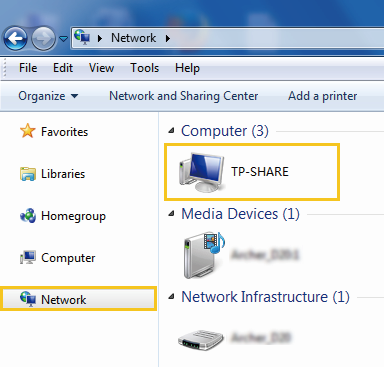

|
Windows computer |
Method 2: Open the Windows Explorer (or go to Computer) and type the server address \\tplinkwifi.net or ftp://tplinkwifi.net in the address bar, then press Enter.
|
|
Mac |
1. Select Go > Connect to Server. 2. Type the server address smb://tplinkwifi.net. 3. Click Connect.
4. When prompted, select the Guest radio box. (If you have set up a username and a password to deny anonymous access to the USB disks, you should select the Registered User radio box. To learn how to set up an account for the access, refer to To Set Up Authentication for Data Security.) |
|
Tablet |
Use a third-party app for network files management. |

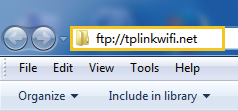

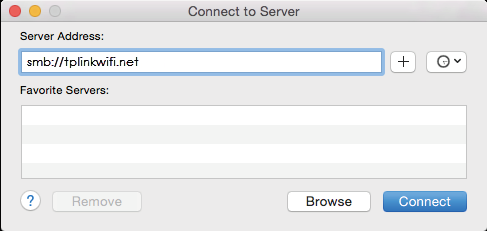
Tips: You can also access your USB storage device by using your Network/Media Server Name as the server address. Refer to To Customize the Address of the USB Storage Device to learn more.
Access the USB Device Remotely:
You can access your USB disk outside the local area network. For example, you can:
• Share photos and other large files with your friends without logging in to (and paying for) a photo-sharing site or email system.
• Get a safe backup for the materials for a presentation.
• Remove the files on your camera’s memory card from time to time during the journey.
Note: If your ISP assigns a private WAN IP address (such as 192.168.x.x or 10.x.x.x), you cannot use this feature because private addresses are not routed on the internet.
Follow the steps below to configure remote access settings.
1. Visit http://tplinkmodem.net or http://192.168.1.1, and log in with the password you set for the GPON router.
2. Go to Advanced > USB Sharing > Sharing Access > Sharing Settings.
3. Tick the FTP checkbox, and then click SAVE.
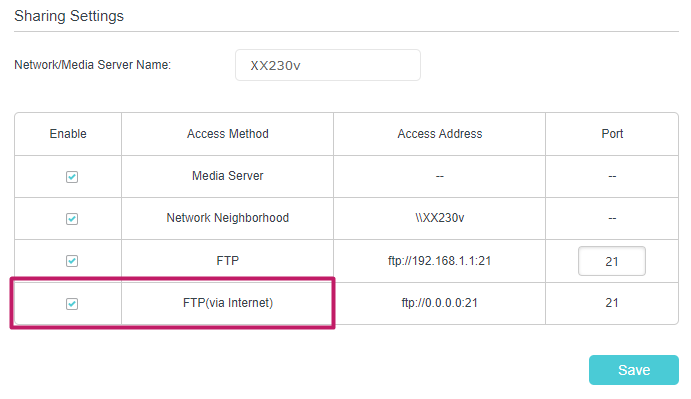
4. Refer to the following table to access your USB disk remotely.
|
Computer |
1. Open the Windows Explorer (or go to Computer, only for Windows users) or open a web browser. 2. Type the server address in the address bar: Type in ftp://<WAN IP address of the router>:<port number> (such
3. Press Enter on the keyboard. 4. Access with the username and password you set in To Set Up Authentication for Data Security.
|
|
Tablet |
Use a third-party app for network files management. |

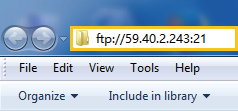
Tips: Click Set Up a Dynamic DNS Service Account to learn how to set up a domain name for you GPON router.
Customize the Access Settings
By default, all the network clients can access all folders on your USB disk. You can customize your sharing settings by setting a sharing account, sharing specific contents and setting a new sharing address on the GPON router’s web management page.
1. Visit http://tplinkmodem.net or http://192.168.1.1, and log in with the password you set for the GPON router.uter.
2. Go to Advanced > USB Sharing > Sharing Access > Sharing Settings.
- To Customize the Address of the USB Storage Device
You can customize the server name and use the name to access your USB storage device.
1. In the Sharing Settings session, make sure Media Server is ticked, and enter a Network/Media Server Name as you like, such as MyShare, then click Save.
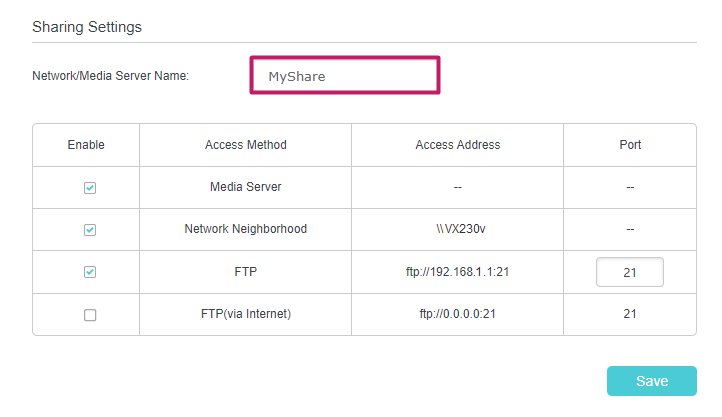
2. Now you can access the USB storage device by visiting \\MyShare (for Windows) or smb://MyShare (for Mac).
- To Set Up Authentication for Data Security
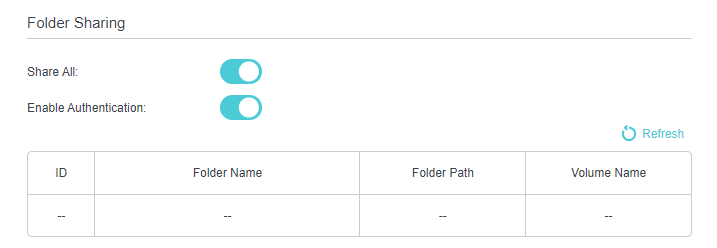
You can set up authentication for your USB storage device so that network clients will be required to enter username and password when accessing the USB storage device.
1. In the Sharing Account section, enable Use New Account.
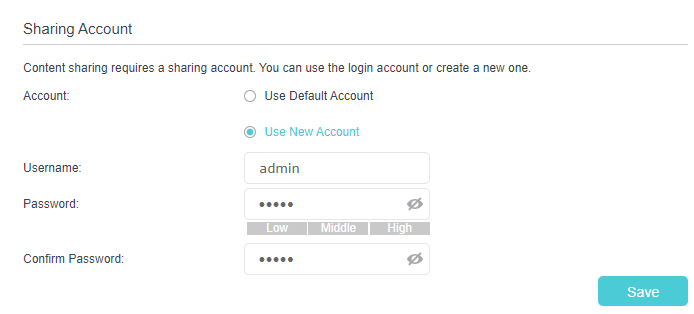
2. Modify the access account. The username and password are both admin for default administrator account, and both visit for default visitor account. Accessing as an administrator can read and modify the shared folders while visitors can only read the shared folders.
Note:
1. For Windows users, do not set the sharing username the same as the Windows username. Otherwise, Windows credential mechanism may cause the following problems:
• If the sharing password is also the same as the Windows password, authentication will not work since the Windows will automatically use its account information for USB access.
• If the sharing password is different from the Windows password, the Windows will be unable to remember your credentials and you will always be required to enter the sharing password for USB access.
2. Due to Windows credential mechanism, you might be unable to access the USB disk after changing Authentication settings. Please log out from the Windows and try to access again. Or you can change the address of the USB disk by referring to To Customize the Address of the USB Storage Device.
Media Sharing
The feature of Media Sharing allows you to view photos, play music and watch movies stored on the USB storage device directly from DLNA-supported devices, such as your computer, tablet and PS2/3/4.
1. Visit http://tplinkmodem.net or http://192.168.1.1, and log in with the password you set for the GPON router.
2. Go to Advanced > USB Sharing > Sharing Access > Sharing Settings.
3. Enable Media Server.

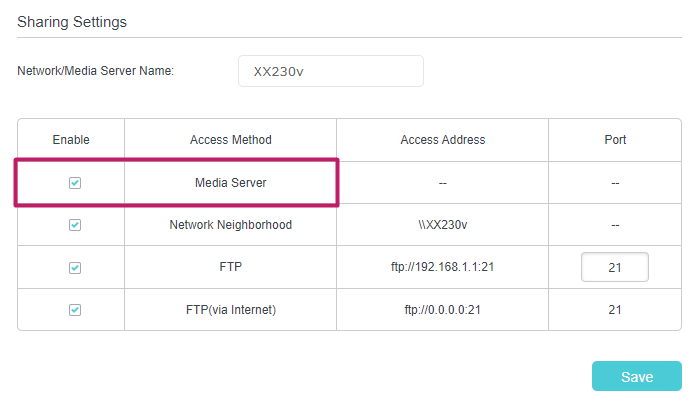
4. When your USB storage device is inserted into the router, your DLNA-supported devices (such as your computer and pad) connected to the router can detect and play the media files on the USB storage devices.
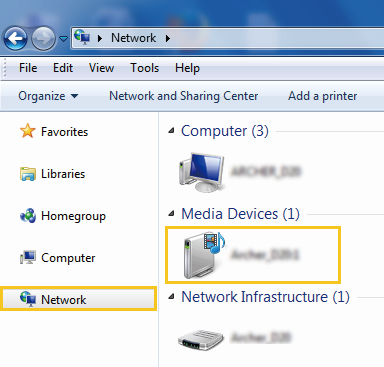
5. Refer to the following table for detailed instructions.
|
Windows Computer |
Go to Computer > Network, then click the Media Server Name (Model number-share by default) in the Media Devices section.
|
|
Tablet |
Use a third-party DLNA-supported player. |

3G/4G Settings
Time Machine backs up all files on your Mac computer to a USB storage device connected to your router.
1. Visit http://tplinkmodem.net or http://192.168.1.1, and log in with the password you set for the GPON router.
2. Go to Advanced > USB Sharing > 3G/4G Settings.

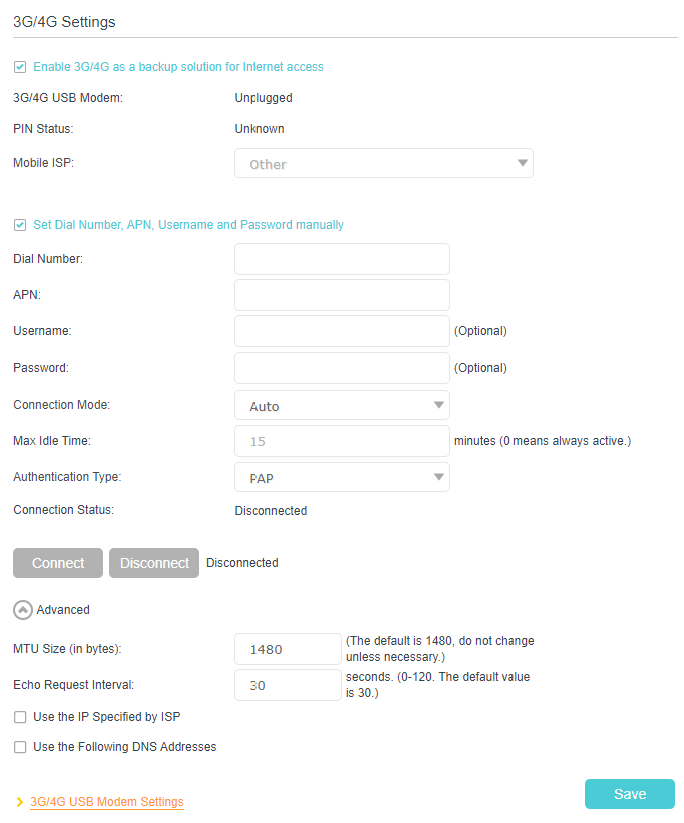
3. Tick the checkbox to enable 3G/4G as a backup solution for Internet access.
4. Tick the checkbox to set the Dial Number, APN, Username and Password manually.
Note: The following Advanced settings will only display if you enable 3G/4G as the backup solution for Internet access.
5. Click SAVE.
EasyMesh with Seamless Roaming
This chapter introduces the TP-Link EasyMesh feature. It contains the following sections:
-
Set Up a EasyMesh Network
-
Manage Devices in the EasyMesh Network
TP-Link EasyMesh Controller and TP-Link EasyMesh Agent work together to form one unified Wi-Fi network. Walk through your home and stay connected with the fastest possible speeds thanks to EasyMesh’s seamless coverage.
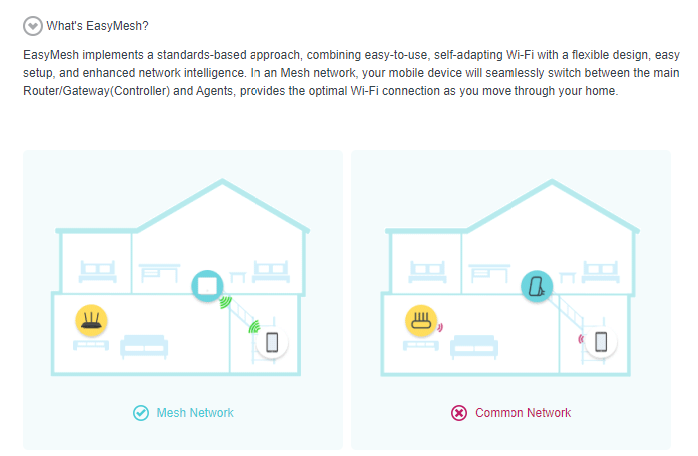
Unified Wi-Fi Network
Controller and agents share the same wireless settings, including network name, password, access control settings and more.
Seamless Roaming
Devices automatically switch between your controller and agents as you move through your home for the fastest possible speeds.
Easy Setup and Management
Set up a EasyMesh network with a push of WPS buttons. Manage all network devices on the Aginet app or at your router’s web management page.
Set Up a EasyMesh Network
1 Visit http://tplinkmodem.net or http://192.168.1.1, and log in with the password you set for the GPON router.
2 Go to Basic > Mesh or Advanced > Wireless > Mesh, and enable EasyMesh.
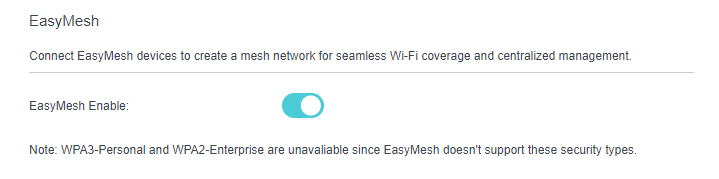
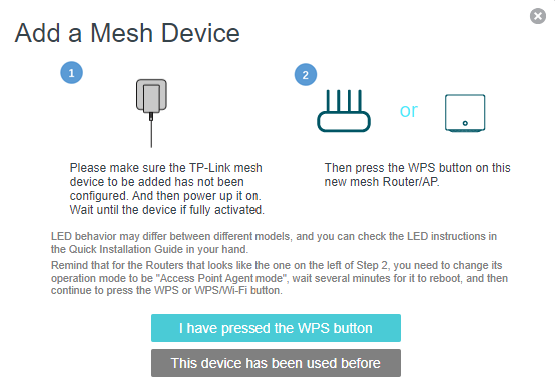
3 Connect a EasyMesh agent to this controller by following the setup instructions in the agent’s manual. The agent will be listed on the controller’s Mesh page.
Note: To check full list of TP-Link EasyMesh devices, visit https://www.tp-link.com.
4 If you have set up the agent to join the EasyMesh network, it will be listed on the controller’s EasyMesh page.
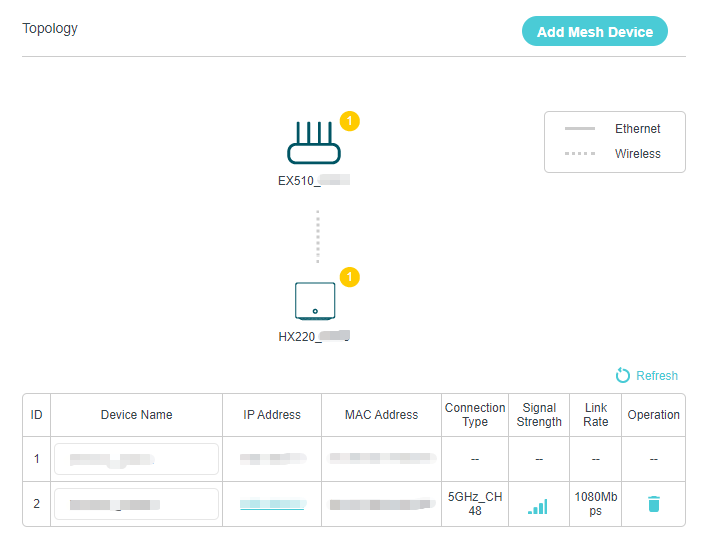
Otherwise, you need to find it in the Add Mesh Device list and click Add to add it to the EasyMesh network.
Done! Now your controller and agents successfully form a EasyMesh network!
Manage Devices in the EasyMesh Network
In a EasyMesh network, you can manage all mesh devices and connected clients on your router’s web page.
To view mesh devices and connected clients in the network:
1 Visit http://tplinkmodem.net or http://192.168.1.1, and log in with the password you set for the GPON router.
2 Go to Basic > Network Map.
3 Click the Main AP icon to view all mesh devices, and click the Device icons to view all connected clients.
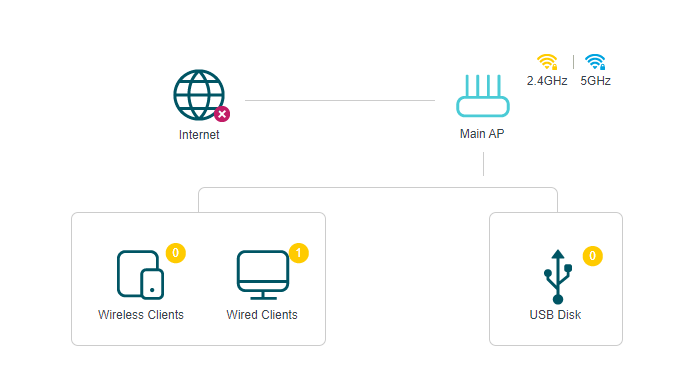
To manage a EasyMesh device in the network:
1 Visit http://tplinkmodem.net or http://192.168.1.1, and log in with the password you set for the GPON router.
2 Go to Basic > Network Map.
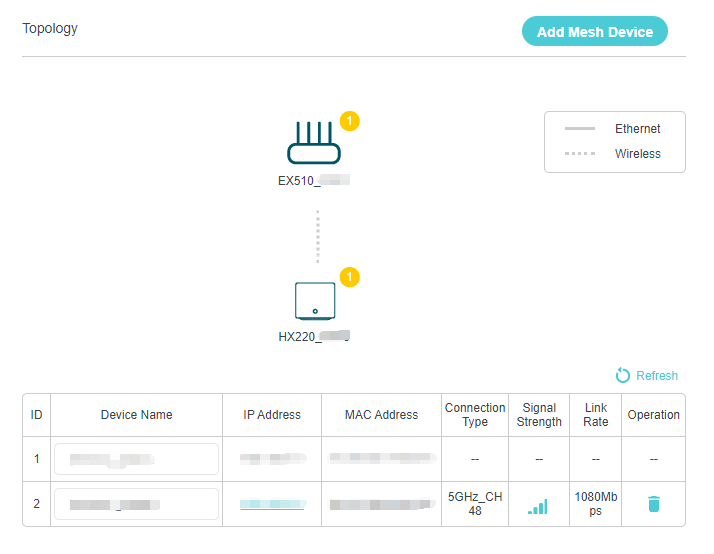
3 Click the Mesh device’s IP Address to redirect to the web management page of this device and view detailed information.
4 Manage the EasyMesh device as needed. You can:
-
Change device information.
-
Delete this device from the EasyMesh network.
Guest Network
This function allows you to provide Wi-Fi access for guests without disclosing your main network. When you have guests in your house, apartment, or workplace, you can create a guest network for them. In addition, you can customize guest network options to ensure network security and privacy.
It contains the following sections:
-
Create a Network for Guests
-
Customize Guest Network Options
Create a Network for Guests
-
Visit http://tplinkmodem.net or http://192.168.1.1, and log in with the password you set for the GPON router.
-
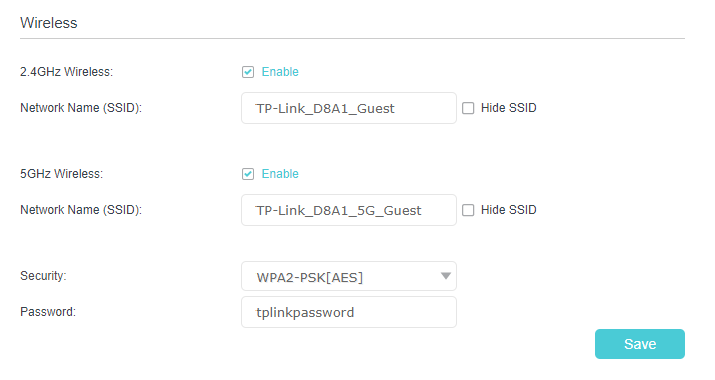
Go to Advanced > Guest Network. Locate the Wireless section.
-
Create a guest network as needed.
-
) Tick the Enable checkbox for the 2.4GHz or 5GHz wireless network.
-
) Customize the SSID. Don‘t select Hide SSID unless you want your guests to manually input the SSID for guest network access.
-
) Select the Security type and customize your own password. If No security is selected, no password is needed to access your guest network.
-
-
Click Save. Now your guests can access your guest network using the SSID and password you set!
Tips: To view guest network information, go to Network Map and locate the Guest Network section. You can turn on or off the guest network function conveniently.
Customize Guest Network Options
-
Visit http://tplinkmodem.net or http://192.168.1.1, and log in with the password you set for the GPON router.
-
Go to Advanced > Guest Network. Locate the Settings section.
-
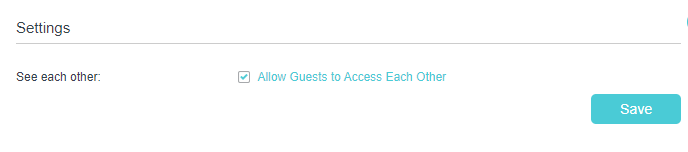
Customize guest network options according to your needs.
-
Allow guests to see each other: Tick this checkbox if you want to allow the wireless clients on your guest network to communicate with each other via methods such as network neighbors and Ping.
-
-
Click Save. Now you can ensure network security and privacy!
NAT Forwarding
The GPON router’s NAT (Network Address Translation) feature makes devices on the LAN use the same public IP address to communicate with devices on the internet, which protects the local network by hiding IP addresses of the devices. However, it also brings about the problem that an external host cannot initiatively communicate with a specified device on the local network.
With the forwarding feature the GPON router can penetrate the isolation of NAT and allows devices on the internet to initiatively communicate with devices on the local network, thus realizing some special functions.
The TP-Link GPON router supports four forwarding rules. If two or more rules are set, the priority of implementation from high to low is Port Forwarding, Port Triggering, UPNP and DMZ.
It contains the following sections:
-
ALG
-
Set Up Public Services on The Local Network by Virtual Servers
-
Open Ports Dynamically by Port Triggering
-
Make Applications Free from Port Restriction by DMZ
-
Make Xbox Online Games Run Smoothly by UPnP
ALG
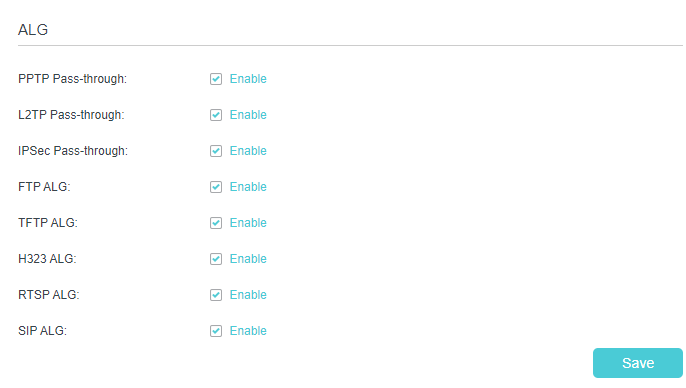
ALG allows customized Network Address Translation (NAT) traversal filters to be plugged into the gateway to support address and port translation for certain application layer “control/data” protocols such as FTP, TFTP, H323 etc. It is recommended to keep the default settings.
You may need to disable SIP ALG when you are using voice and video applications to create and accept a call through the router, since some voice and video communication applications do not work well with SIP ALG.
Visit http://tplinkmodem.net or http://192.168.1.1, and log in with the password you set for the GPON router. Go to Advanced > Security > ALG.
Set Up Public Services on The Local Network by Virtual Servers
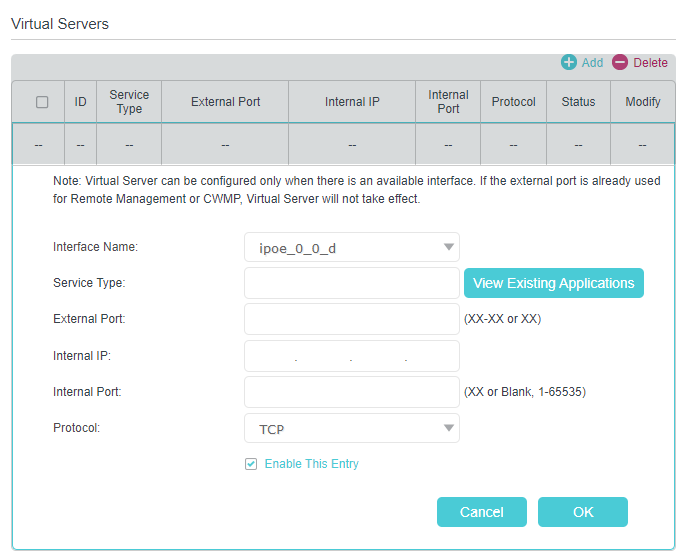
Virtual Servers are used to set up public services on the local network. A virtual server is defined as an external port, and all requests from the Internet to this external port will be redirected to a designated computer, which must be configured with a static or reserved IP address. When you build up a server on the local network and want to share it on the Internet, Virtual Servers can realize the service and provide it to the Internet users.
The table displays the relevant parameters of the virtual server. To set up a Virtual Server rule:
-
Visit http://tplinkmodem.net or http://192.168.1.1, and log in with the password you set for the GPON router.
-
Go to Advanced > NAT Forwarding > Virtual Servers and click +Add.
-
Select an interface name from the drop-down list.
-
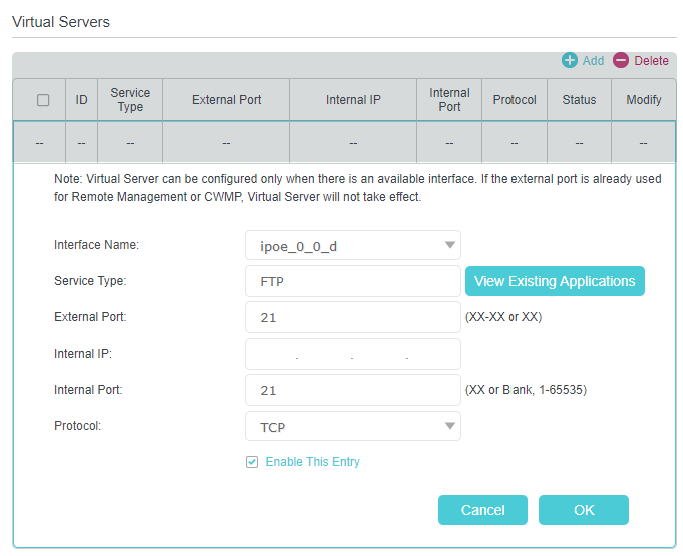
Click View Existing Applications to select a service from the list to automatically populate the appropriate port number in the External Port and Internal Port fields. If the service is not listed, enter the External Port number (e.g. 21) or a range of ports (e.g. 21-25). Leave the Internal Port blank if it is the same as the External Port or enter a specific port number (e.g. 21) if the External Port is a single port. The following picture takes application FTP as an example.
-
Enter the IP address of the computer running the service application in the Internal IP field.
-
Select a protocol for the service application: TCP, UDP, or All from the Protocol drop- down list.
-
Select Enable This Entry.
-
Click OK.
Tips:
If you want to disable this entry, click the Bulb icon.
It is recommended to keep the default settings of Internal Port and Protocol if you are not clear about which port or protocol to use.
If the local host device is hosting more than one type of available services, you need to create a rule for each service. Please note that the External Port should NOT be overlapped.
Open Ports Dynamically by Port Triggering
Port Triggering can specify a triggering port and its corresponding external ports. When a host on the local network initiates a connection to the triggering port, all the external ports will be opened for subsequent connections. The router can record the IP address of the host. When the data from the internet return to the external ports, the router can forward them to the corresponding host. Port Triggering is mainly applied to online games, VoIPs, video players and common applications including MSN Gaming Zone, Dialpad and Quick Time 4 players, etc.
Follow the steps below to configure the Port Triggering rules:
-
Visit http://tplinkmodem.net or http://192.168.1.1, and log in with the password you set for the GPON router.
-
Go to Advanced > NAT Forwarding > Port Triggering and click +Add.
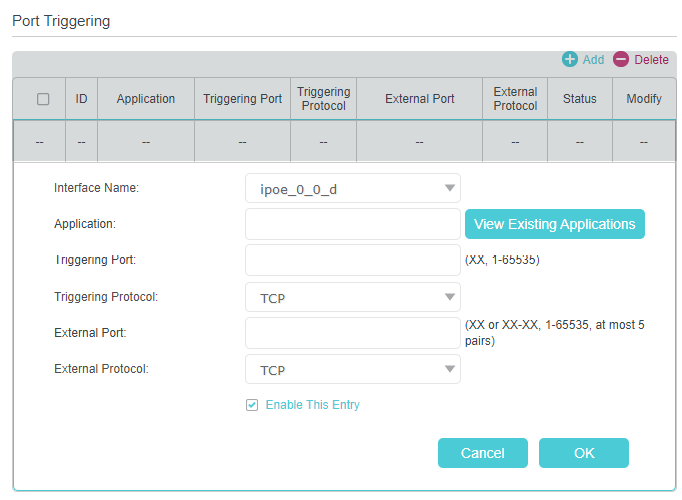
-
Click View Existing Applications, and select the desired application. The Triggering Port, Triggering Protocol and External Port will be automatically filled in. The following picture takes application MSN Gaming Zone as an example.
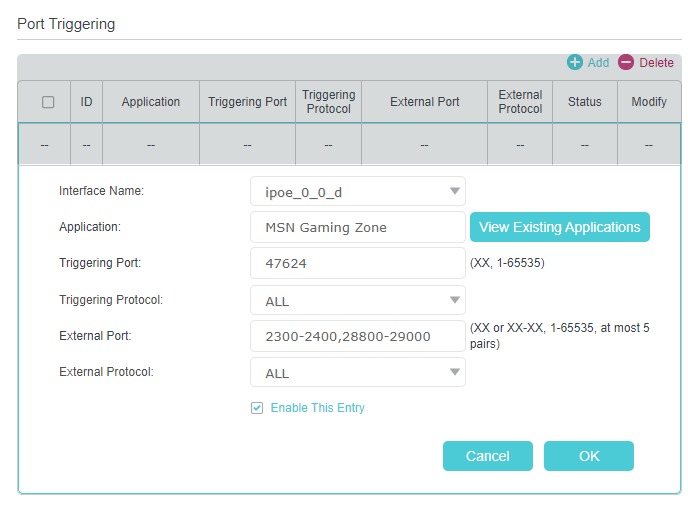
-
Click OK.
Tips:
You can add multiple port triggering rules according to your network need.
The triggering ports can not be overlapped.
If the application you need is not listed in the Existing Applications list, please enter the parameters manually. You should verify the external ports the application uses first and enter them into External Port field according to the format the page displays.
Make Applications Free from Port Restriction by DMZ
When a PC is set to be a DMZ (Demilitarized Zone) host on the local network, it is totally exposed to the internet, which can realize the unlimited bidirectional communication between internal hosts and external hosts. The DMZ host becomes a virtual server with all ports opened. When you are not clear about which ports to open in some special applications, such as IP camera and database software, you can set the PC to be a DMZ host.
Note: When DMZ is enabled, the DMZ host is totally exposed to the internet, which may bring some potential safety hazards. If DMZ is not in use, please disable it in time.
I want to:
Make the home PC join the internet online game without port restriction.
For example, due to some port restriction, when playing the online games, you can log in normally but cannot join a team with other players. To solve this problem, set your PC as a DMZ host with all ports open.
How can I do that?
1 Assign a static IP address to your PC, for example 192.168.1.100.
2 Visit http://tplinkmodem.net or http://192.168.1.1, and log in with the password you set for the GPON router.
3 Go to Advanced > NAT Forwarding > DMZ and tick to enable DMZ.
4 Enter the PC’s IP address 192.168.1.100 manually in the DMZ Host IP Address field.
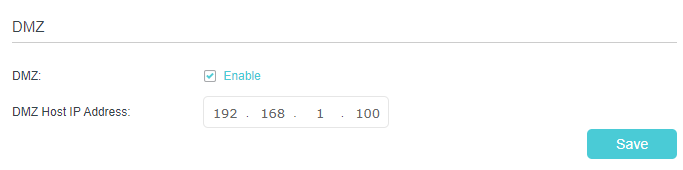
5 Click SAVE.
Done!
The configuration is completed. You’ve set your PC to a DMZ host and now you can make a team to game with other players.
Make Xbox Online Games Run Smoothly by UPnP
The UPnP (Universal Plug and Play) protocol allows applications or host devices to automatically find the front-end NAT device and send request to it to open the corresponding ports. With UPnP enabled, the applications or host devices on the local network and the internet can freely communicate with each other thus realizing the seamless connection of the network. You may need to enable the UPnP if you want to use applications for multiplayer gaming, peer-to-peer connections, real-time communication (such as VoIP or telephone conference) or remote assistance, etc.
Tips:
-
UPnP is enabled by default in this router.
-
Only the application supporting UPnP protocol can use this feature.
-
UPnP feature needs the support of operating system (e.g. Windows Vista/ Windows 7/ Windows 8, etc. Some of operating system need to install the UPnP components).
For example, when you connect your Xbox to the router which has connected to the internet to play online games, UPnP will send request to the router to open the corresponding ports allowing the following data penetrating the NAT to transmit. Therefore, you can play Xbox online games without a hitch.
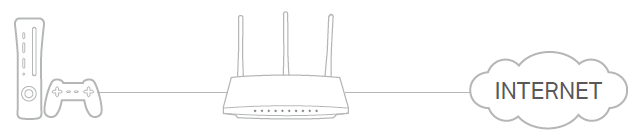
If necessary, you can follow the steps to change the status of UPnP.
1 Visit http://tplinkmodem.net or http://192.168.1.1, and log in with the password you set for the GPON router.
2 Go to Advanced > NAT Forwarding > UPnP and toggle on or off according to your needs.
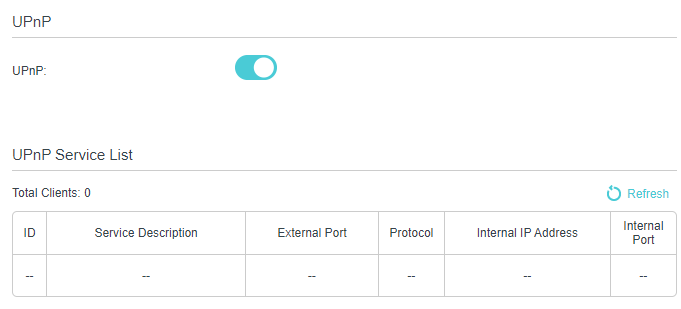
Parental Controls
This function allows you to block inappropriate, explicit and malicious websites, and control access to specified websites at specified time.
I want to:
Control what types of websites my children or other home network users can visit and the time of day they are allowed to access the internet.
For example, I want to allow my children’s devices (e.g. a computer or a tablet) to access only www.tp-link.com and Wikipedia.org from 18:00 (6 PM) to 22:00 (10 PM) on the weekdays and not other time.
How can I do that?
1 Visit http://tplinkmodem.net or http://192.168.1.1, and log in with the password you set for the GPON router.
2 Go to Basic > Parental Controls or Advanced > Parental Controls.
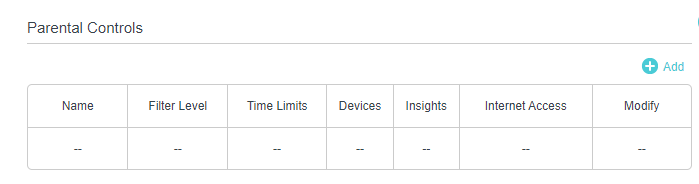
3 Click Add, and then enter the Name manually. Click Add and specify the devices belonging to the family member. Click Next.
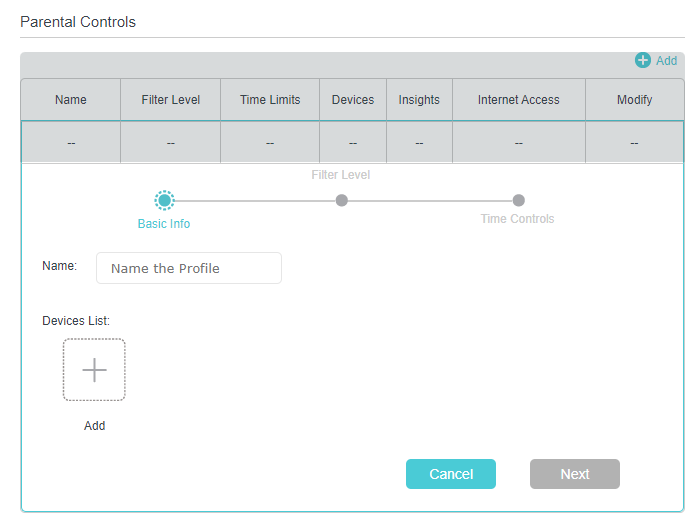
4 Select a filter level based on the age of the family member. Blocked content will then be displayed in the Filter Content list. Click Next.
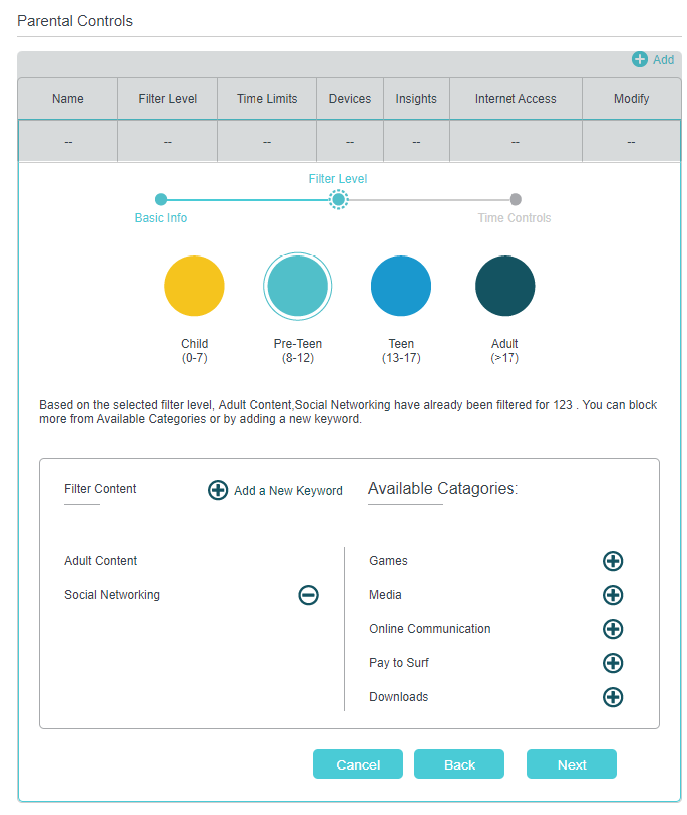
5 (Optional) Delete items from the Filter Content list, add items from the Available Categories list, or click Add a New Keyword to add a filter keyword (for example, “Facebook”) or URL.
6 Enable Time Limits for Mon to Fri and Sat & Sun, then set the daily internet time allowed. Enable BedTime on School Nights (Sunday to Thursday) and Weekend (Friday and Saturday), then set the time period during devices in the profile cannot access the internet.
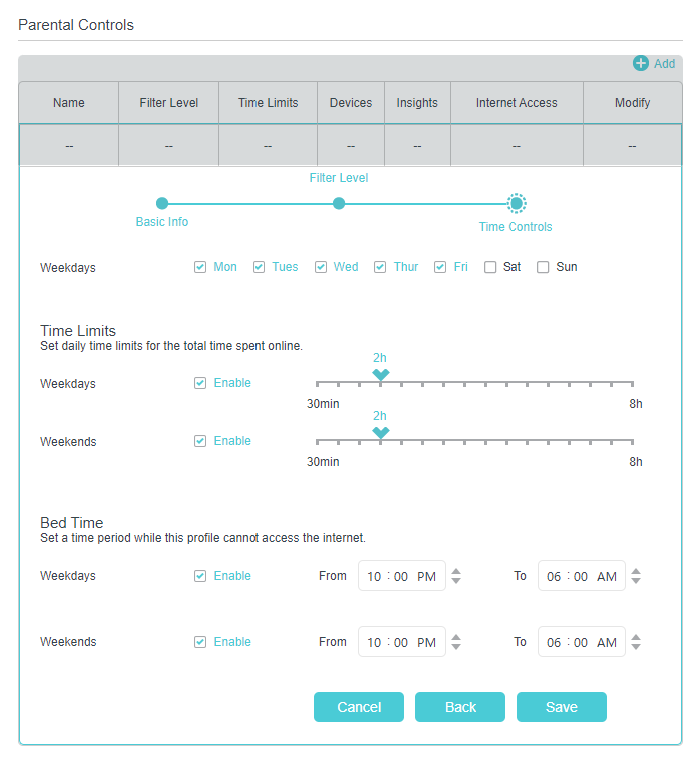
7 Click Save.
Done!
Now you can control your children’s internet access as needed.
To monitor internet usage of a family member:
1) Find the profile of the family member, then click the Insights icon.
2) On the Top 5 Visits page, select a day of the last 7 days to check the time spent online and top visited websites. You can block the websites if needed.
3) On the Blocked History page, select a day of the last 7 days to check the blocked website history. You can unblock websites if needed, and click Unblocked Websites to view them.
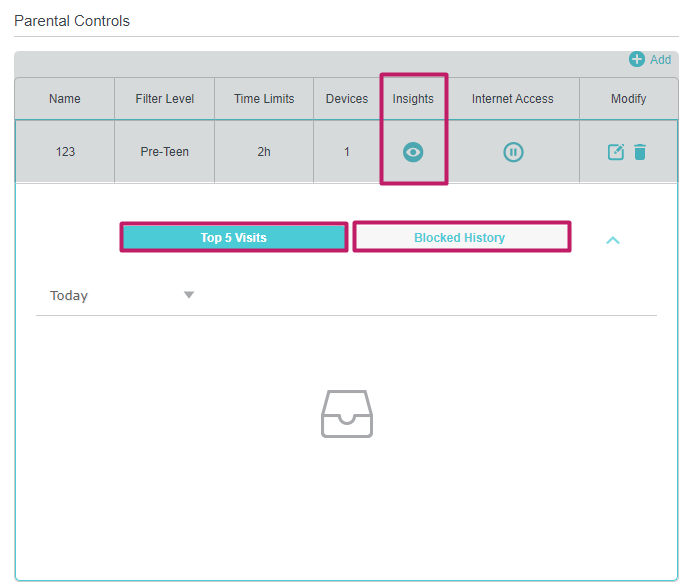
To pause or resume internet access of a family member:
Find the profile of the family member, then click the Pause/Play icon.
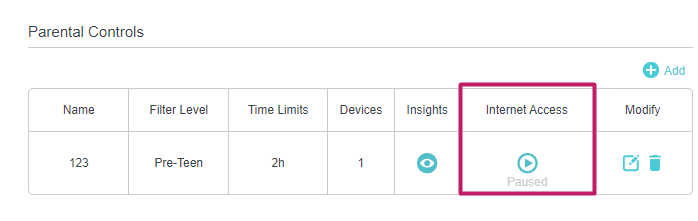
Quality of Service
This function allows you to specify the priority of traffic and minimizes the impact of network congestion.
This chapter contains the following sections:
-
Set up QoS for the network
-
Configure Queue Settings
- Configure Flow Classification
The GPON router allows you to configure the quality of service (QoS) for optimal throughput and performance when handling differentiated wireless traffic, such as Voiceover-IP (VoIP), other types of audio, video, streaming media, and traditional IP data.
To configure QoS on the GPON routers, you should set parameters on the transmission queues for different types of wireless traffic. In normal use, we recommend that you keep the default values for the GPON routers.
Set up QoS for the network
This feature helps the GPON router allocate upstream bandwidth to improve the network’s overall performance.
To set up QoS for the network:
1 Visit http://tplinkmodem.net or http://192.168.1.1, and log in with the password you set for the GPON router.
2 Go to Advanced > QoS > Basic Settings.
3 Enable QoS.
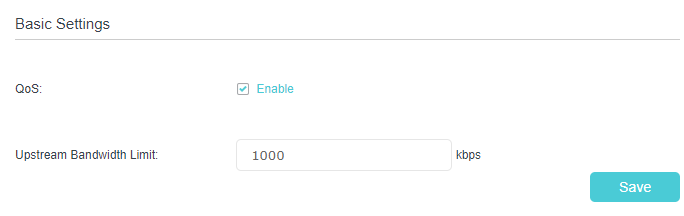
4 Enter your total Upstream Bandwidth Limit.
5 Click Save to make the settings effective.
Configure Queue Settings
This page allows you to manage your network with queues. With SP algorithm, you can define packets which is more important and get throught more quickly; with WRR algorithm, you can allocate quota of bandwith to certain kind of packets.
To add a new queue:
1 Visit http://tplinkmodem.net or http://192.168.1.1, and log in with the password you set for the GPON router.
2 Go to Advanced > QoS > Queue Settings.
3 Click Add.
4 Enter a Queue Name.
5 Select Interface.
6 Enter queue’s Shaping rate.
7 Select the scheduling algorithm according to your needs.
-
SP (Strict Priority): Select this if you want to ensure services in higher-priority queues. The router will process outgoing traffic from the highest-priority queue first, then from a lower-priority queue.
- WRR (Weighted Round Robin): Select this if you want to balance traffic in queues proportional to their queue weight. The router will process more packets in a queue if the queue has a higher weight.
8 Select queue's Precedence if queue's algorithm is SP.
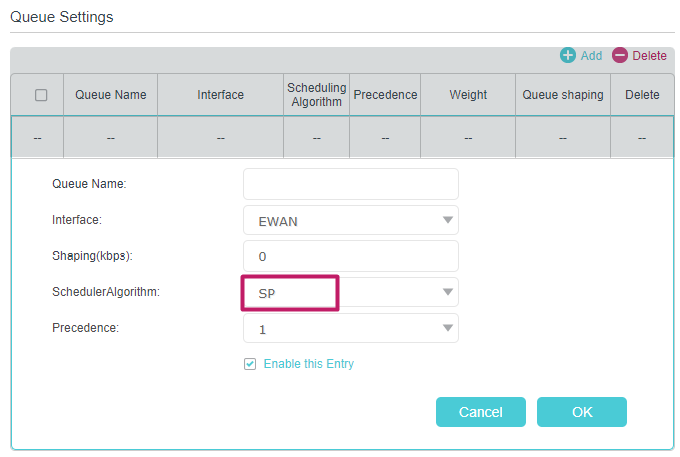
9 Enter queue's Weight if queue's algorithm is WRR.
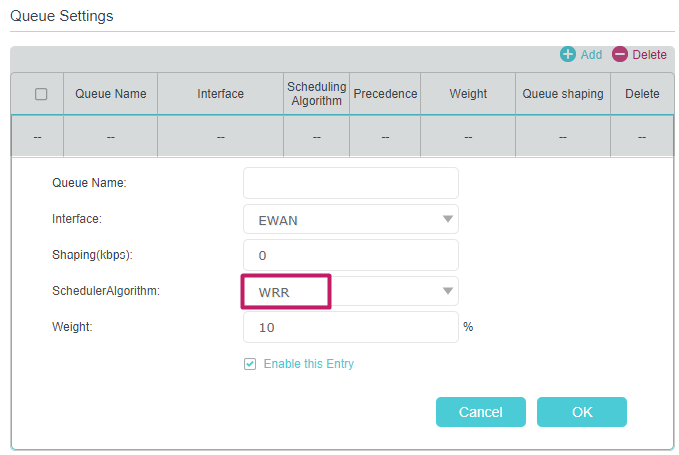
10 Click OK to save queue.
To delete a queue:
1 Visit http://tplinkmodem.net or http://192.168.1.1, and log in with the password you set for the GPON router.
2 Go to Advanced > QoS > Queue Settings.
3 In the queue list, select the corresponding checkbox of the queue to be deleted and click Delete above the table to delete multi queues, or click delete icon to delete one queue.
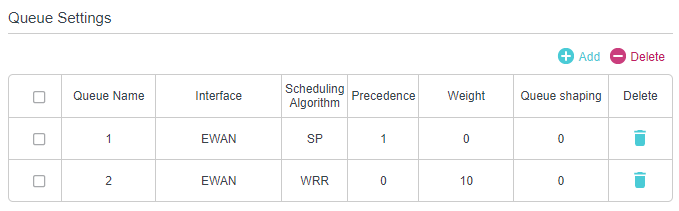
Configure Flow Classification
This page allows you to add classification rules to choose certain kind of packages to enter a queue. The classification of packages is based mainly on the differences of data link layer header, network layer header, transport layer header and so on.An option should be empty if you don’t want to use it for a classification.
To add a new classification:
1 Visit http://tplinkmodem.net or http://192.168.1.1, and log in with the password you set for the GPON router.
2 Go to Advanced > QoS > Flow Classification
3 Click Add to enter new information and configure more settings.
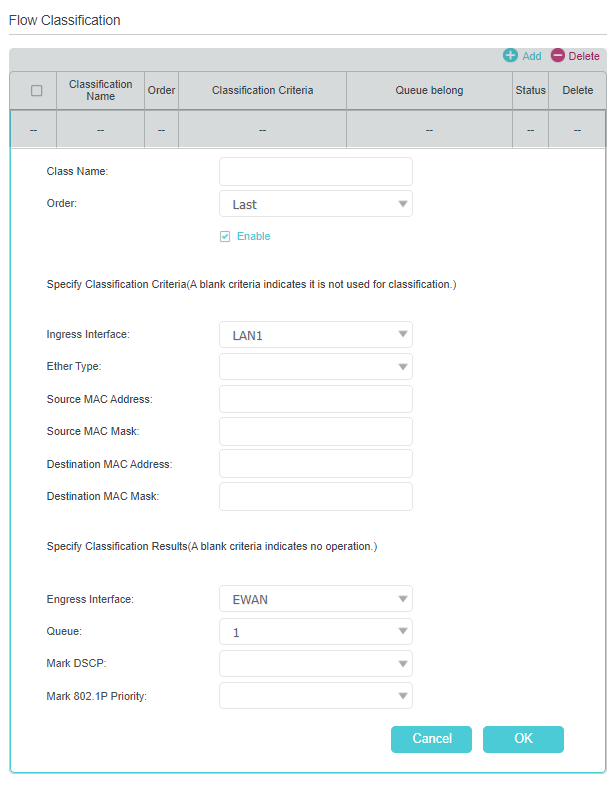
- Class Name: Each classification has a unique name as its identification.
- Order: Each packet can match only one flow classification. Matching is started from low order to high order.
- Ingress interface: Classification will only take effect at packets ingressing from this interface.
- Ether Type: Ethernet protocol for classification.
- Source MAC Address: Source mac address for classification. Source MAC Mask: Source mac mask for classification
- Destination MAC Address: Destination mac address for classification. Please note that only LAN mac address can take effect.
- Destination MAC Mask: Destination mac mask for classification. Source IP Address: Source ip address for classification.
- Source IP Mask: Source ip mask for classification.
- Destination IP Address: Destination ip address for classification. Destination IP Mask: Destination ip mask for classification.
- DSCP Check: Classification will only take effect at packets having this DSCP. Protocol: Classification will only take effect at packets of this protocol.
- Queue: Packets matching the classification will enter this queue.
- Mark DSCP: Packets matching the classification will be marked at DSCP field.
- Mark 802.1P Priority: Packets matching the classification will be marked at 802.1P field. Committed Rate: Set the maximum rate allowed for the flow.
- Committed Burst Size: Set the maximum traffic amount allowed to be transmitted in case of a burst of traffic.
Note: If you want to delete a classification, select the corresponding checkbox of the rules to be deleted in the classification list, and click Delete above the table to delete selected classifications, or click Delete icon to delete one classification.
To delete a queue:
1 Visit http://tplinkmodem.net or http://192.168.1.1, and log in with the password you set for the GPON router.
2 Go to Advanced > QoS > Flow Classification.
3 In the classification list, select the corresponding checkbox of the rules to be deleted and click Delete above the table to delete selected classifications, or click delete icon to delete one classification.
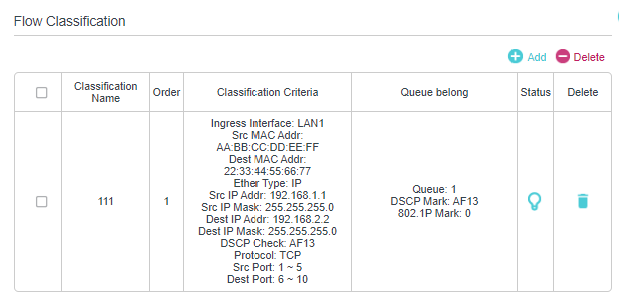
Network Security
This chapter guides you on how to protect your home network from unauthorized users by implementing network security functions. You can block or allow specific client devices to access your wireless network using MAC Filtering, or using Access Control for wired and wireless networks, or you can prevent ARP spoofing and ARP attacks by using IP & MAC Binding.
This chapter contains the following sections:
-
Firewall & DoS Protection
-
Service Filtering
-
Access Control
- IP & MAC Binding
Firewall & DoS Protection
The SPI (Stateful Packet Inspection) Firewall and DoS (Denial of Service) Protection protect the router from cyber attacks.
The SPI Firewall can prevent cyber attacks and validate the traffic that is passing through the router based on the protocol. This function is enabled by default, and it is recommended to keep the default settings.

DoS Protection can protect your home network against DoS attacks from flooding your network with server requests. Follow the steps below to configure DoS Protection.
1 Visit http://tplinkmodem.net or http://192.168.1.1, and log in with the password you set for the GPON router.
2 Go to Advanced > Security > Firewall & DoS Protection.
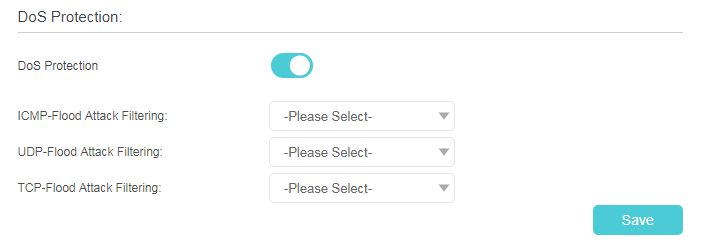
3 Enable DoS Protection.
4 Set the protection level (Low, Middle or High) for ICMP-Flood Attack Filtering, UDP- Flood Attack Filtering and TCP-Flood Attack Filtering.
-
ICMP-Flood Attack Filtering - Enable to prevent the ICMP (Internet Control Message Protocol) flood attack.
-
UDP-Flood Attack Filtering - Enable to prevent the UDP (User Datagram Protocol) flood attack.
- TCP-Flood Attack Filtering - Enable to prevent the TCP (Transmission Control Protocol) flood attack.
5 Click Save.
Tips:
-
The level of protection is based on the number of traffic packets. You can specify the level under DoS Protection Level Settings.
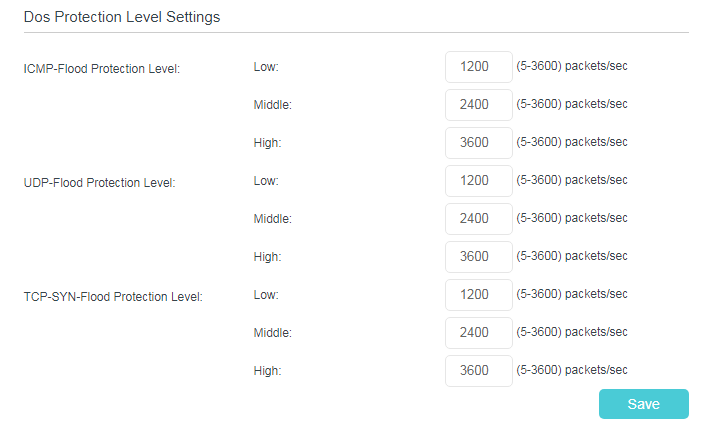
-
The protection will be triggered immediately when the number of packets exceeds the preset threshold value, and the vicious host will be displayed in the Blocked DoS Host List.
Service Filtering
With Service Filtering, you can prevent certain users from accessing the specified service, and even block internet access completely.
1 Visit http://tplinkmodem.net or http://192.168.1.1, and log in with the password you set for the GPON router.
2 Go to Advanced > Security > Service Filtering, and enable Service Filtering.

3 Click Add.
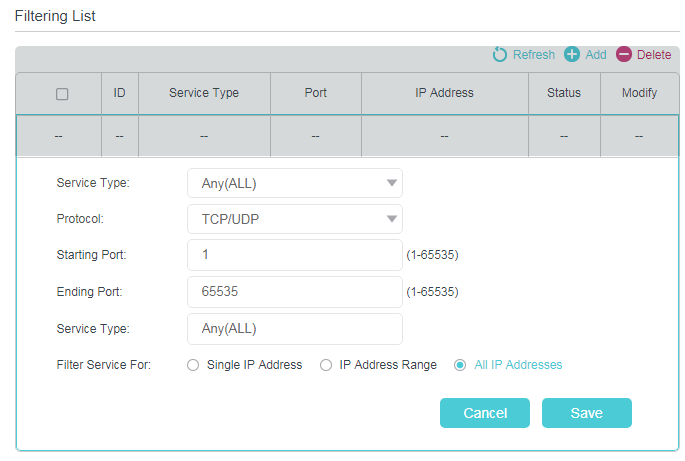
4 Select a Service Type from the drop-down list and the following four fields will be automatically filled in. Select Custom when your desired service type is not listed, and enter the information manually.
5 Specify the IP address(es) that this filtering rule will apply to.
6 Click Save to make the settings effective.
Note: If you want to disable an entry, click the Bulb icon.
Access Control
Access Control is used to block or allow specific client devices to access your network (via wired or wireless) based on a list of blocked devices (Blacklist) or a list of allowed devices (Whitelist).
I want to:
Block or allow specific client devices to access my network (via wired or wireless).
How can I do that?
1 Visit http://tplinkmodem.net or http://192.168.1.1, and log in with the password you set for the GPON router.
2 Go to Advanced > Security > Access Control and enable Access Control.

3 Select the access mode to either block (recommended) or allow the device(s) to access your network.
To block specific device(s):
-
) Select Blacklist and click Save.
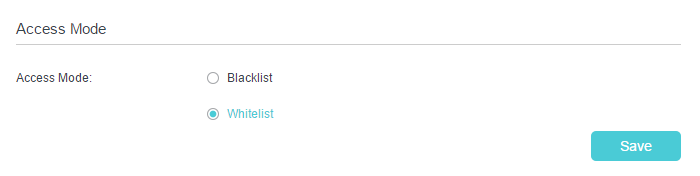
-
) Select the device(s) to be blocked in the Online Devices table (or click the Add under the Devices in Blacklist and enter the Device Name and MAC Address manually).
-
) Click Block above the Online Devices table. The selected devices will be added to Devices in Blacklist automatically.
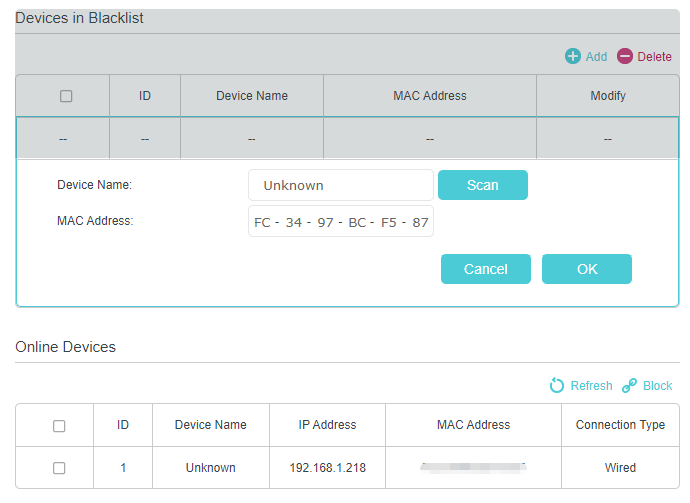
To allow specific device(s):
-
) Select Whitelist and click Save.
-
) Click Add in the Devices in Whitelist section.
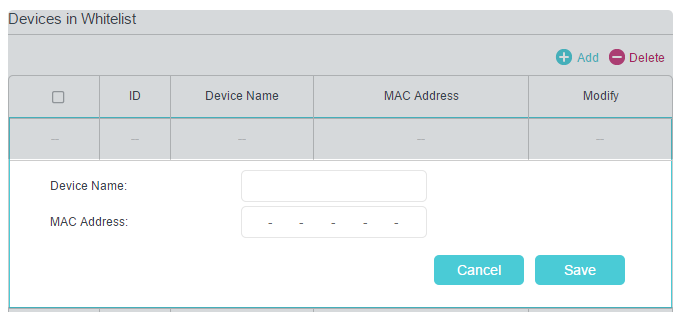
-
) Enter the Device Name and MAC Address. (You can copy and paste the information from Online Devices table if the device is connected to your network.)
-
) Click Save.
Done!
Now you can block or allow specific client devices to access your network (via wired or wireless) by Blacklist or Whitelist.
IP & MAC Binding
IP & MAC Binding, namely, ARP (Address Resolution Protocol) Binding, is used to bind a network device’s IP address to its MAC address. This will prevent ARP spoofing and other ARP attacks by denying network access to a device with a matching IP address in the Binding list, but an unrecognized MAC address.
I want to:
Prevent ARP spoofing and ARP attacks.
How can I do that?
1 Visit http://tplinkmodem.net or http://192.168.1.1, and log in with the password you set for the GPON router.
2 Go to Advanced > Security > IP & MAC Binding, and enable IP & MAC Binding.
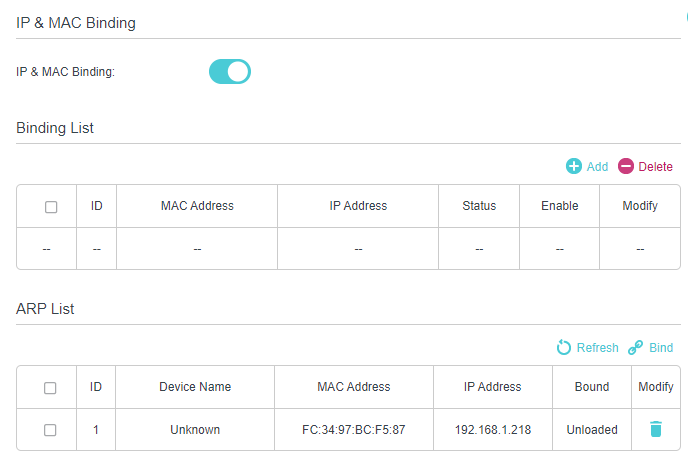
3 Bind your device(s) according to your needs.
To bind the connected device(s):
1 ) Select the device(s) to be bound in the ARP List.
2 ) Click Bind to add to the Binding List.
To bind the unconnected device:
1) Click Add in the Binding List section.
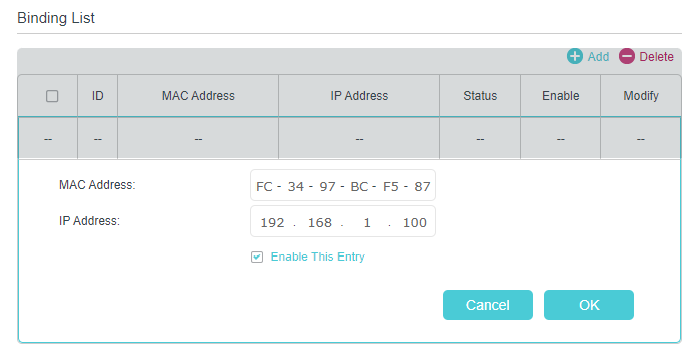
2) Enter the MAC address and IP address that you want to bind.
3) Select the Enable This Entry check box to enable the entry and click Save.
Done!
Enjoy the internet without worrying about ARP spoofing and ARP attacks.
VPN Server&Client
The router offers several ways to set up VPN connections:
VPN Server allows remote devices to access your home network in a secured way through the internet. The router supports three types of VPN Server:
OpenVPN is somewhat complex but with higher security and more stability, suitable for restricted environments such as campus network and company intranet.
PPTP VPN is easy to use with the built-in VPN software of computers and mobile devices, but it is vulnerable and may be blocked by some ISPs.
L2TP/IPSec VPN is more secure but slower than PPTP VPN, and may have trouble getting around firewalls.
VPN Client allows devices in your home network to access remote VPN servers, without the need to install VPN software on each device.
This chapter contains the following sections:
-
Use OpenVPN to Access Your Home Network
-
Use PPTP VPN to Access Your Home Network
-
Use IPSec VPN to Access Your Home Network
-
VPN Connections
Use OpenVPN to Access Your Home Network
OpenVPN Server is used to create an OpenVPN connection for remote devices to access your home network.
To use the VPN feature, you need to enable OpenVPN Server on your router, and install and run VPN client software on remote devices. Please follow the steps below to set up an OpenVPN connection.
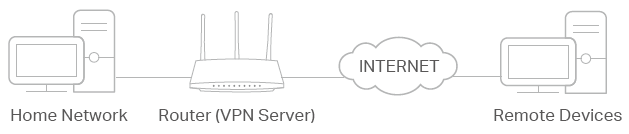
Step1. Set up OpenVPN Server on Your Router
1 Visit http://tplinkmodem.net or http://192.168.1.1, and log in with the password you set for the GPON router.
2 Go to Advanced > VPN > OpenVPN, and tick the box of Enable VPN Server.
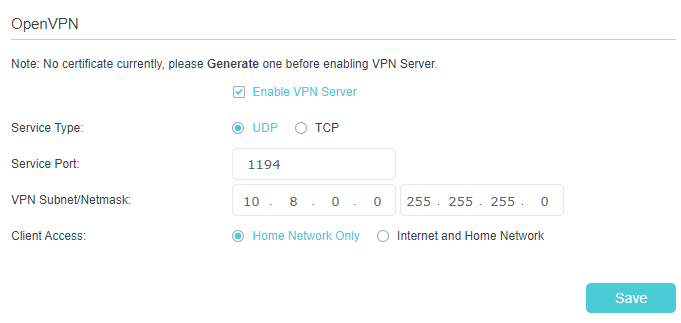
Note:
• Before you enable VPN Server, we recommend you configure Dynamic DNS Service (recommended) or assign a static IP address for router’s WAN port and synchronize your System Time with internet.
• The first time you configure the OpenVPN Server, you may need to generate a certificate before you enable the VPN Server.
3 Select the Service Type (communication protocol) for OpenVPN Server: UDP, TCP.
4 Enter a VPN Service Port to which a VPN device connects, and the port number should be between 1024 and 65535.
5 In the VPN Subnet/Netmask fields, enter the range of IP addresses that can be leased to the device by the OpenVPN server.
6 Select your Client Access type. Select Home Network Only if you only want the remote device to access your home network; select Internet and Home Network if you also want the remote device to access internet through the VPN Server.
7 Click SAVE.
8 Click GENERATE to get a new certificate.

Note: If you have already generated one, please skip this step, or click GENERATE to update the certificate.
9 Click EXPORT to save the OpenVPN configuration file which will be used by the remote device to access your router.
Step 2 Configure OpenVPN Connection on Your Remote Device
1 Visit http://openvpn.net/index.php/download/community-downloads.html to download the OpenVPN software, and install it on your device where you want to run the OpenVPN client utility.
Note: You need to install the OpenVPN client utility on each device that you plan to apply the VPN function to access your router. Mobile devices should download a third-party app from Google Play or Apple App Store.
2 After the installation, copy the file exported from your router to the OpenVPN client utility’s “config” folder (for example, C:\Program Files\OpenVPN\config on Windows). The path depends on where the OpenVPN client utility is installed.
3 Run the OpenVPN client utility and connect it to OpenVPN Server.
Use PPTP VPN to Access Your Home Network
PPTP VPN Server is used to create a PPTP VPN connection for remote devices to access your home network.
To use the VPN feature, you need to set up PPTP VPN Server on your router, and configure the PPTP connection on remote devices. Please follow the steps below to set up a PPTP VPN connection.
Step 1 Set up PPTP VPN Server on Your Router
1 Visit http://tplinkmodem.net or http://192.168.1.1, and log in with the password you set for the GPON router.
2 Go to Advanced > VPN > PPTP VPN, and tick the box of Enable VPN Server.
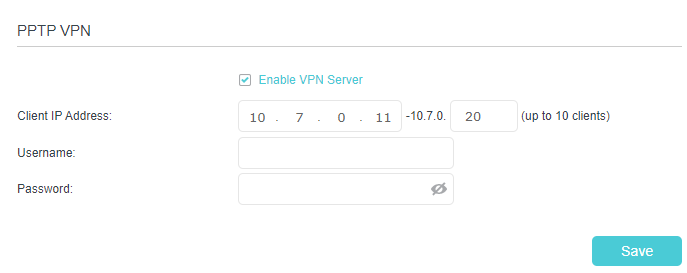
Note: Before you enable VPN Server, we recommend you configure Dynamic DNS Service (recommended) or assign a static IP address for router’s WAN port and synchronize your System Time with internet.
3 In the Client IP Address field, enter the range of IP addresses (up to 10) that can be leased to the devices by the PPTP VPN server.
4 Enter the Username and Password to authenticate clients to the PPTP VPN server.
5 Click SAVE.
6 On the client devices, create a PPTP VPN connection. The official supported platforms include Windows, Mac OSX, Linux, iOS, and Android.
7 Launch the PPTP VPN program, add a new connection and enter the domain name of the registered DDNS service or the static IP address that is assigned to the WAN port, to connect the client device to the PPTP VPN server.
Step 2 Configure PPTP VPN Connection on Your Remote Device
The remote device can use the Windows built-in PPTP software or a third-party PPTP software to connect to PPTP Server. Here we use the Windows built-in PPTP software as an example.
1 Go to Start > Control Panel > Network and Internet > Network and Sharing Center.
2 Select Set up a new connection or network.
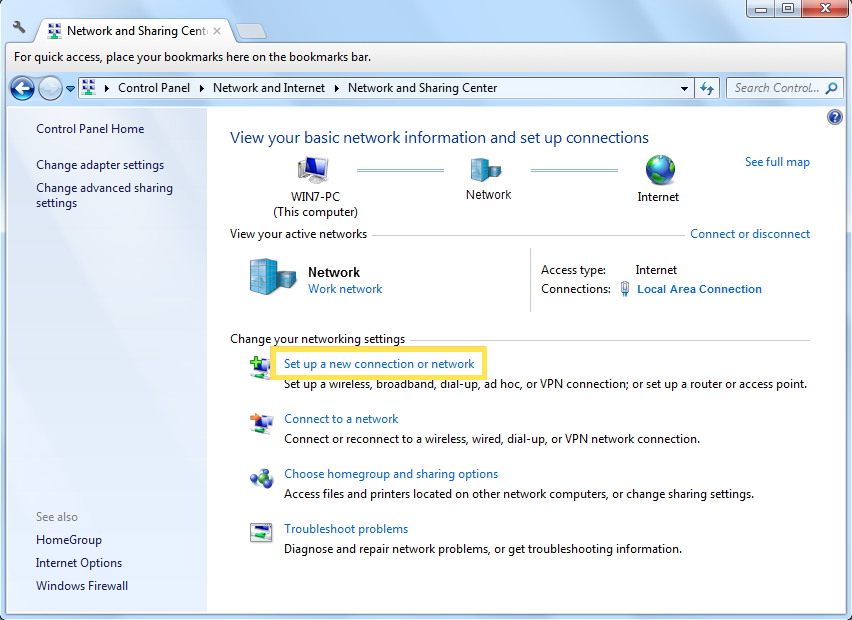
3 Select Connect to a workplace and click Next.
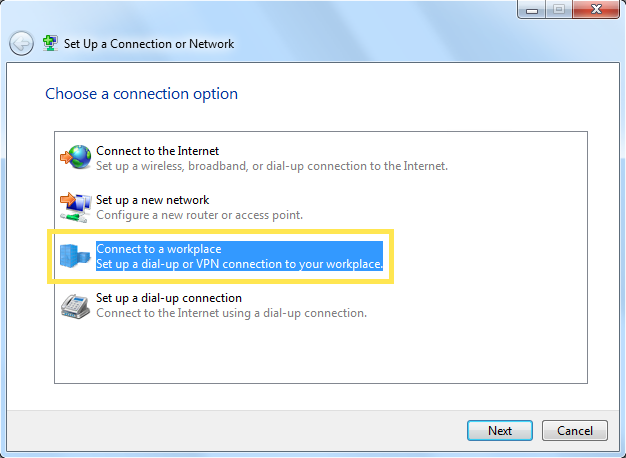
4 Select Use my Internet connection (VPN).
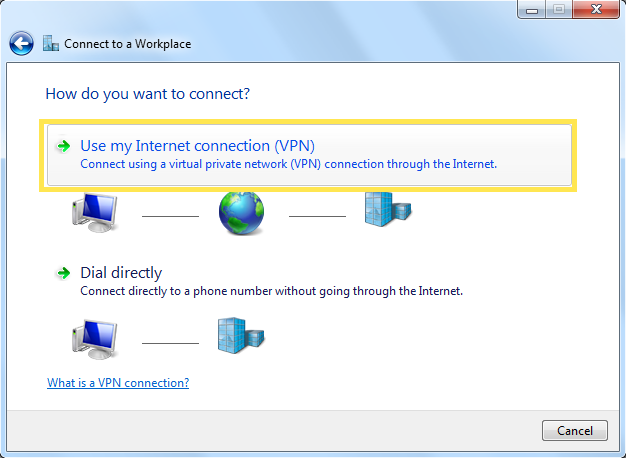
5 Enter the internet IP address of the router (for example: 218.18.1.73) in the Internet address field. Click Next.
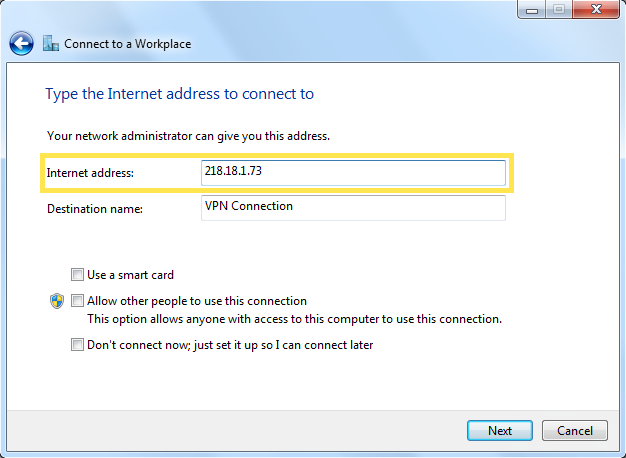
6 Enter the User name and Password you have set for the PPTP VPN server on your router, and click Connect.
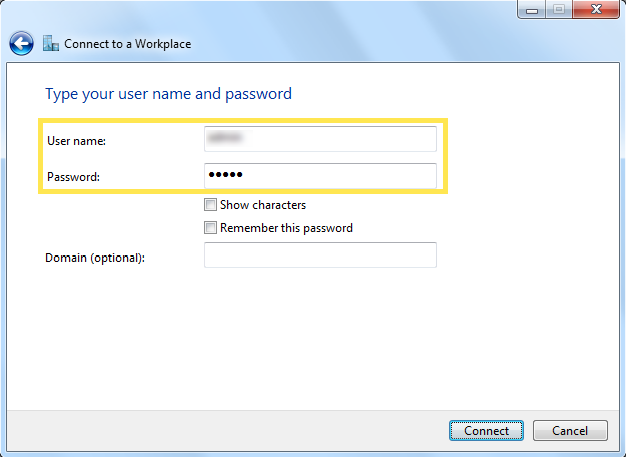
7 Click Connect Now when the VPN connection is ready to use.
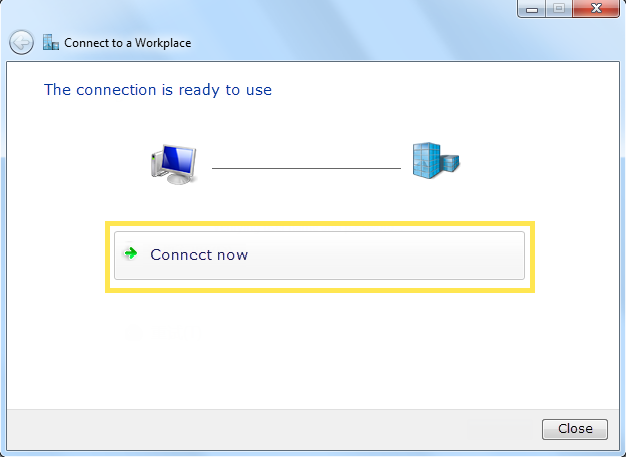
Use IPSec VPN to Access Your Home Network
IPSec VPN Server is used to create a IPSec VPN connection for remote devices to access your home network.
To use the VPN feature, you need to set up IPSec VPN Server on your router, and configure theIPSec connection on remote devices. Please follow the steps below to set up the IPSec VPN connection.
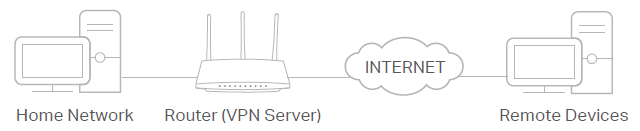
Step 1. Set up IPSec VPN Server on Your Router
1. Visit http://tplinkmodem.net or http://192.168.1.1, and log in with the password you set for the GPON router.
2. Go to Advanced > VPN > IPSec VPN, and enable Dead Peer Detection.
Note:
• Firmware update may be required to support IPSec VPN Server.
• Before you enable Dead Peer Detection, we recommend you configure Dynamic DNS Service (recommended) or assign a static IP address for router’s WAN port and synchronize your System Time with internet.
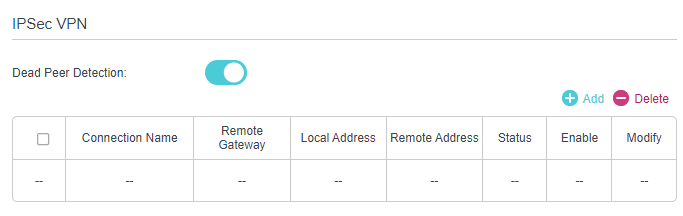
3. Click Add.
4. Configure the IPSec VPN server parameters.
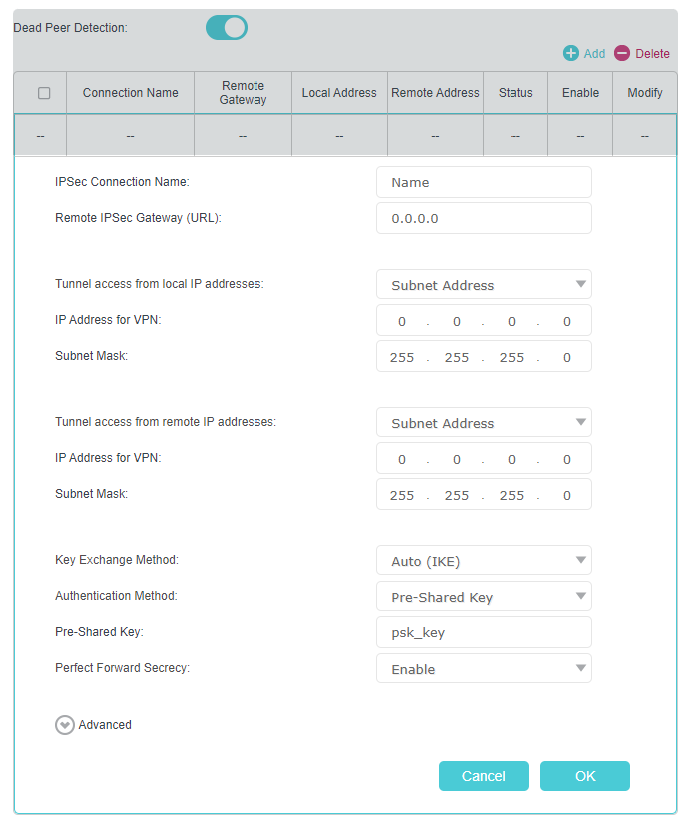
5. Configure the advanced settings according to the following explanation. We recommend that you keep the default settings. If you want to change these settings, make sure that both VPN server endpoints use the same Encryption Algorithm, Integrity Algorithm, Diffie-Hellman Group and Key Lifetime in both phase1 and phase2.
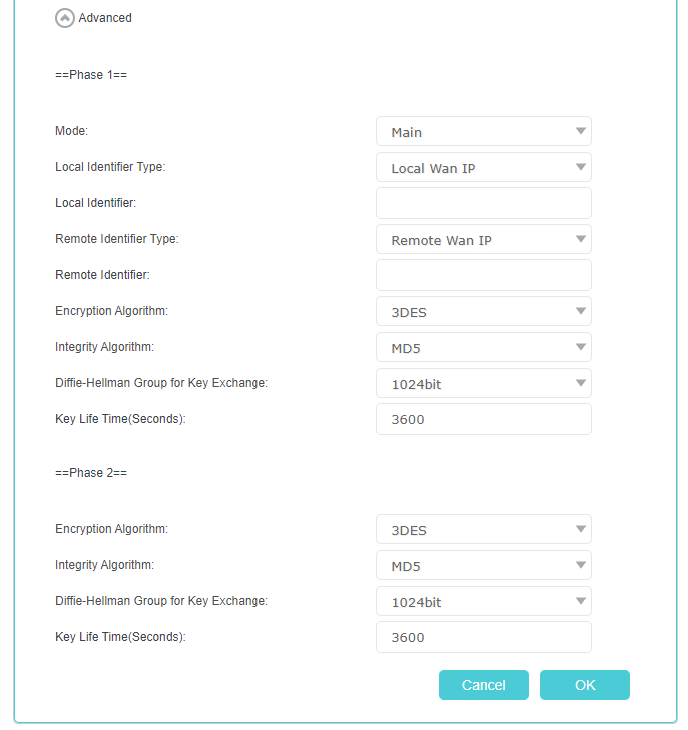
6. Click OK.
Note: For the comprehensive guide, please refer to the User Guide on the product’s support page.
Step 2.Configure IPSec VPN Connection on Your Remote Device
The remote device can use the Windows or Mac OS built-in IPSec software or a third- party IPSec software to connect to IPSec Server. Here we use the Windows built-in IPSec software as an example.
1 Go to Start > Control Panel > Network and Internet > Network and Sharing Center.
2 Select Set up a new connection or network.
3 Select Connect to a workplace and click Next.
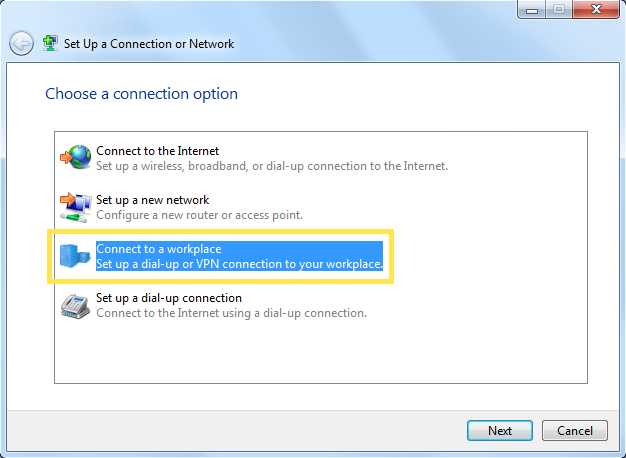
4 Select Use my Internet connection (VPN).
5 Enter the internet IP address of the router (for example: 218.18.1.73) in the Internet address field, and select the checkbox Don’t connect now; just set it up so I can connect later. Click Next.
6 Enter the User name and Password you have set for the IPSec VPN server on your router, and click Connect.
7 Click Close when the VPN connection is ready to use
8 Go to Network and Sharing Center and click Change adapter settings.
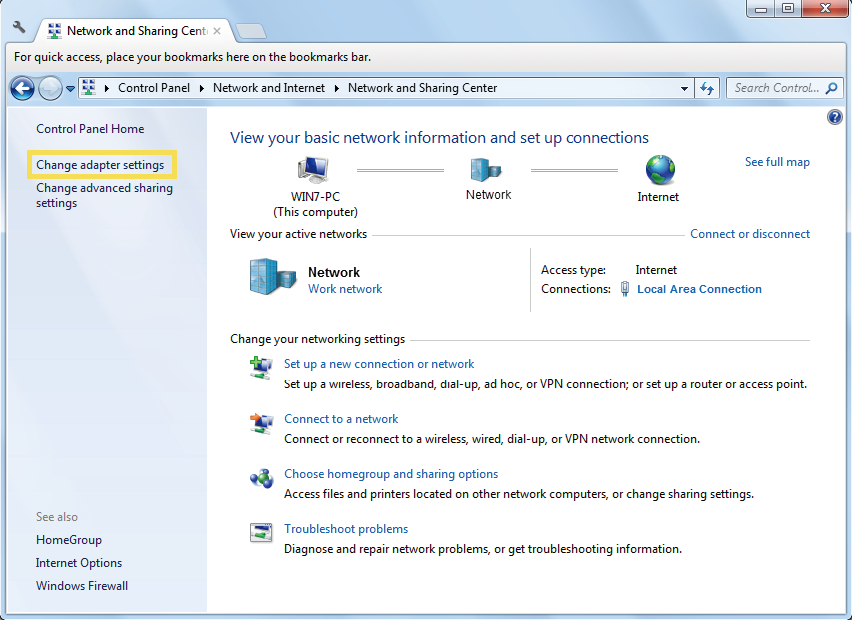
9 Find the VPN connection you created, then double-click it.
10 Enter the User name and Password you have set for the IPSec VPN server on your router, and click Properties.
11 Switch to the Security tab, select Layer 2 Tunneling Protocol with IPsec (L2TP/ IPSec) and click Advanced settings.
12 Select Use preshared key for authentication and enter the IPSec Pre-Shared Key you have set for the IPSec VPN server on your router. Then click OK.
Done! Click Connect to start VPN connection.
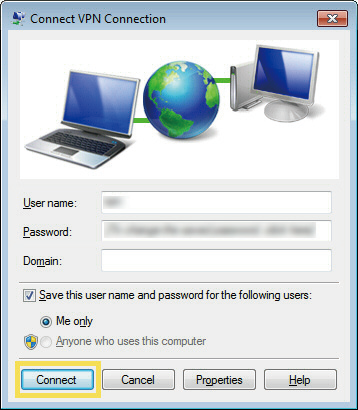
VPN Connections
VPN Connections page displays the clients that are currently connected to the OpenVPN servers, PPTP VPN servers and IPSec VPN hosted on the router.
1 Visit http://tplinkmodem.net or http://192.168.1.1, and log in with the password you set for the GPON router.
2 Go to Advanced > VPN > VPN connections.
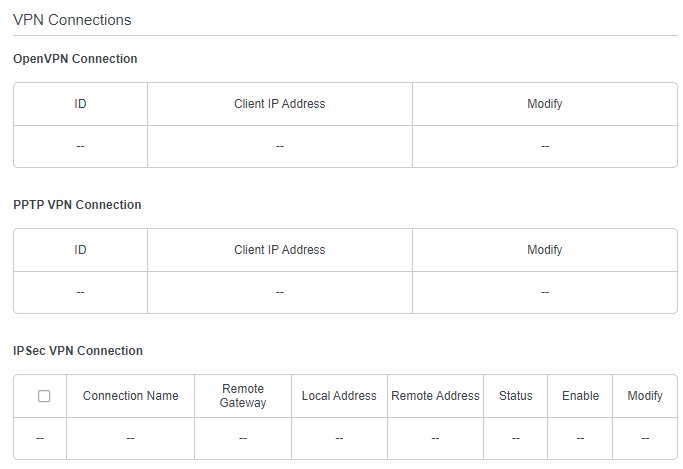
Manage Your GPON Router
This chapter introduces how to change the system settings and administrate your router’s network.
This chapter contains the following sections:
-
Set System Time
-
Control the LED
-
Test Internet Connectivity
-
Update the Firmware
-
Back Up and Restore Configuration Settings
-
Reboot the GPON Router
-
Administration Management
-
System Log
-
CWMP Settings
-
SNMP Settings
-
Monitor the Internet Traffic Statistics
Set System Time
System time is the time displayed while the router is running. The system time you configure here will be used for other time-based functions like Parental Controls and Wireless Schedule. You can manually set how to get the system time.
Follow the steps below to set your system time.
1 Visit http://tplinkmodem.net or http://192.168.1.1, and log in with the password you set for the GPON router.
2 Go to Advanced > System Tools > Time Settings page.
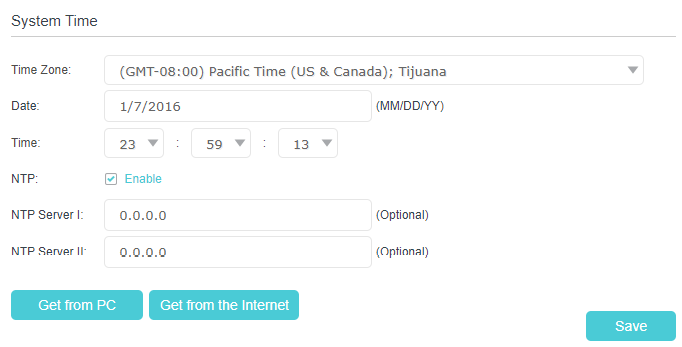
3 Configure the system time using the following methods:
- Get from PC: Click this button if you want to use the current time of your PC.
- Get from the Internet: Click this button if you want to get time from the internet. Make sure your router can access the internet before you select this way to get system time.
4 Click Save.
5 After setting the system time, you can set Daylight Saving Time according to your needs. Enable Daylight Saving Time, and set the start and end time and then click Save to make the settings effective.
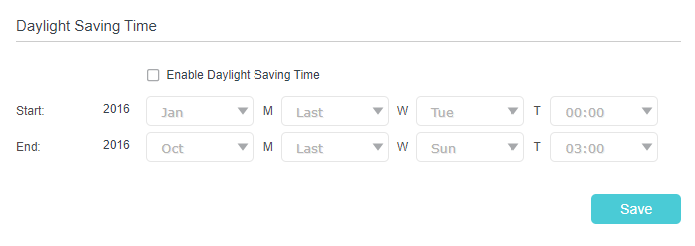
Control the LED
The LED of the router indicates its activities and status. You can enable the Night Mode feature to specify a time period during which the LED is off.
1 Visit http://tplinkmodem.net or http://192.168.1.1, and log in with the password you set for the GPON router.
2 Go to Advanced > System > LED Control.
3 Enable Night Mode.
4 Specify the LED off time, and the LED will be off during this period every day.
5 Click SAVE.
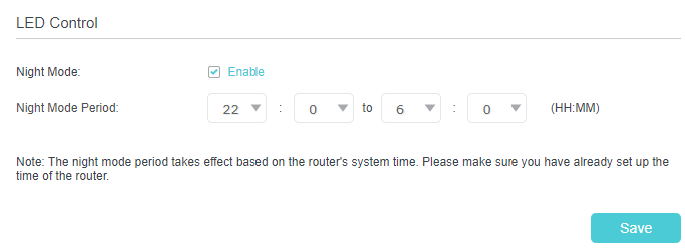
Test Internet Connectivity
Diagnostics function is used to test the connectivity between the router and the host or other network devices.
1 Visit http://tplinkmodem.net or http://192.168.1.1, and log in with the password you set for the GPON router.
2 Go to Advanced > System Tools > Diagnostics page.
To test the internet connection of the router:
Locate the Diagnostic Tools section, and click the Start to test the internet connectivity and you will find the test results in the gray box.
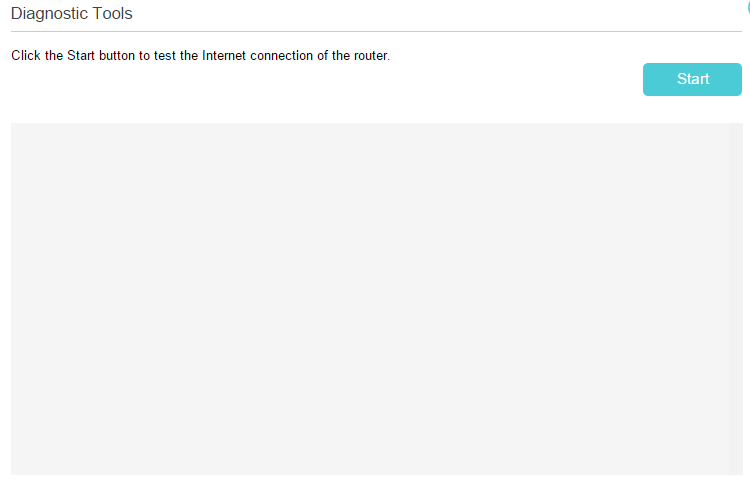
Update the Firmware
TP-Link is dedicated to improving product features, giving you a better network experience.
We will inform you through the web management page if there’s any update firmware available for your router. The latest firmware can also be downloaded from the Support page of our website www.tp-link.com for free.
Note:
- Make sure that you have a stable connection between the router and your computer. It is NOT recommended to upgrade the firmware wirelessly.
- Back up your router configuration before upgrading the firmware.
- DO NOT turn off the router during the firmware upgrade.
Follow the steps below to upgrade the firmware online:
1 Click Check for Upgrades.
2 If a new firmware is displayed, click Upgrade and click Yes when prompted, then the router will automatically download the latest firmware file and upgrade.
Follow the steps below to manually update the firmware:
1 Download the latest firmware file for the router from our website www.tp-link.com.
2 Visit http://tplinkmodem.net or http://192.168.1.1, and log in with the password you set for the GPON router.
3 Go to Advanced > System Tools > Firmware Upgrade.
4 Focus on the Device Information section. Make sure the downloaded firmware file matches with the Hardware Version.
5 Focus on the Local Upgrade section. Click Browse to locate the downloaded new firmware file, and click Upgrade.
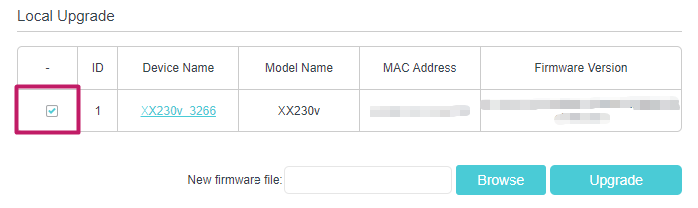
6 Wait a few minutes for the upgrading and rebooting.
Back Up and Restore Configuration Settings
The configuration settings are stored as a configuration file in the router. You can back up the configuration file to your computer for future use and restore the router to a previous settings from the backup file when needed. Moreover, if needed you can erase the current settings and reset the router to its default factory settings.
1 Visit http://tplinkmodem.net or http://192.168.1.1, and log in with the password you set for the GPON router.
2 Go to Advanced > System Tools > Backup & Restore.
To back up configuration settings:
Click Backup to save a copy of the current settings to your local computer. A conf.bin file will be stored to your computer.

To restore configuration settings:
1 Click Browse to locate the previous backup configuration file, and click Restore.
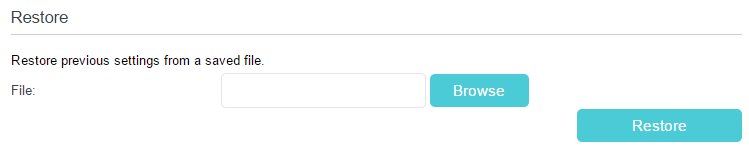
2 Wait a few seconds for the restoring and rebooting.
To reset the router to factory default settings:
1 Locate the Factory Default Restore section, and click Factory Restore to reset the router.
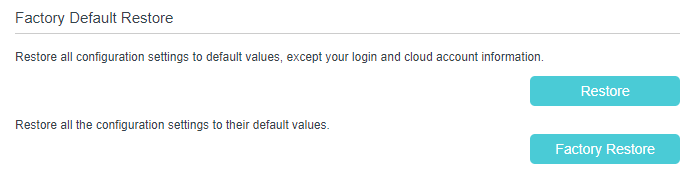
2 Wait a few minutes for the resetting and rebooting.
Note:
- During the resetting process, do not turn off the router.
- We strongly recommend you back up the current configuration settings before resetting the router
Reboot the GPON Router
The Reboot feature cleans the cache to enhance the running performance of the router. You can reboot the router manually or set it to reboot regularly.
1 Visit http://tplinkmodem.net or http://192.168.1.1, and log in with the password you set for the GPON router.
2 Go to Advanced > System Tools > Reboot Schedule, and you can restart your router.
To reboot the router manually:
Click Reboot, and wait a few minutes for the router to rebooting.

To schedule the router to reboot at a specific time:
1 Enable Auto Reboot.
2 Specify the Time when the router reboots.
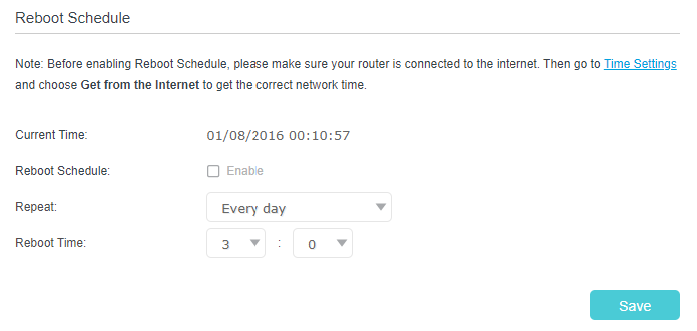
3 Click Save to make the settings effective.
Some settings of the router may take effect only after rebooting, including:
- Change the LAN IP Address (system will reboot automatically).
- Change the Operation Mode (system will reboot automatically).
- Upgrade the firmware of the router (system will reboot automatically).
- Restore the router to its factory defaults (system will reboot automatically).
- Update the configuration with the file (system will reboot automatically).
Note: The Auto Reboot feature takes effect based on the router’s system time. Please make sure you have already set up the time of the router.
Administration Management
Change the Login Password
A login password is required to log in to the router’s web management page. You are asked to set a login password at first login. You can change it with the account management feature.
1 Visit http://tplinkmodem.net or http://192.168.1.1, and log in with the password you set for the GPON router.
2 Go to Advanced > System Tools > Administration, and locate the Account Management section.
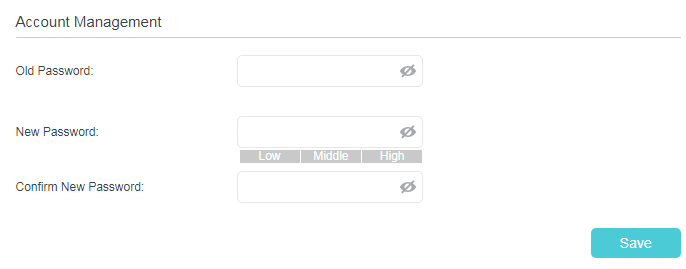
3 Enter the old password and a new password twice (both case-sensitive).
4 Click Save to make the settings effective.
Local Management
You can control the local devices’ authority to manage the router via Local Management feature. By default all local connected devices are allowed to manage the router. You can also specify one device to manage the router and enable local management over a more secure way, HTTPS.
Follow the steps below to allow only the specific device to manage the router via the local management over HTTPS.
1 Visit http://tplinkmodem.net or http://192.168.1.1, and log in with the password you set for the GPON router.
2 Go to Advanced > System Tools > Administration, and locate the Local Management section.
3 Enable Local Management over HTTPS and keep the Port for HTTP and Port for HTTPS as the default settings. Enter the IP address or MAC address of the local device to manage the router.
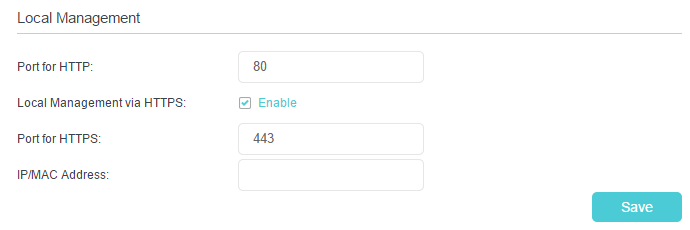
4 Click Save.
Now, you can manage the GPON router over both HTTP (http://tplinkmodem.net) and HTTPS (https://tplinkmodem.net).
Note: If you want all local devices can manage the router, just leave the IP/MAC Address field blank.
Remote Management
By default, the remote devices are not allowed to manage the router from the internet. You can enable remote management over HTTP and/or HTTPS if needed. HTTPS is a more secure way to access the router.
Note: If your ISP assigns a private WAN IP address (such as 192.168.x.x or 10.x.x.x), you cannot use the remote management feature because private addresses are not routed on the internet.
Follow the steps below to allow remote devices to manage the router over HTTPS.
1 Visit http://tplinkmodem.net or http://192.168.1.1, and log in with the password you set for the GPON router.
2 Go to Advanced > System Tools > Administration, and locate the Remote Management section.
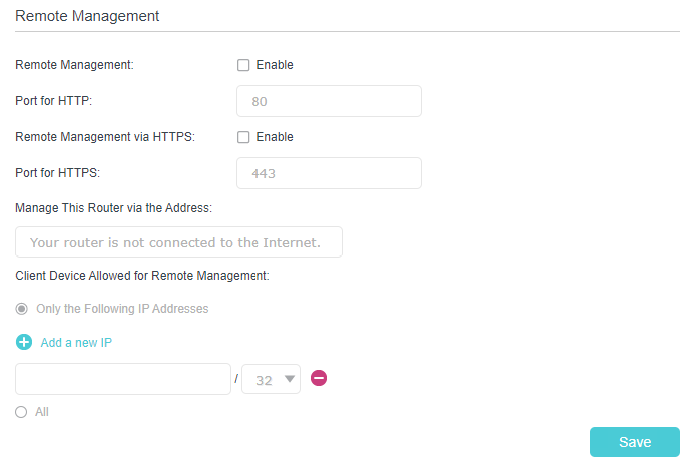
3 Enable Remote Management and Remote Management via HTTPS to allow for HTTPS connection. Keep the Port as the default setting.
4 Set the client device allowed for remote management. Select All to allow all remote devices to manage the router. If you just want to allow a specific device to manage the router, select Only the Following IP/MAC Address and enter the IP/MAC address of the remote device.
5 Click Save.
All devices or the specific device on the internet can log in to your router using the address displayed on the Manage This Router via the Address field to manage the router.
Tips:
-
If you were warned about the certificate when visiting the web management page remotely, click Trust (or a similar option) to continue. To avoid this warning, you can download and install the certificate on the router’s web management page at Advanced > System Tools > Administration.

-
The router’s WAN IP is usually a dynamic IP. Please refer to Set Up a Dynamic DNS Service Account if you want to log in to the router through a domain name.
HTTP Referer Head Check
HTTP referer header check function can protect your networks against CSRF attacks. This function is enabled by default. You can disable this function if needed.
1 Visit http://tplinkmodem.net or http://192.168.1.1, and log in with the password you set for the GPON router.
2 Go to Advanced > System Tools > Administration, and locate the HTTP Referer Head Check section.
3 Clear the Enable check box and click Save if you want to disable this function.

ICMP Ping
ICMP (Internet Control Message Protocol) Ping is used to diagnose the network by sending ICMP echo request packets to the target remote or local host and waiting for an ICMP response.
You can control the router’s replies to ICMP Ping requests.
1 Visit http://tplinkmodem.net or http://192.168.1.1, and log in with the password you set for the GPON router.
2 Go to Advanced > System Tools > Administration, and locate the ICMP Ping section.

3 Specify the ICMP Ping reply options.
- Remote: Select it if you want the computers on a public network to ping the router’s WAN IP address.
- Local: Enabled by default, if enabled, the computers on a private network can ping the router’s LAN IP address.
4 Click Save to make the settings effective.
Session ID
When Session ID function is enabled, it will be saved into Flash every time the PPP connection is updated. This can prevent some problems of PPPoE/L2TP/PPTP connection being rejected to reconnect to servers when the device is powered off or the network disconnect accidentally.
1 Visit http://tplinkmodem.net or http://192.168.1.1, and log in with the password you set for the GPON router.
2 Go to Advanced > System Tools > Administration, and locate the Session ID section.

3 Enable the Update Session ID and Click Save to make the settings effective.
System Log
System Log can help you know what happened to your router, facilitating you to locate the malfunctions. For example when your router does not work properly, you may need to save the system log and send it to the technical support for troubleshooting.
1 Visit http://tplinkmodem.net or http://192.168.1.1, and log in with the password you set for the GPON router.
2 Go to Advanced > System Tools > System Log page.
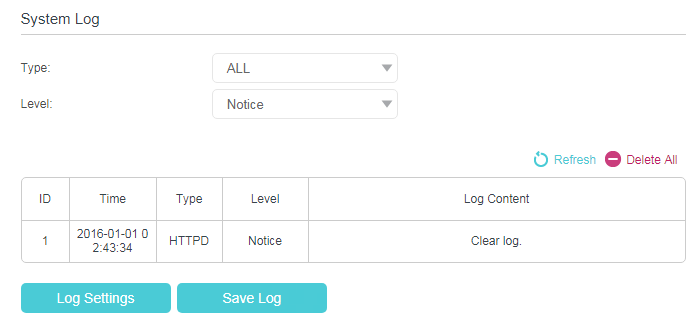
To view the system logs:
You can view specific system logs by selecting the log type and level. Click Refresh to refresh the log list.
To save the system logs:
You can save the system logs to your local computer or a remote server
Click Save Log to save the logs in a txt file to your computer.
Click Log Settings to set the storage path of logs.
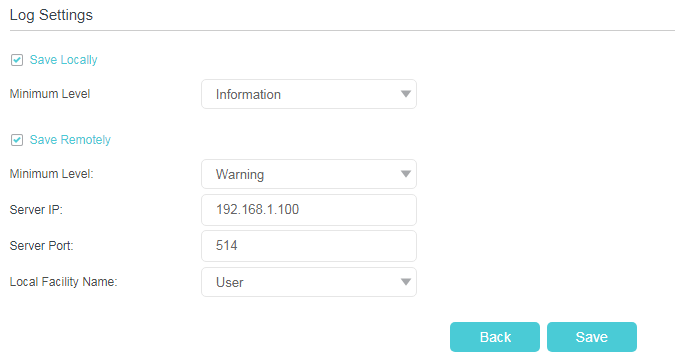
- Save Locally: Select this option to cache the system log to the router’s local memory, select the minimum level of system log to be saved from the drop-down list. The logs will be shown in the table in descending order on the System Log page.
- Save Remotely: Select this option to send the system log to a remote server, select the minimum level of system log to be saved from the drop-down list and enter the information of the remote server. If the remote server has a log viewer client or a sniffer tool implemented, you can view and analyze the system log remotely in real-time.
CWMP Settings
The router supports CWMP (CPE WAN Management Protocol), also called TR-069. This collects information, performs diagnostics and configures the devices automatically via ACS (Auto-Configuration Server).
1 Visit http://tplinkmodem.net or http://192.168.1.1, and log in with the password you set for the GPON router.
2 Go to Advanced > System Tools > CWMP Settings page.
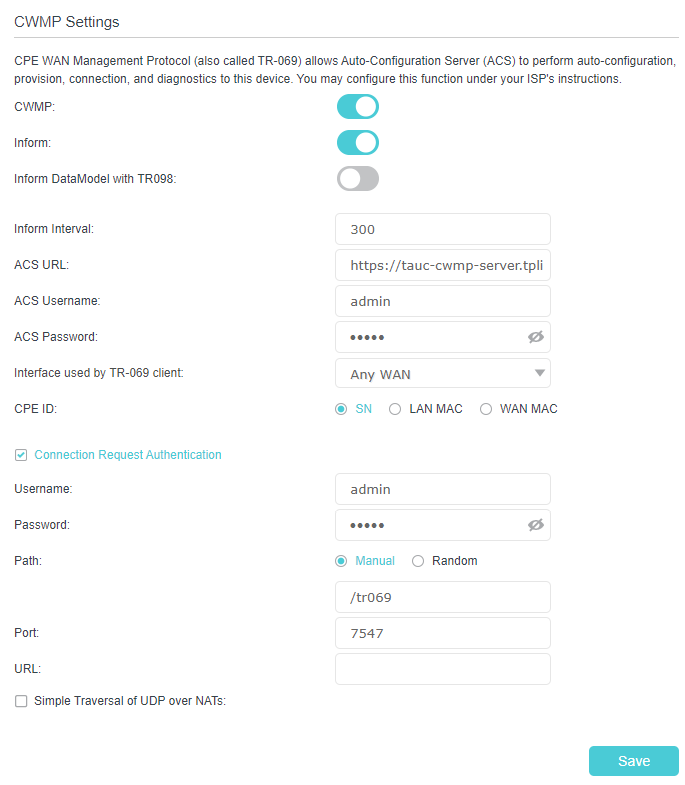
- CWMP: Enable or disable the CWMP (CPE WAN Management Protocol) function.
- Inform: Enable or disable the function of sending an inform message to the ACS (Auto Configuration Server) periodically.
- Inform Interval: Set the time interval in seconds when the Inform message will be sent to the ACS.
- ACS URL: Enter the web address of the ACS which is provided by your ISP.
- ACS Username/Password: Enter the username/password to log in to the ACS server.
- Interface used by TR-069 client: Select which interface to be used by the TR-069 client.
- Display SOAP messages on serial console: Enable or disable this function.
- Connection Request Authentication: Select this check box to enable authentication for the connection request.
- Username/Password: Enter the username/password for the ACS server to log in to the router.
- Path: Enter the path for the ACS server to log in to the router.
- Port: Enter the port that connects to the ACS server.
- URL: Enter the URL that connects to the ACS server.
- Simple Traversal of UDP over NATs: Select this check box to enable STUN for the connection request and set the STUN maximum and minimum keep alive period, server address and port.
Click Save to make the settings effective.
SNMP Settings
SNMP (Simple Network Management Protocol) is widely used in network management for network monitoring. It allows management applications to retrieve status updates and statistics from the SNMP agent within this device. In this way, network administrators can easily search and modify the information on any node on the network. Meanwhile, they can locate faults promptly and implement the fault diagnosis, capacity planning and report generating.
The SNMP Agent is an application running on the router that performs the operational role of receiving and processing SNMP messages, sending responses to the SNMP manager, and sending traps when an event occurs. So a router contains SNMP “agent” software can be monitored and/or controlled by SNMP Manager using SNMP messages.
1 Visit http://tplinkmodem.net or http://192.168.1.1, and log in with the password you set for the GPON router.
2 Go to Advanced > System Tools > SNMP Settings page.
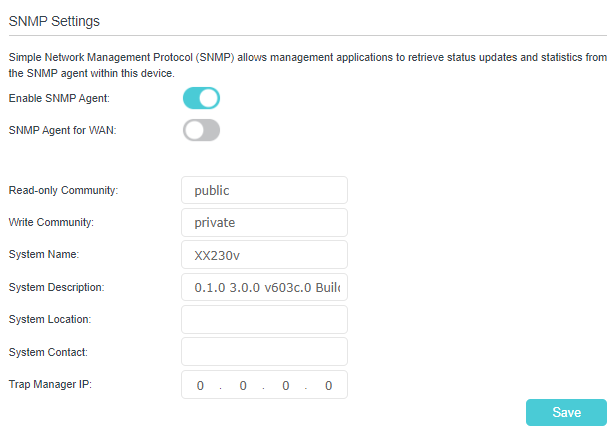
- SNMP Agent/SNMP Agent for WAN: Turn on to enable the built-in SNMP agent that allows the router to operate as the operational role in receiving and processing of SNMP messages, sending responses to the SNMP manager, and triggering SNMP traps when an event occurs.
- Read-only Community: Displays the default public community string that protects the router from unauthorized access.
- Write Community: Displays the default write community string that protects the router from unauthorized changes.
- System Name: Displays the administratively-assigned name for this managed device.
- System Description: Displays the textual description of the managed device. This value should include the full name and version identification of the system’s hardware type, software operating-system, and networking software.
- System Location: Displays the physical location of this device (for example, the telephone closet, 3rd floor).
- System Contact: Displays the textual identification of the contact person for this managed device, together with information on how to contact this person.
- Trap Manager IP: Displays the IP address of the host to receive the traps.
You are suggested to keep the default settings. Click Save to make the settings effective.
Monitor the Internet Traffic Statistics
The traffic statistics function allows you to monitor the volume of internet traffic statistics. You can view the network traffic of the LAN, WAN and WLAN sent and received packets.
1 Visit http://tplinkmodem.net or http://192.168.1.1, and log in with the password you set for the GPON router.
2 Go to Advanced > System Tools > Traffic Statistics.
3 Turn on Enable Traffic Statistics to enable traffic statistics function, you can view the total number of packets and bytes received and transmitted by the router within the selected Statistics Interval. This function is disabled by default.
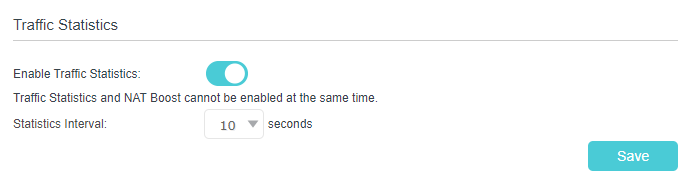
4 You can refer to Traffic Statistics List for the detailed information about the traffic usage of all devices.
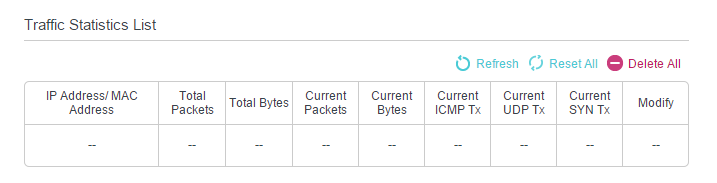
FAQ
Q1 What should I do if I forget my wireless password?
The default wireless password is printed on the label of the router. If the password has been altered:
1 Connect your computer to the router using an Ethernet cable.
2 Visit http://tplinkmodem.net or http://192.168.1.1, and log in with the password you set for the GPON router.
3 Go to Wireless to retrieve or reset your wireless password.
Q2 What should I do if I forget my web management password?
If you are using a TP-Link ID to log in, or you have enabled the Password Recovery feature of the router, click Forgot password on the login page and then follow the instructions to reset it.
Alternatively, press and hold the Reset button of the router until the Power LED blinks to restore factory default settings, and then visit http://tplinkmodem.net or http://192.168.1.1 to create a new login password.
Note: You’ll need to reconfigure the router to surf the internet once the router is reset, and please mark down your new password for future use.
Q3 What should I do if I can’t log in to the router’s web management page?
This can happen for a variety of reasons. Please try the methods below to log in again.
・Make sure your computer is connected to the router correctly and the corresponding LED indicator(s) light up.
・Make sure the IP address of your computer is configured as Obtain an IP address automatically and Obtain DNS server address automatically.
・Make sure http://tplinkmodem.net or http://192.168.1.1 is correctly entered.
・Check your computer’s settings:
- ) Go to Start > Control Panel > Network and Internet, and click View network status and tasks.
-
) Click Internet Options on the bottom left.
-
) Click Connections and select Never dial a connection.
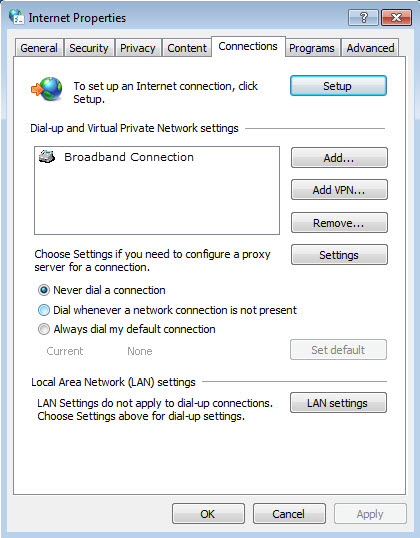
-
) Click LAN settings and deselect the following three options and click OK.
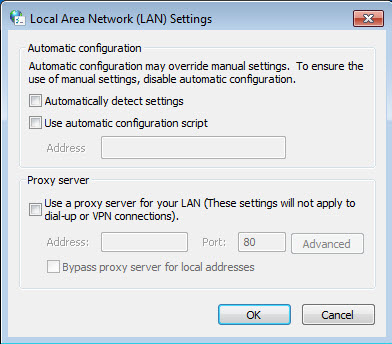
-
) Go to Advanced > Restore advanced settings, click OK to save the settings.
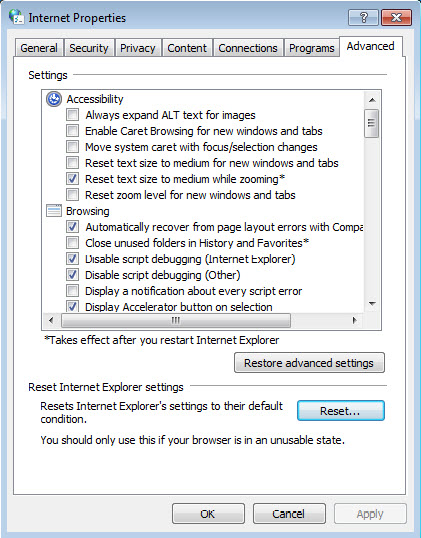
-
Use another web browser or computer to log in again.
-
Reset the router to factory default settings and try again. If login still fails, please contact the technical support. Note: You’ll need to reconfigure the router to surf the internet once the router is reset.
Q4 What should I do if I can’t access the internet even though the configuration is finished?
1 Visit http://tplinkmodem.net or http://192.168.1.1, and log in with the password you set for the GPON router.
2 Go to Advanced> Network > Status to check internet status:
If IP Address is a valid one, please try the methods below and try again:
・Your computer might not recognize any DNS server addresses. Please manually configure the DNS server.
- 1 ) Go to Advanced > Network > LAN Settings.
- 2 ) Enter 8.8.8.8 as Primary DNS, click SAVE.
- Tips: 8.8.8.8 is a safe and public DNS server operated by Google.
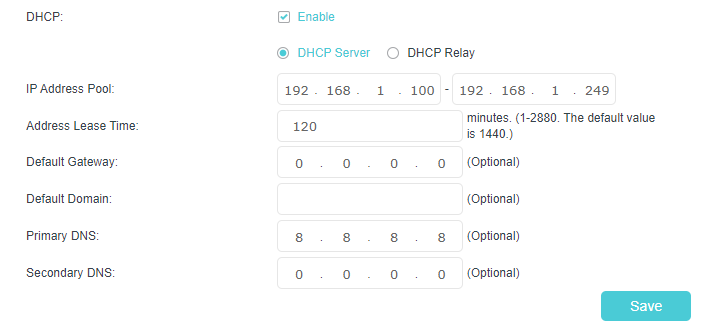
・Restart the modem and the router.
-
) Power off your modem and router, and leave them off for 1 minute.
-
) Power on your modem first, and wait about 2 minutes until it gets a solid cable or Internet light.
-
) Power on the router.
-
) Wait another 1 or 2 minutes and check the internet access.
・Reset the router to factory default settings and reconfigure the router.
・Upgrade the firmware of the router.
・Check the TCP/IP settings on the particular device if all other devices can get internet from the router.
As the picture below shows, if the IP Address is 0 0 0 0, please try the methods below and try again:
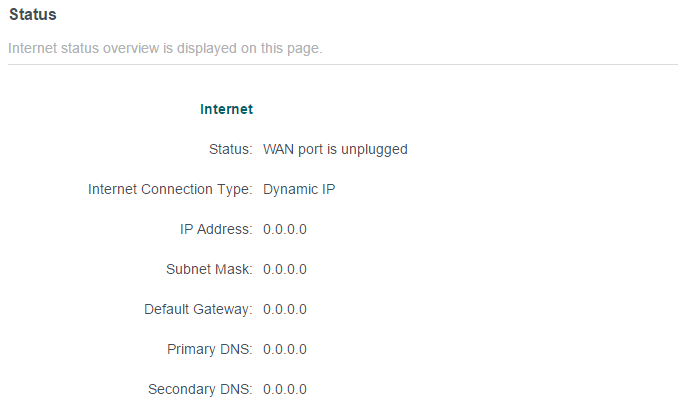
・Make sure the physical connection between the router and the modem is proper.
・Clone the MAC address of your computer.
-
) Visit http://tplinkmodem.net or http://192.168.1.1, and log in with the password you set for the GPON router.
-
) Go to Internet or Advanced > Network > Internet and focus on the MAC Clone section.
-
) Choose an option as needed (enter the MAC address if Use Custom MAC Address is selected), and click SAVE.
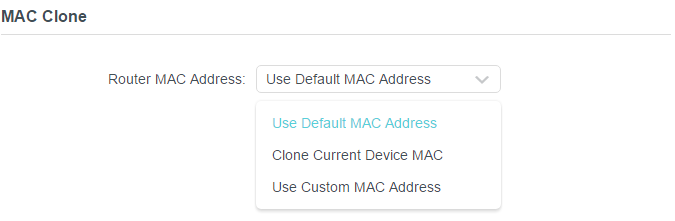
- Tips:
- Some ISP will register the MAC address of your computer when you access the internet for the first time through their Cable modem, if you add a router into your network to share your internet connection, the ISP will not accept it as the MAC address is changed, so we need to clone your computer’s MAC address to the router.
- The MAC addresses of a computer in wired connection and wireless connection are different.
・Modify the LAN IP address of the router.
- Note: Most TP-Link routers use 192.168.0.1/192.168.1.1 as their default LAN IP address, which may conflict with the IP range of your existing ADSL modem/router. If so, the router is not able to communicate with your modem and you can’t access the internet. To resolve this problem, we need to change the LAN IP address of the router to avoid such conflict, for example, 192.168.2.1.
-
) Visit http://tplinkmodem.net or http://192.168.1.1, and log in with the password you set for the GPON router.
-
) Go to Advanced > Network > LAN.
-
) Modify the LAN IP address as the follow picture shows. Here we take 192.168.2.1 as an example.
-
) Click Save.
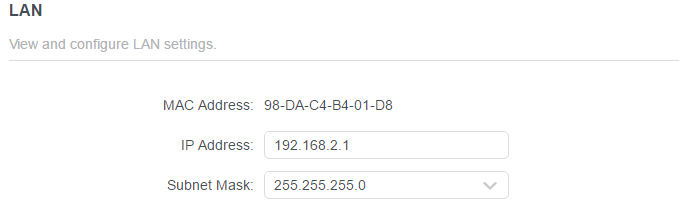
・Restart the modem and the router.
-
) Power off your modem and router, and leave them off for 1 minute.
-
) Power on your modem first, and wait about 2 minutes until it get a solid cable or Internet light.
-
) Power on the router.
-
) Wait another 1 or 2 minutes and check the internet access.
・Double check the internet connection type.
-
) Confirm your internet connection type, which can be learned from the ISP.
-
) Visit http://tplinkmodem.net or http://192.168.1.1, and log in with the password you set for the GPON router.
-
) Go to Advanced > Network > Internet.
-
) Select your Internet Connection Type and fill in other parameters.
-
) Click Save.
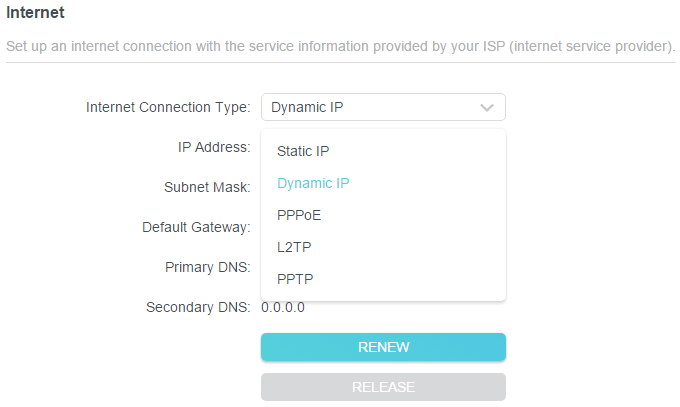
-
) Restart the modem and the router again.
・Please upgrade the firmware of the router.
If you’ve tried every method above but still cannot access the internet, please contact the technical support.
Q5 What should I do if I can’t find my wireless network or I cannot connect the wireless network?
If you fail to find any wireless network, please follow the steps below:
・Make sure the wireless function of your device is enabled if you’re using a laptop with built-in wireless adapter. You can refer to the relevant document or contact the laptop manufacturer.
・Make sure the wireless adapter driver is installed successfully and the wireless adapter is enabled.
-
On Windows 7
-
) If you see the message No connections are available, it is usually because the wireless function is disabled or blocked somehow.
-
) Click Troubleshoot and windows might be able to fix the problem by itself.
-
-
On Windows XP
-
) If you see the message Windows cannot configure this wireless connection, this is usually because windows configuration utility is disabled or you are running another wireless configuration tool to connect the wireless.
-
) Exit the wireless configuration tool (the TP-Link Utility, for example).
-
) Select and right click on My Computer on desktop, select Manage to open Computer Management window.
-
) Expand Services and Applications > Services, find and locate Wireless Zero Configuration in the Services list on the right side.
-
) Right click Wireless Zero Configuration, and then select Properties.
-
) Change Startup type to Automatic, click on Start button and make sure the Service status is Started. And then click OK.
-
If you can find other wireless network except your own, please follow the steps below:
・Check the WLAN LED indicator on your wireless router/modem.
・Make sure your computer/device is still in the range of your router/modem. Move it closer if it is currently too far away.
・Go to Wireless or Advanced > Wireless > Wireless Settings, and check the wireless settings. Double check your wireless Network Name and SSID is not hided.
If you can find your wireless network but fail to connect, please follow the steps below:
・Authenticating problem/password mismatch:
-
) Sometimes you will be asked to type in a PIN number when you connect to the wireless network for the first time. This PIN number is different from the Wireless Password/Network Security Key, usually you can only find it on the label of your router.
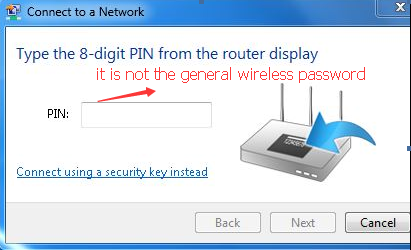
-
) If you cannot find the PIN or PIN failed, you may choose Connecting using a security key instead, and then type in the Wireless Password/Network Security Key.
-
) If it continues to show note of Network Security Key Mismatch, it is suggested to confirm the wireless password of your wireless router.
Note: Wireless Password/Network Security Key is case sensitive.
・Windows unable to connect to XXXX / Can not join this network / Taking longer than usual to connect to this network:
- Check the wireless signal strength of your network. If it is weak (1~3 bars), please move the router closer and try again.
- Change the wireless Channel of the router to 1, 6 or 11 to reduce interference from other networks.
- Re-install or update the driver for your wireless adapter of the computer.