


What Is a Next-Generation Firewall? NGFW Explained
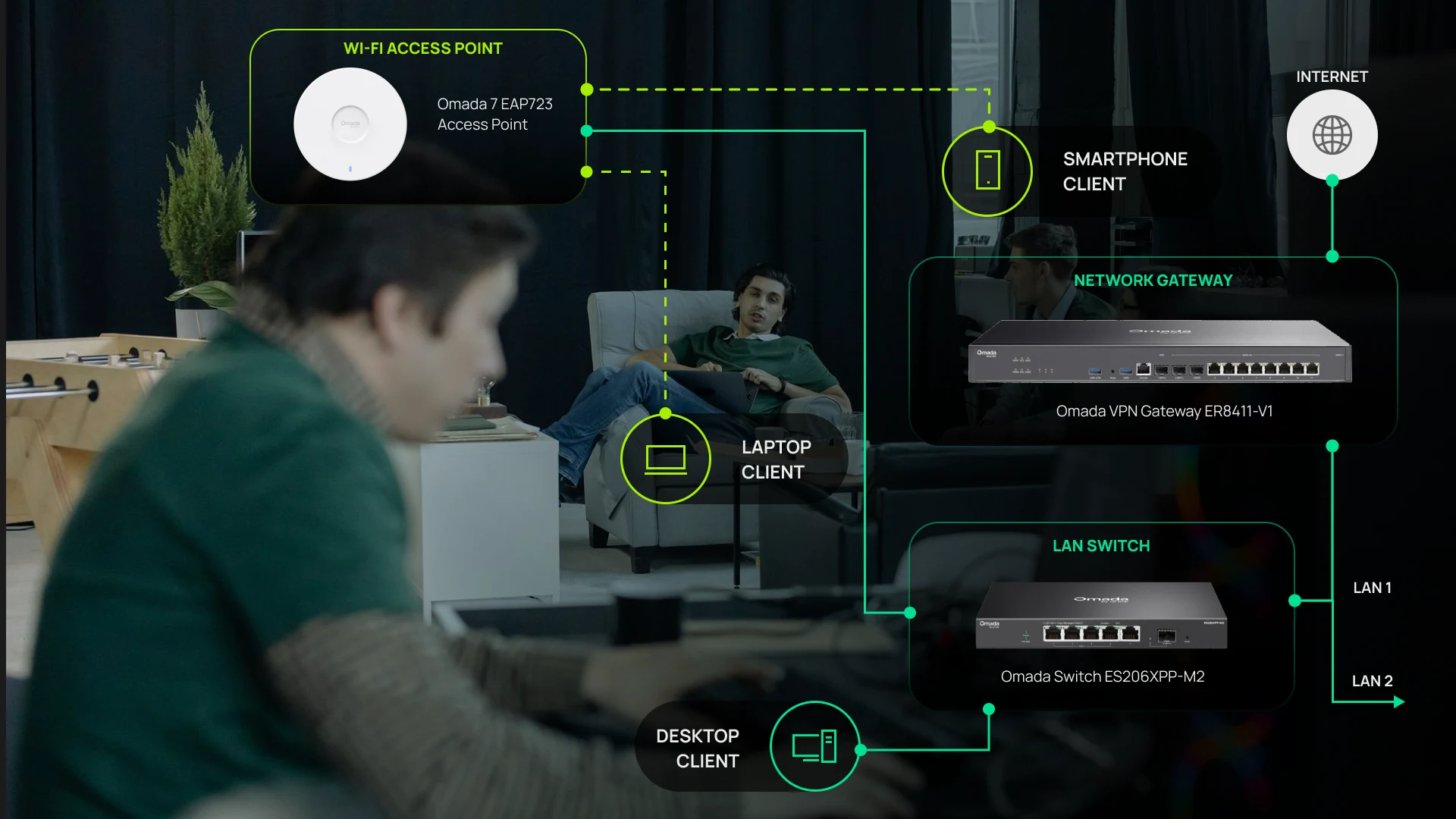
Most business networks already run a firewall. A next-generation firewall (NGFW) is what you add when that stateful firewall stops catching the threats your business actually faces today. Port-based filtering made sense when most traffic ran on a handful of predictable ports, but modern attacks hide inside encrypted, application-layer traffic a traditional firewall cannot see.
A next-generation firewall (NGFW) is a firewall that combines traditional stateful packet filtering with deep packet inspection, application awareness, integrated intrusion prevention, user identity awareness, and real-time threat intelligence in a single appliance, giving businesses visibility into traffic a standard firewall cannot inspect.
This guide explains what an NGFW is, how it compares to a traditional firewall, the features that matter most, and when a business should consider upgrading.
Key Takeaways
- A next-generation firewall (NGFW) combines the stateful packet filtering of a traditional firewall with deep packet inspection, application control, integrated intrusion prevention, user identity awareness, and threat intelligence in one appliance.
- The defining difference from a traditional firewall is Layer 7 visibility: an NGFW inspects the actual application and content behind the traffic, not just the port and IP address.
- Core NGFW features include deep packet inspection, intrusion detection and prevention, application control, SSL/TLS inspection, user and device identity, and integrated threat intelligence.
- NGFWs are important for enterprise businesses now because modern threats, including phishing, ransomware, and encrypted malware, routinely bypass port-based firewalls entirely.
- When evaluating an NGFW, the key buying criteria are throughput with inspection enabled, VPN capabilities, the management model, and total cost including feature licensing.
What Is a Next-Generation Firewall (NGFW)?
A next-generation firewall extends traditional port and protocol-based filtering with deeper, application- and content-aware inspection. A standard firewall decides whether to allow traffic based on source, destination, and port; an NGFW adds security services that once required separate appliances, including intrusion detection and prevention, URL filtering, anti-malware scanning, and threat intelligence feeds.
The "next generation" label is a category of firewalls that decide at Layer 7 (the application layer) rather than stopping at Layers 3 and 4.
NGFW isn't one fixed product spec. It describes a capability set, and vendors implement it differently, so two products marketed as NGFWs can still vary in throughput, feature depth, and licensing.
Next-Generation Firewall vs. Traditional Firewall
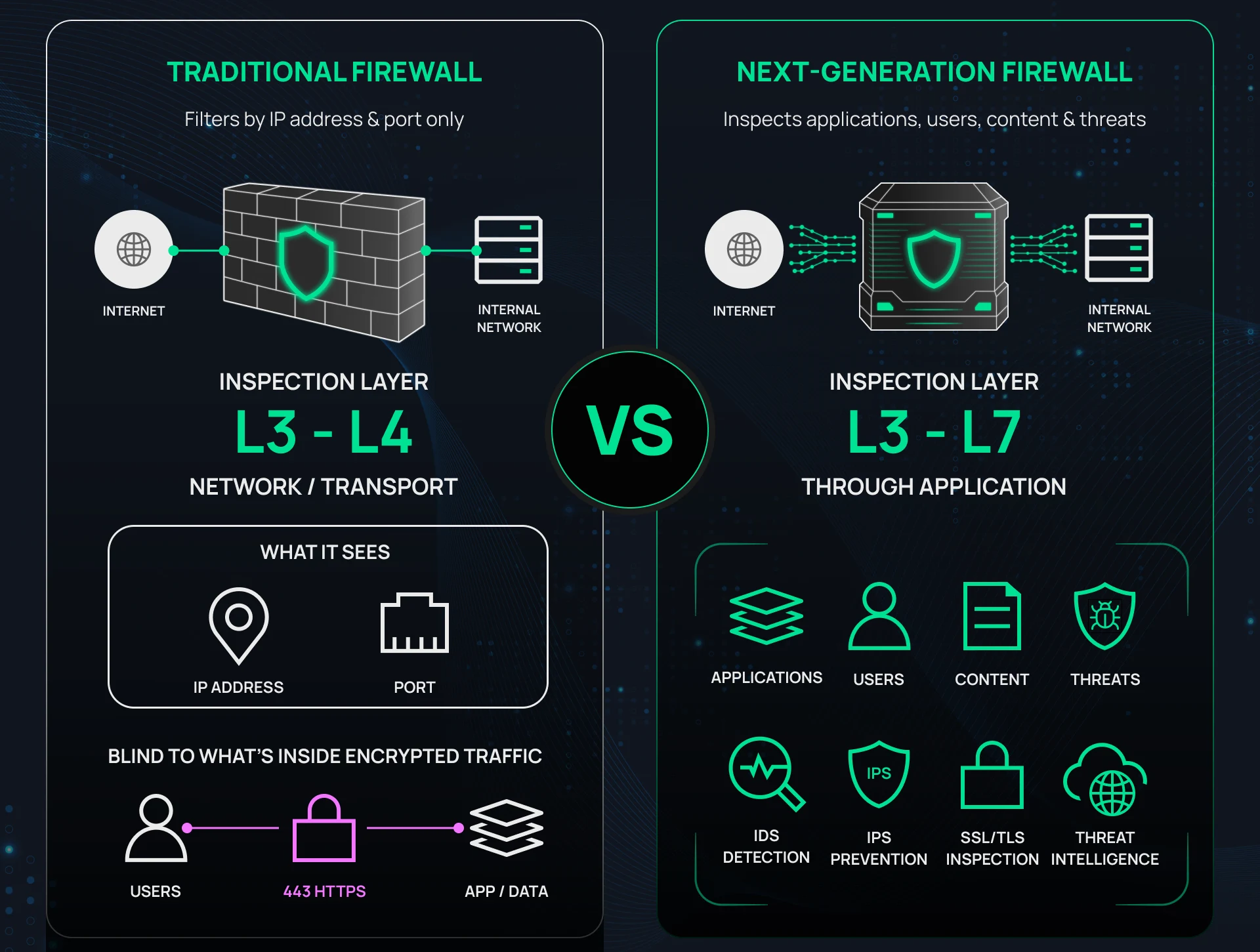
A traditional, stateful firewall decides what to allow based on IP address, port, and connection state. A next-generation firewall adds the application generating the traffic, the user or device behind it, the content inside it, and known threat signatures to that decision.
| Capability | Traditional Firewall | Next-Generation Firewall |
| Inspection layer | Layers 3–4 (network/transport) | Layers 3–7 (through application) |
| Application awareness | No | Yes |
| User identity | No | Yes, via directory or device integration |
| Intrusion detection (IDS) | No | Yes, integrated |
| Intrusion prevention (IPS) | No | Yes, integrated |
| SSL/TLS inspection | No | Yes |
| Threat intelligence | No | Yes, real-time feeds |
| Typical deployment era | Pre-2010 perimeter security |
Modern cloud and hybrid-work security |
Traditional firewalls still do their original job well: basic perimeter filtering by port and IP address. The gap is that they're blind to anything running over HTTPS on port 443, which by volume is most business traffic today, so a threat hiding inside that encrypted traffic passes through uninspected.
Key Features of a Next-Generation Firewall
Vendors position NGFWs around slightly different feature lists, but six capabilities define the category, each addressing something a stateful firewall structurally cannot see.
Deep Packet Inspection (DPI)
DPI examines a packet's payload, not just its header, catching hidden malware, policy violations, and data exfiltration riding inside traffic that looks like ordinary HTTPS. A stateful firewall would pass a ransomware payload embedded in a download as normal traffic; DPI is what catches it first.
Application Awareness and Control
Application awareness identifies the specific application generating traffic, for example, distinguishing Dropbox from Salesforce from a BitTorrent client, rather than reading a port number. That lets a business write policy in terms it understands: allow Microsoft 365, block peer-to-peer file sharing.
This visibility also supports segmentation strategies like separating personal devices from business systems for BYOD network security.
Intrusion Detection and Prevention (IDS/IPS)
An intrusion detection system (IDS) monitors traffic and alerts administrators to suspicious activity; an intrusion prevention system (IPS) automatically blocks malicious traffic in real time. Businesses once ran separate IDS and IPS appliances alongside a firewall, but modern NGFWs consolidate both into a single platform, which can block a known exploit against an unpatched server before it succeeds.
User and Device Identity
Rather than treating traffic as anonymous packets from an IP address, an NGFW ties traffic to a specific user or device, typically through directory integration, a captive portal, or device fingerprinting. That lets security policy follow the user across changing IP addresses, which is essential once a workforce is remote or hybrid.
SSL/TLS Inspection
Most business traffic today is encrypted. An NGFW decrypts, inspects, and re-encrypts HTTPS sessions so DPI, IPS, and application control can see what's inside, catching command-and-control traffic that would otherwise be invisible in TLS. There is a caveat, though: inspection carries a performance cost, along with privacy and compliance implications that should be factored into any evaluation.
Threat Intelligence and Anti-Malware
An NGFW pulls real-time feeds of known-bad IP addresses, domains, URLs, and file hashes to block traffic tied to active threat campaigns. For businesses that may have a small IT team and limited resources to conduct independent threat research, integrated feeds are a practical way to gain vendor-scale visibility into emerging attacks.
How a Next-Generation Firewall Works
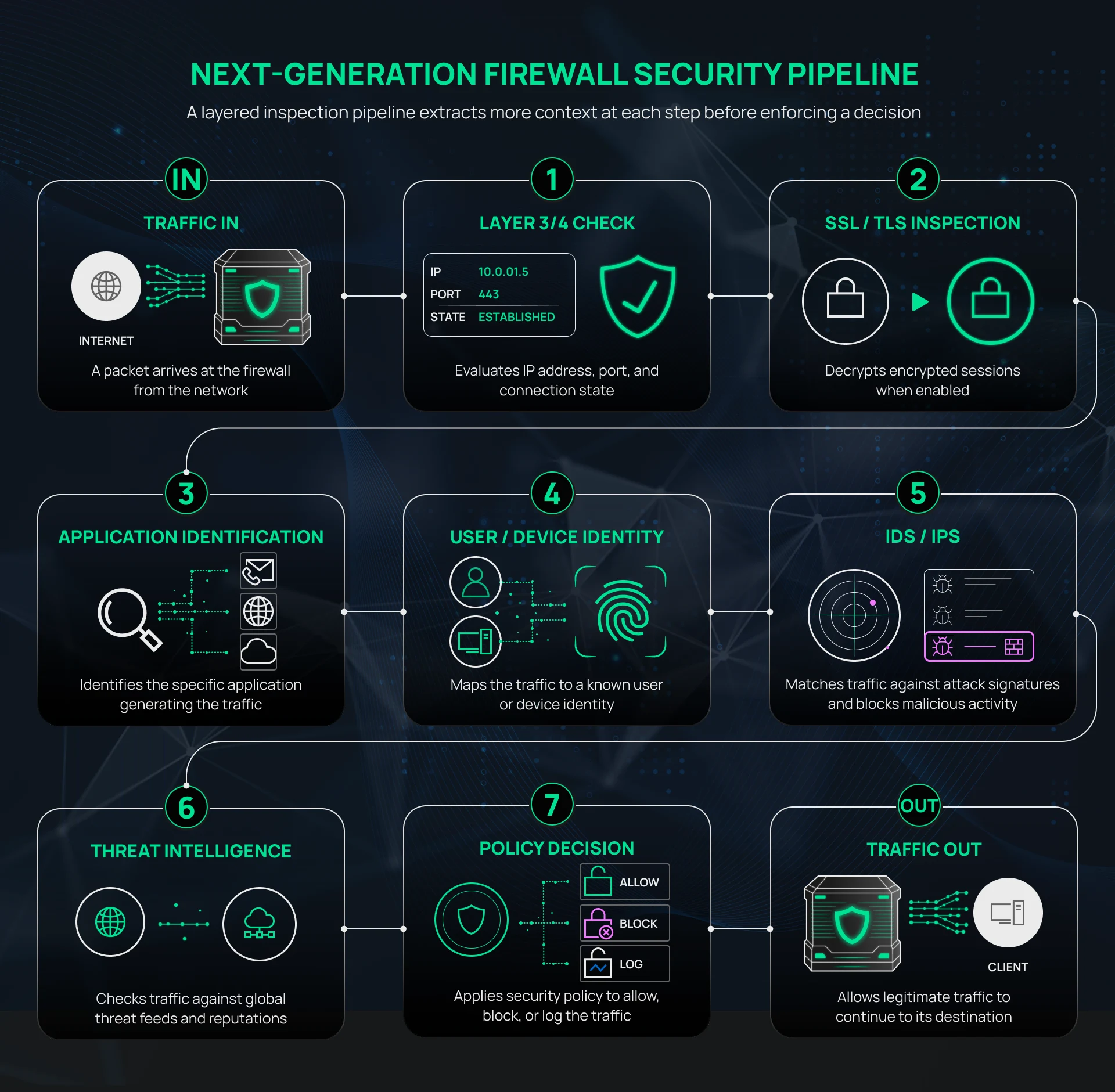
An NGFW processes traffic through a layered inspection pipeline, checking more context at each step before deciding:
- A packet arrives at the firewall.
- A Layer 3/4 stateful check evaluates IP address, port, and connection state.
- SSL/TLS inspection decrypts encrypted sessions when enabled.
- Layer 7 inspection identifies the specific application generating the traffic.
- A user or device identity lookup ties the traffic to a known identity.
- IDS/IPS signature matching flags and can block known attack patterns.
- A threat intelligence lookup checks the traffic against current threat feeds.
- The firewall makes a policy decision: allow, block, or log.
The value for a business isn't necessarily any single step; it's that one tool now performs checks that used to require several separate appliances. That consolidation is what makes NGFW-grade protection realistic for a lean IT team to actually operate day to day.
When Does Your Business Need a Next-Generation Firewall?
The following criteria can help you assess whether an NGFW fits your business's actual risk profile. An NGFW is worth considering if:
- Most of your traffic is HTTPS or cloud applications a stateful firewall can't inspect.
- You support a remote or hybrid workforce needing consistent policy regardless of location.
- A compliance requirement references intrusion prevention, application control, or detailed logging, such as PCI DSS, HIPAA, or CMMC.
- Your business has faced phishing or malware incidents a stateful firewall didn't stop.
- You're growing from a single site to multiple sites and need a unified policy.
Note that a very small office with minimal internet-facing services may still be adequately protected by a stateful firewall paired with strong endpoint protection. Matching the investment to actual risk exposure matters more than defaulting to the newest category.
For businesses that do need centralized and advanced protection, explore the Omada Fusion Gateways collection.
Choosing a Next-Generation Firewall for an Enterprise Business
Rather than comparing products on a single spec, evaluate NGFW options against the following buying criteria.
Throughput with Inspection Enabled
The spec to prioritize during evaluation is throughput with DPI and IPS active, not raw firewall throughput. Vendors often advertise the latter because it yields a higher figure, but it reflects performance with deeper inspection turned off. Ask for inspected throughput specifically since it predicts real-world performance under load.
VPN and Remote Access
Site-to-site and client VPN are table stakes for hybrid work. Verify which protocols a gateway supports, such as IPsec, SSL/OpenVPN, or WireGuard, and its concurrent tunnel count. Select Omada gateways, including models in the Wired Gateways collection, support IPsec, WireGuard, and SSL VPN alongside DPI-based application control. The ER8411 is one example built for higher-throughput sites, with two 10G SFP+ ports and load balancing across up to 10 WAN connections.
Management Model — Cloud, On-Premise, or Hybrid
Single-site businesses often prefer on-box management, while multi-site or MSP-managed deployments benefit from centralized cloud or controller management with configuration templates and zero-touch provisioning. Integrated gateway-controller devices, such as Omada's Fusion Gateways, combine routing and controller functions in one appliance for businesses that want centralized management without a separate controller.
Licensing and Total Cost of Ownership
Watch for a hidden-cost pattern common in this category: many NGFW vendors license DPI, IPS, threat intelligence, and SSL inspection separately, each with its own annual renewal. Calculate total cost of ownership over three years, not year-one hardware cost, before comparing options. Licensing structure can be the deciding factor between vendors, and enterprise-grade security outcomes are achievable without enterprise-level licensing complexity. Some platforms, including Omada, bundle capabilities like DPI and IPS/IDS into controller tiers rather than metering them as separate add-on subscriptions.
Planning Your Next-Generation Firewall Upgrade
A next-generation firewall is the evolution of the stateful firewall into an application-aware, threat-intelligent security appliance. For most businesses, the real question isn't whether NGFW-grade capabilities should be a priority, but when and how to deploy them without adding enterprise licensing complexity.
Omada's Fusion Gateways provide most NGFW capabilities suitable for SMB scenarios. Explore the Fusion Gateways lineup, with solutions like integrated VPN, advanced security, and centralized management for unified, scalable control.
Frequently Asked Questions
What is the difference between a next-generation firewall and a traditional firewall?
A traditional firewall filters traffic by IP address, port, and connection state alone. A next-generation firewall adds visibility into the application, the user or device behind it, and the content inside traffic, including encrypted sessions.
What is considered a next-generation firewall?
A firewall is generally considered an NGFW if it combines stateful packet filtering with deep packet inspection, application awareness, integrated intrusion prevention, and threat intelligence in one appliance. NGFW describes a capability set rather than a single spec, so implementations vary by vendor.
What are the main features of a next-generation firewall?
The core features are deep packet inspection, application awareness and control, integrated intrusion detection and prevention, user and device identity, SSL/TLS inspection, and real-time threat intelligence.
Do small businesses need a next-generation firewall?
Many do, particularly if most traffic runs over HTTPS, the business supports remote or hybrid work, or a compliance requirement calls for intrusion prevention or detailed logging. Very small offices with minimal internet-facing services may still be well served by a stateful firewall and strong endpoint protection.
Is a next-generation firewall the same as a UTM?
They overlap heavily but aren't strictly identical. Unified threat management (UTM) is an older term for consolidating security functions into one appliance, and many UTM products have since added NGFW-grade features. The terms are often used interchangeably today, though NGFW emphasizes Layer 7 application visibility specifically.
Does a next-generation firewall replace antivirus or endpoint protection?
No. An NGFW inspects traffic at the network perimeter, but it doesn't protect a device once malware is already running on it. Endpoint protection and an NGFW cover different layers of the same strategy, and most businesses need both.
What is NGFW throughput and why does it matter?
NGFW throughput is the amount of traffic a firewall can process with deep packet inspection and intrusion prevention actively enabled, as opposed to raw firewall throughput with those features off. Inspected throughput is what determines real performance once the firewall is doing its full job.
_20260728184505e.jpg)