Best Outdoor Security Camera Philippines 2026: IP Rating, Night Vision, and Installation Guide
Published: June 18, 2026
Quick Answer
-
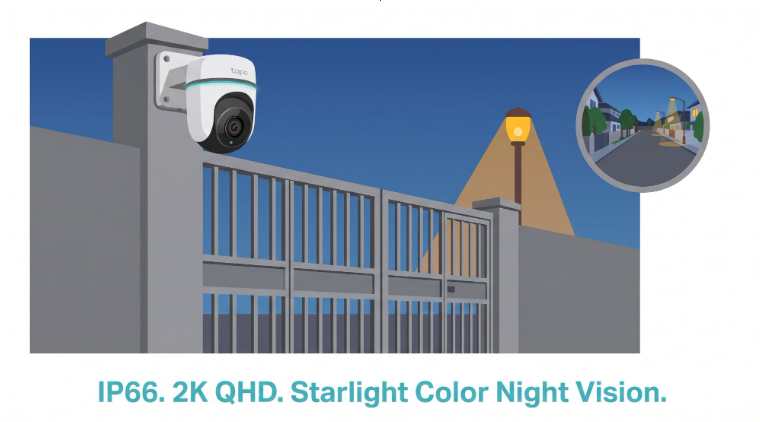
For any fully exposed outdoor position in the Philippines - gate, perimeter wall, open driveway - the Tapo C520WS (IP66, 2K QHD, starlight color night vision, 360-degree pan/tilt) is the strongest all-around pick for 2026. IP66 is the non-negotiable minimum rating for positions that receive direct typhoon-force rain.
-
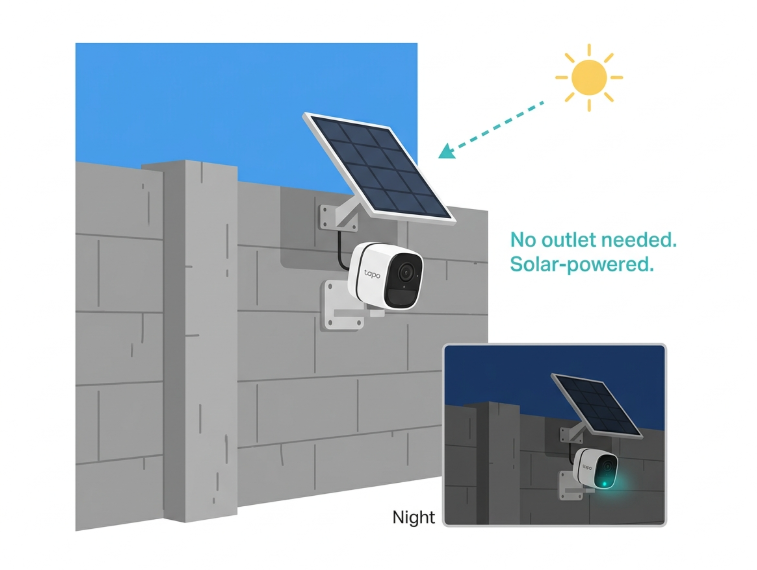
For wire-free installation with no outlet nearby, a far corner of a provincial lot, a rooftop, or a condo balcony, the Tapo C410 with the Tapo Solar Panel Kit handles Philippine weather at IP65. It runs indefinitely on Philippine sunlight without manual recharging.
-
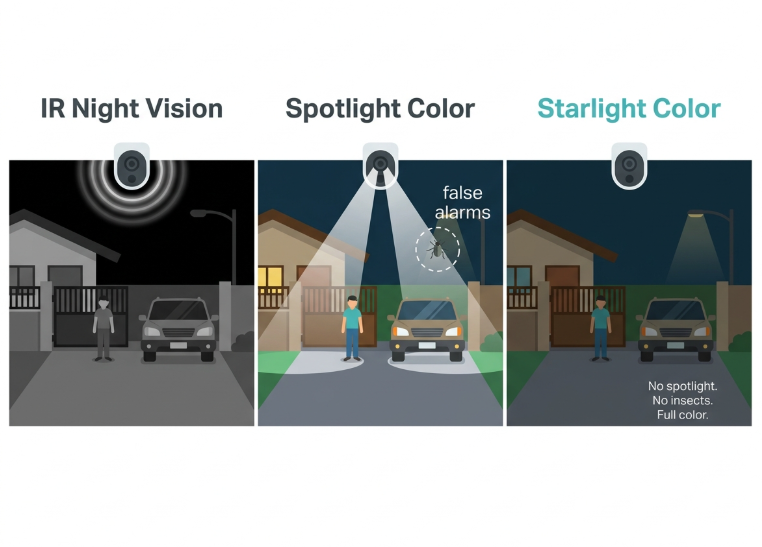
Night vision technology matters as much as weatherproofing: starlight color night vision (C520WS, C325WB) delivers full-color footage from ambient light alone, with no spotlights to attract insects or alert intruders. Standard IR produces black-and-white only. Spotlight color adds identification detail but draws insects in Philippine outdoor environments.
An outdoor security camera in the Philippines faces conditions that most product reviews in other countries never account for. PAGASA records an average of 20 tropical cyclones entering the Philippine Area of Responsibility per year, with peak intensity from July to October.
A camera rated for drizzle in a temperate country is not the same camera that survives a sideways typhoon downpour on an open gate post in Pampanga or a sustained monsoon on a perimeter wall in Cagayan de Oro.
This guide covers what the IP ratings actually mean in Philippine conditions, which night vision technology works in the genuine darkness of a Filipino compound at 2 AM, and how to match the right Tapo camera to your specific installation.
Table of Contents
In the Philippines, IP66 Is the Minimum for Fully Exposed Outdoor Positions
Best Tapo Outdoor Cameras for Philippine Homes in 2026
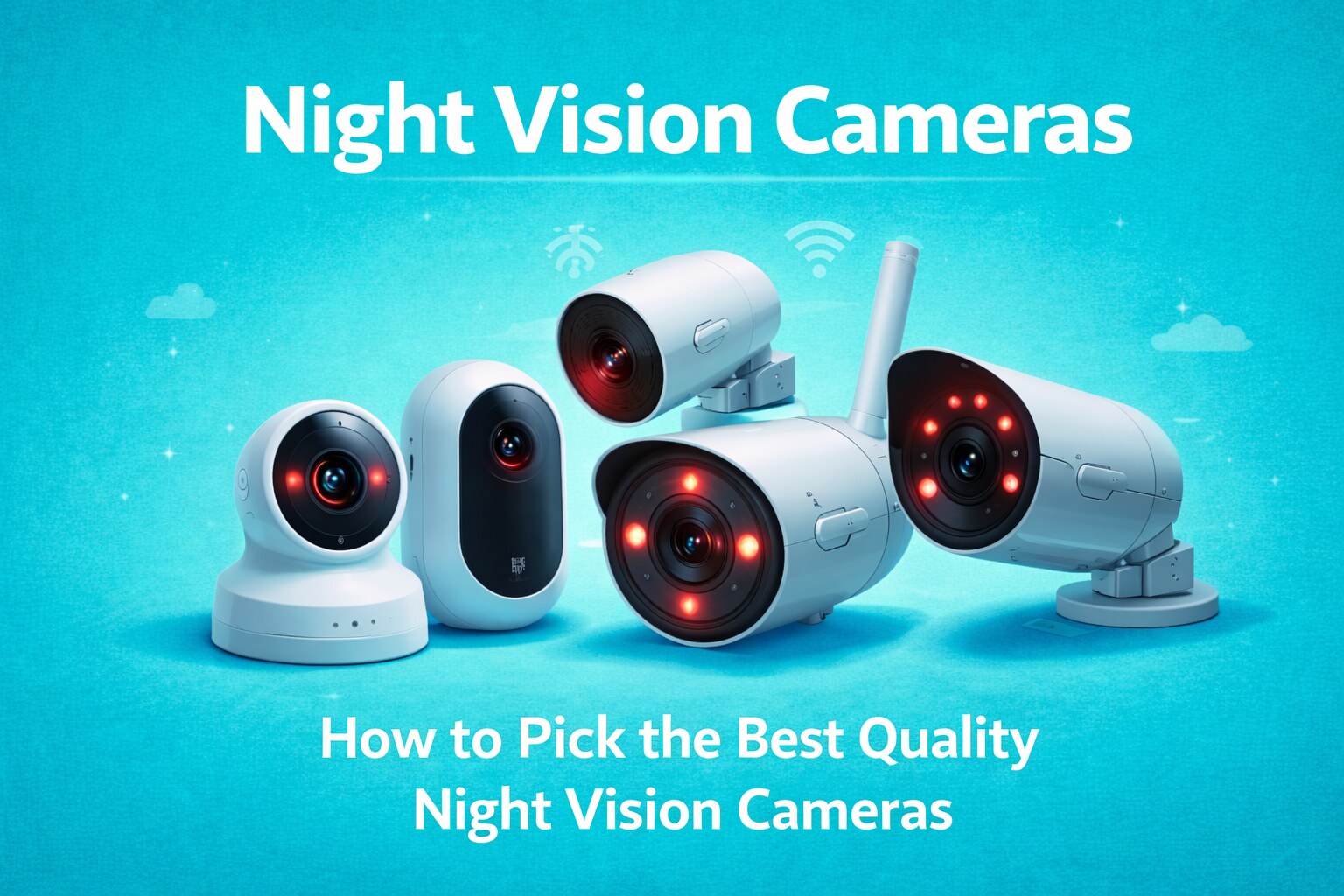
Night Vision Technology Comparison: What Actually Works in a Dark Philippine Compound
Matching the Right Camera to Your Specific Philippine Installation
Local microSD Storage Is the More Practical Choice for Most Philippine Households
In the Philippines, IP66 Is the Minimum for Fully Exposed Outdoor Positions
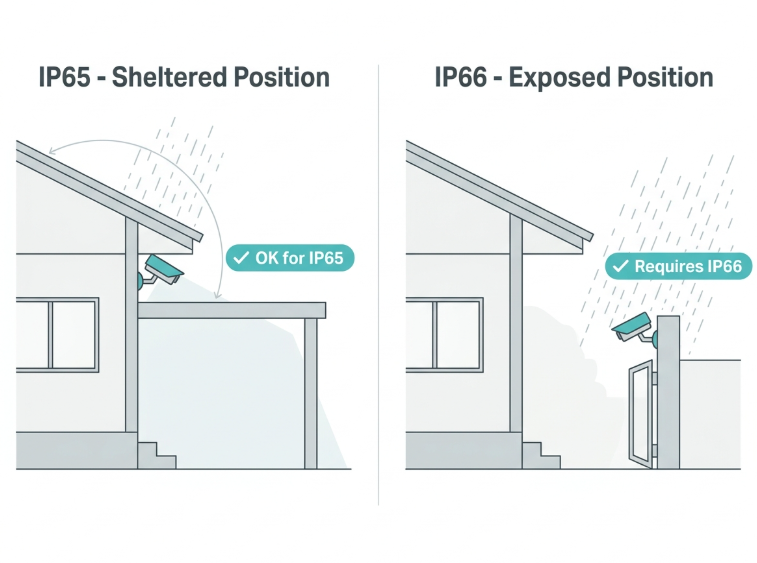
The International Electrotechnical Commission (IEC) defines IP ratings by two numbers: the first covers dust protection and the second covers water. Both IP65 and IP66 are fully dust-tight (rated 6 for solids). The difference is the water level. IP65 withstands low-pressure water jets; IP66 withstands high-pressure water jets from any direction.
In the Philippine context, that difference matters because typhoon rain is not a trickle. When Habagat drives rain sideways at sustained speed, an IP65 camera mounted on an open wall receives water at angles and pressures beyond its design tolerance. An IP66 camera handles the same conditions within its rated specification.
|
Rating |
What It Withstands |
Best For in the Philippines |
|---|---|---|
|
IP65 |
Dust-tight + low-pressure water jets |
Sheltered positions: under roof eaves, covered carport, recessed balcony |
|
IP66 |
Dust-tight + high-pressure water jets from any direction |
Fully exposed outdoors: open walls, gates, yards, direct typhoon rain |
IP rating definitions per IEC 60529 standard. Philippine typhoon season data per PAGASA.
The practical rule for Philippine installations: use IP65 for sheltered positions where the camera faces inward under sheltered eaves, a carport ceiling, or a recessed balcony. Use IP66 for any position that will receive direct typhoon-force rain, including open gate posts, compound perimeter walls, rooftop mounts, and any location facing outward with no overhead cover.
Best Tapo Outdoor Cameras for Philippine Homes in 2026
All cameras below connect to 2.4 GHz Wi-Fi, are managed through the free Tapo app, and support local microSD storage up to 512GB with optional Tapo Care cloud storage. No hub is required for any model. All are available through TP-Link Philippines' authorized resellers.
|
Model |
IP Rating |
Resolution |
Night Vision |
Power |
Best For |
|---|---|---|---|---|---|
|
Tapo C520WS |
IP66 |
2K QHD (2560x1440) |
Starlight color + IR |
Wired (Wi-Fi or Ethernet) |
All-around outdoor: gate, driveway, yard |
|
Tapo C325WB |
IP66 |
2K QHD |
ColorPro (no spotlight needed) |
Wired (Wi-Fi or PoE) |
Low-light areas: dark alleys, under eaves |
|
Tapo C120 |
IP66 |
2K QHD |
Dual spotlight + starlight + IR |
Wired (Wi-Fi) |
Flexible indoor/outdoor: balcony, hallway, door |
|
Tapo C510W |
IP65 |
2K QHD (2304x1296) |
Color night vision to 98 ft |
Wired (Wi-Fi) |
360-degree pan/tilt: large compound, wide yard |
|
Tapo C500 |
IP65 |
1080p Full HD |
Color night vision to 30 m |
Wired (Wi-Fi) |
Entry-level outdoor: carport, small yard |
|
Tapo C410 (battery) |
IP65 |
2K QHD |
Color night vision |
Battery + optional Tapo Solar Panel |
Wire-free: far corners, rooftops, no outlet nearby |
Specifications sourced from official TP-Link Philippines product pages as of June 2026. Prices vary by retailer. Verify availability at tp-link.com/ph before purchasing.
Night Vision Technology Comparison: What Actually Works in a Dark Philippine Compound
Night vision is where outdoor cameras most commonly underdeliver in real Philippine conditions. A camera that looks sharp in a vendor demo under partial lighting may produce unusable footage in the genuine darkness of a provincial lot at midnight or even a Metro Manila side street with inconsistent street lighting. Understanding the three main technologies helps Filipino buyers choose a camera that will not disappoint when it matters most.
Standard infrared (IR) night vision
The baseline technology in entry-level outdoor cameras. IR LEDs cast invisible infrared light that the sensor reads and converts to a black-and-white image. The Tapo C500 uses this approach. At a 30-meter range under complete darkness, the footage identifies movement and general shapes but captures no color. A red motorcycle and a blue sedan look identical.
Color night vision with spotlights
Mid-range cameras like the Tapo C510W add white LED spotlights that activate on motion or continuously to illuminate the scene in full color. The footage is dramatically more useful for identification: vehicle color, clothing, and facial detail are all visible. The trade-off in a Philippine outdoor environment is that spotlights attract insects year-round, which the Tapo app's motion detection then picks up as false alarms. The correct setting is Smart Mode, which only activates spotlights on confirmed person or vehicle detection, not continuous spotlight operation.
Starlight-color night vision (no spotlight required)
The technology used in the Tapo C520WS and C325WB. A large-aperture lens and a high-sensitivity sensor capture enough ambient light to render a full-color image without any spotlight. In practice, a Philippine home's perimeter camera produces color footage from streetlamp spillover or moonlight alone, with no activated light to attract insects or alert a potential intruder that the camera is live. The Tapo C325WB's ColorPro technology extends this further with an F1.0 lens optimized for ultra-low-light outdoor color imaging.
For Philippine installations with any ambient light at all, a streetlamp 20 meters away, a neighbor's porch light, or starlight technology delivers color footage without spotlight activation. Most Metro Manila and urban Philippine installations have sufficient ambient light for starlight to perform well. For positions in complete darkness with no ambient source, spotlights are the correct choice.
If you are still deciding between models after reading the night vision section, go to the Tapo camera lineup to compare specifications and current pricing side by side.
Matching the Right Camera to Your Specific Philippine Installation
The most common installation mistake in Philippine homes is buying a camera for a general outdoor use case without accounting for the specific physical conditions of the location. These four scenarios cover the most frequent setups in Filipino residential properties.
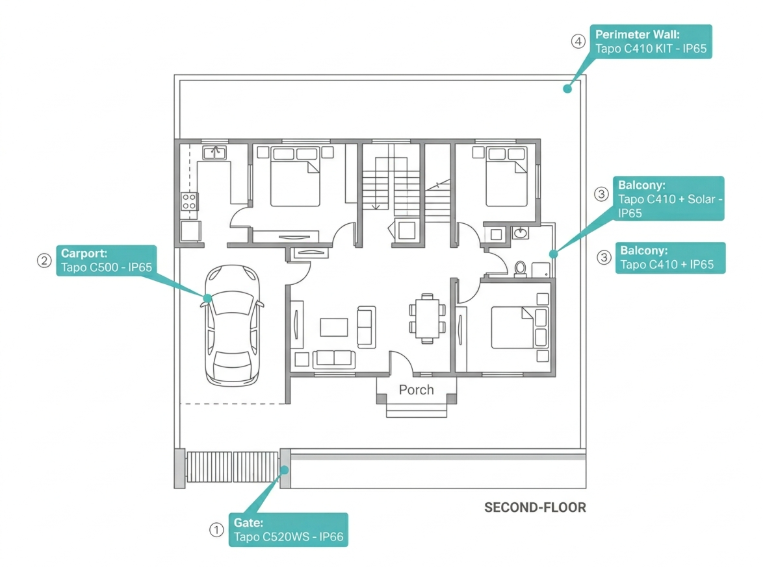
The front gate of a house-and-lot in a subdivision
This is the highest-risk position in most Philippine homes. The gate faces a public road, receives direct rain during typhoon season, and is the most likely point of entry for unauthorized visitors. The right camera is the Tapo C520WS (IP66, pan/tilt, 360-degree coverage). Mount it above the gate frame, angled to cover both the street-facing and interior sides. The pan/tilt mechanism monitors both directions without a second camera. IP66 is non-negotiable here because the gate position typically has no overhead cover.
The carport or covered driveway
A covered carport provides natural overhead shelter, which changes the IP requirement. If the camera mounts on the interior face of the carport ceiling or wall, facing downward into the covered area, IP65 is sufficient and opens up a wider model range. The Tapo C500 handles this well at a lower price point. If the camera mounts on the exterior edge of the carport facing outward toward the street, use IP66.
The second-floor balcony of a condo or townhouse
Balcony cameras in Philippine condo buildings face a specific constraint: no Ethernet port, often no outdoor outlet, and concrete walls that may require landlord approval to drill. The Tapo C410 battery-powered camera solves this. At IP65, it handles sheltered balcony conditions, mounts without drilling using its adjustable magnetic base, and runs on a rechargeable battery for up to 180 days per charge under laboratory conditions. Pair it with the optional Tapo Solar Panel to eliminate battery management, using Philippine sunlight to recharge continuously.
The back perimeter wall or the far corner of a provincial lot
Provincial Philippine lots often have a perimeter wall or a far corner 30 or more meters from the nearest outlet. Running a cable that distance is impractical. The Tapo C410 with the solar panel kit fits this scenario, with IP65 weatherproofing adequate for a wall-mounted position with partial overhead cover from the wall cap. For a completely open, exposed wall face with no overhead structure, the IP65 rating warrants a sheltered mounting position rather than straight exposure to typhoon rain.
If you are building a multi-camera setup for a larger property and want to store all footage locally without a monthly subscription fee, see the Tapo H200 Smart Hub for centralized local storage.
Local microSD Storage Is the More Practical Choice for Most Philippine Households
All Tapo outdoor cameras support local storage via a microSD card up to 512GB. The Tapo C520WS product page estimates approximately 680 hours of 2K QHD footage per card under laboratory conditions. Tapo Care cloud storage adds 30-day video history, encrypted backup, and notification snapshots at a monthly fee.
For most Philippine homeowners, local storage is the correct starting point. During typhoons, when security risk is highest, internet connectivity is often the first thing to drop. A camera relying on cloud storage may lose its ability to save footage precisely when the footage is most needed. A camera with a microSD card records locally regardless of internet status, as long as it has power.
The one scenario where Tapo Care cloud storage adds clear value for Philippine users is multi-property monitoring. If you own a second property in a different region, or if you manage rental units, cloud access to footage from any location is more reliable than depending on being physically present to retrieve the SD card.
Before inserting a card, check tp-link.com/ph/support/faq/3048/, not all cards format correctly, and incompatible brands cause recording failures.
Frequently Asked Questions
Is IP66 weatherproofing strong enough to survive a Philippine typhoon?
IP66 is the appropriate rating for exposed outdoor positions in the Philippines during typhoon conditions. It covers complete dust protection and high-pressure water jets from any direction, which includes the sideways rain characteristic of typhoon conditions. No consumer camera is rated for full immersion or sustained hurricane-force wind loads, so the physical mount, cable entry point sealing, and installation position all contribute to real-world durability beyond the IP rating alone.
Can I use a Tapo outdoor camera without a Wi-Fi connection to the internet?
Yes. When internet connectivity drops, a Tapo outdoor camera continues recording to a local microSD card as long as it has power and local network connectivity. You can still access live view and recordings from your phone when on the same local Wi-Fi network, even without internet. Remote access and cloud storage upload require an active internet connection, which is the reason local microSD storage is the recommended baseline for Philippine households where brownouts and typhoon-related outages are seasonal realities.
What is the maximum distance a Tapo outdoor camera can be from the Wi-Fi router?
The Tapo C520WS dual external antennas reach up to 492 feet (approximately 150 meters) in open areas. Real-world range in a Philippine home with concrete walls is lower, typically 15 to 30 meters per concrete wall the signal passes through. For cameras mounted far from the router, a TP-Link Deco mesh node or range extender placed as an intermediate point resolves most connectivity issues. The C520WS and C325WB also support wired Ethernet connections, which eliminates Wi-Fi distance.
Does the Tapo C410 battery-powered camera work in the Philippine heat and humidity?
The Tapo C410 is rated for operating temperatures from -20°C to 50°C, which covers Philippine ambient temperatures comfortably, even during the March to May peak summer period. The IP65 weatherproof rating covers the humidity and rain conditions typical of Philippine outdoor use. The Tapo Solar Panel Kit is specifically well-suited to Philippine installations because high daily sun hours keep the battery topped up with less manual recharging than in lower-sun regions. PAGASA data shows the Philippines averages 4.5 to 5.5 peak sun hours daily, which is well above the 45 minutes of direct sunlight the solar panel needs for all-day camera operation.
Do Tapo cameras work with Globe and PLDT Home Fiber routers in the Philippines?
Tapo outdoor cameras connect to any 2.4 GHz Wi-Fi network, which all major Philippine ISP-issued routers broadcast. Globe, PLDT, Converge, and Sky home broadband units all include a 2.4 GHz band. During camera setup, connect to the 2.4 GHz network, not the 5 GHz band. If your ISP router broadcasts both bands on the same network name, temporarily disable the 5 GHz band in the router settings during camera setup, then re-enable it after the camera is connected.
Can I use a Tapo outdoor camera without any subscription fee?
Yes. All Tapo outdoor cameras include free basic features: live view, local microSD recording, motion alerts, person and vehicle detection, and two-way audio, where supported. No subscription is required for any of these. Tapo Care cloud storage is optional; it adds 30-day cloud video history, encrypted backup, and enhanced notification snapshots for users who want off-site footage access. The camera works fully without it.
What is the difference between the Tapo C520WS and C325WB?
Both are IP66, 2K QHD cameras with starlight-class color night vision and no spotlight requirement. The key differences are form and function. The C520WS is a pan/tilt camera with 360-degree horizontal coverage and dual external antennas for extended Wi-Fi range, the right choice for gates and open areas where wide coverage from one unit matters. The C325WB is a fixed-lens camera with ColorPro technology, an F1.0 aperture, and PoE support, the right choice for a specific fixed angle where wired power is available, and ultra-low-light color performance takes priority over pan/tilt flexibility.
Final Thoughts
The single most important decision for an outdoor camera in the Philippines is not brand or resolution. It is whether IP65 or IP66 is the right protection level for where the camera will actually be mounted. Getting that wrong means replacing the camera after the first typhoon season.
For a gate, perimeter wall, or open driveway with no overhead cover, the Tapo C520WS is the right camera: IP66-rated, full color at night without a spotlight, and 360-degree coverage from one unit. For a covered carport, a recessed balcony, or any sheltered position, IP65 opens the range to the more affordable Tapo C500 or the wire-free Tapo C410. For a completely exposed far corner with no outlet, the Tapo C410 with the solar panel runs indefinitely on Philippine sunlight.
Choose your installation position first, then choose your camera:
-
Mounting on a gate post, open perimeter wall, or any position with no overhead cover? The Tapo C520WS is confirmed IP66 for that exact scenario; see the Tapo C520WS product page to see how it stacks up against the full 2026 lineup.
-
No outlet at the installation point- far corner of the lot, rooftop, or provincial perimeter wall? The Tapo outdoor camera lineup is the wireless answer built for the Philippine sun.
-
Running multiple cameras on a larger property and want to store all footage locally without paying a monthly fee? Set up the Tapo H200 Smart Hub for centralized local storage.
-
Unsure which microSD card brand works reliably with your Tapo model? Check the recommended microSD card compatibility guide before buying a card that may not format correctly.
Disclosure: Product specifications mentioned in this article are accurate as of the publication date and may change. Always refer to the official TP-Link Philippines product page for current specifications, availability, and pricing information.