
How to Change the Wi-Fi Password and Settings on a TP-Link Mobile Wi-Fi Router
This guide provides step-by-step instructions for changing the wireless settings on your TP-Link Mobile Wi-Fi Router, including the SSID, password, and channel. To change your Wi-Fi password on a TP-Link from mobile or desktop, the steps vary slightly between 3G/4G and 5G models. Both scenarios are covered below, with configuration options available via the tpMiFi app, Tether app, or the web management page at http://tplinkmifi.net.
Key Takeaways
- Wireless settings on a TP-Link Mobile Wi-Fi Router — including the Wi-Fi name (SSID), password, and channel — can be changed via the tpMiFi app, Tether app, or web management page at http://tplinkmifi.net.
- For 3G/4G models, the tpMiFi app handles SSID and password changes. Advanced settings, such as channel selection, require the web management page.
- For 5G models, wireless settings can be changed via the device screen, the Tether app, or the web management page.
- The default SSID for TP-Link Mobile Wi-Fi Routers is TP-Link_XXXX, where XXXX represents the last four characters of the device's MAC address.
- Setting the wireless channel to "Auto" lets the device automatically select the clearest channel and is recommended for most users.
How to Change Wireless Settings
Scenario 1: For 3G/4G Mobile Wi-Fi Routers
Method 1: Via The tpMiFi App
Step 1. Connect your phone to the Mobile Wi-Fi Router's network and open the tpMiFi app. Tap the Mobile router under My Devices and go to Tools > Wireless Settings. You will see your current Wi-Fi name (SSID) and password displayed there.
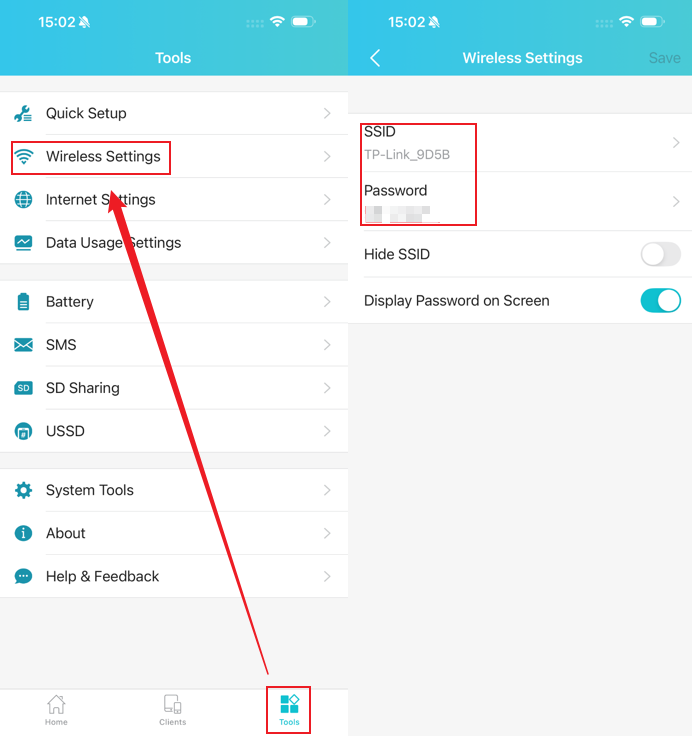
Step 2. Tap the SSID or Password field, enter your new Wi-Fi name or password, then click Save to apply your changes.
Note: To modify advanced wireless settings (such as channel selection) for 3G/4G models, please log in to the web management interface. Detailed steps can be found in Method 2.
Method 2: Via Web Management Page
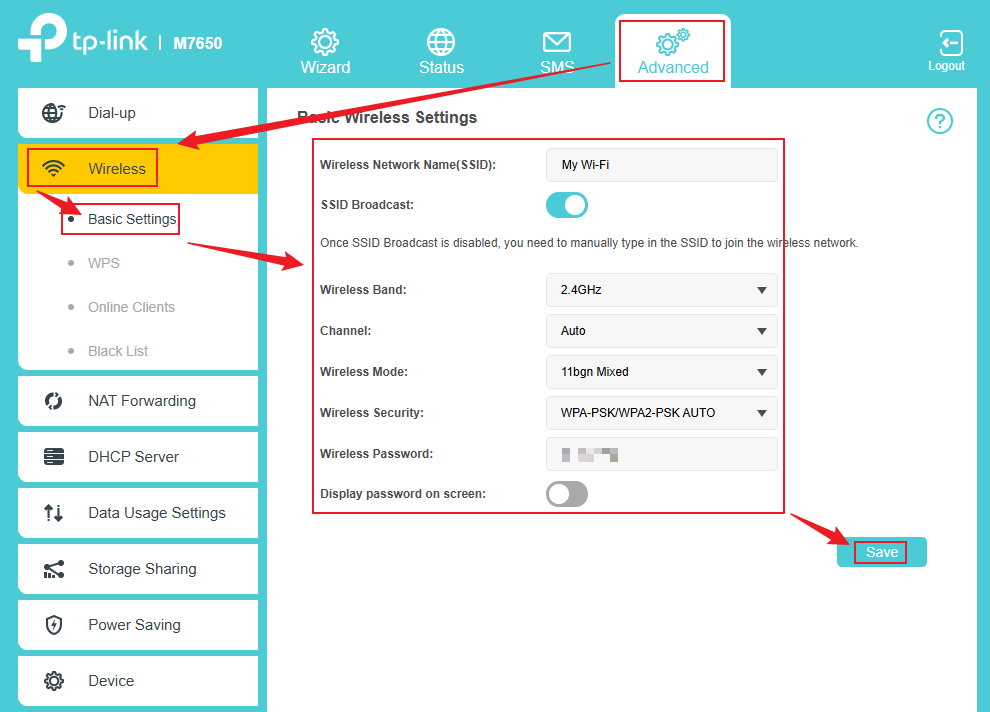
Step 1. Connect your computer to the Mobile Wi-Fi Router's network, then open a browser and go to http://tplinkmifi.net.
Step 2. Go to Advanced > Wireless > Basic Settings. Here, you can configure all Wi-Fi-related options. Remember to click Save after making any changes.
Notes:
1. The default wireless settings (excluding SSID and password) are preconfigured for optimal security and performance, so we recommend modifying them only if necessary for specific use cases.
2. The Wi-Fi settings that can be changed may vary slightly between models. Please refer to the interface display on your model for detailed settings.
Scenario 2: For 5G Mobile Wi-Fi Router
Method 1: Via The Mobile Wi-Fi Screen
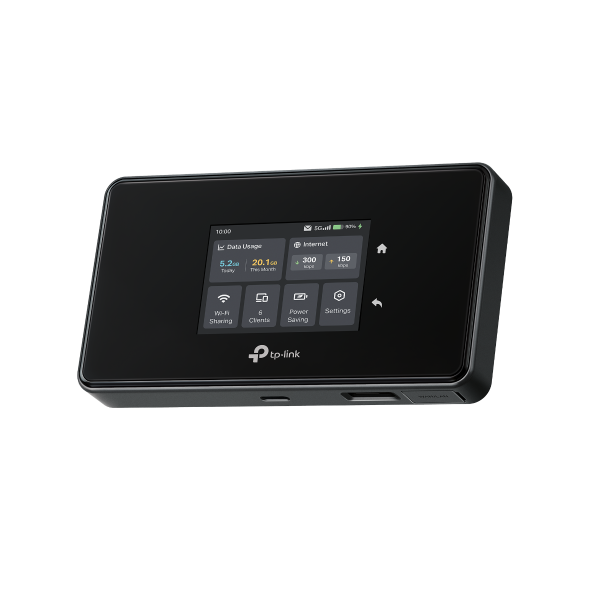
To modify your wireless network settings, simply click the Settings option on the screen. This will display all available Wi-Fi configuration options, including the Wireless SSID (Network Name), Password, and other advanced settings. After making your desired changes, click Save to apply them.
Note: For more detailed configuration options, we recommend using the web management interface. For guidance on this method, please refer to Method 3.
Method 2: Via the Tether app
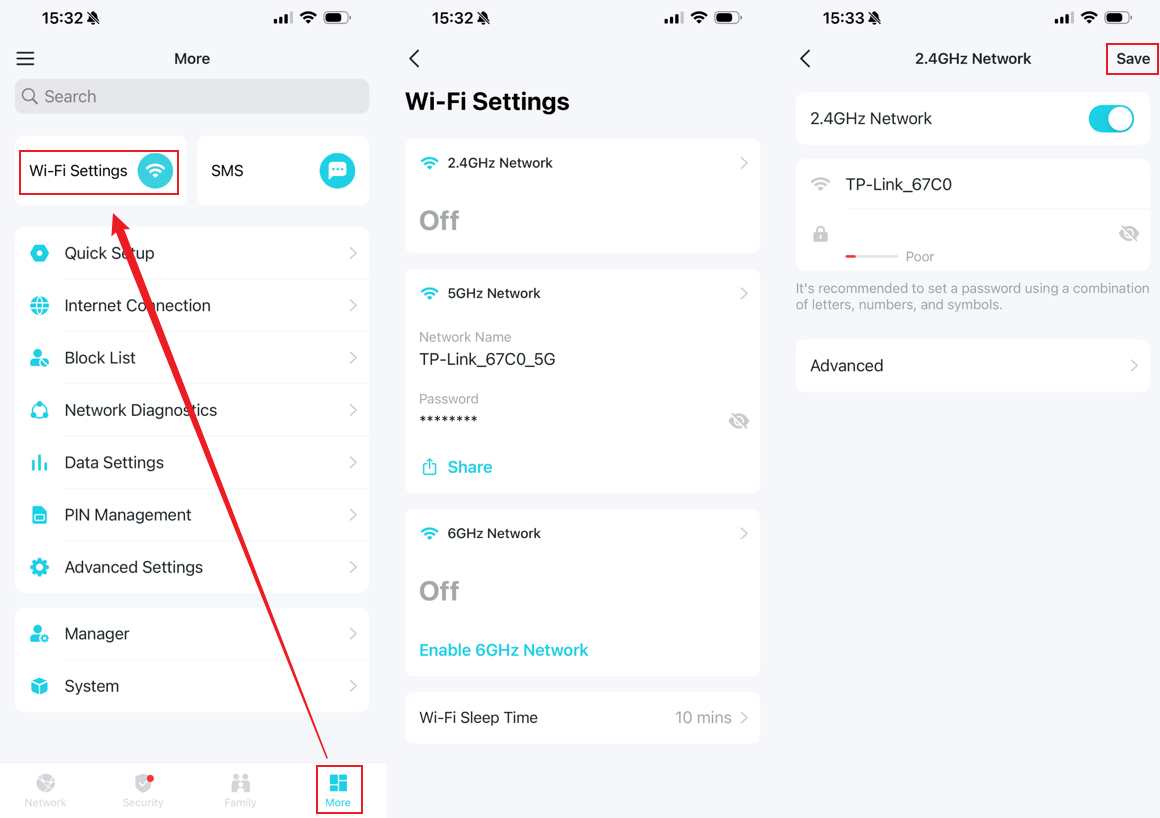
Step 1. Connect your phone to the 5G Mobile Wi-Fi Router's Wi-Fi network, then open the Tether app to begin management.
Step 2. In the Tether app, tap Mobile router under My Devices, then tap More > Wi-Fi Settings to access all wireless configuration options. You can change the Wi-Fi channel under the Advanced page.
Method 3: Via web management page
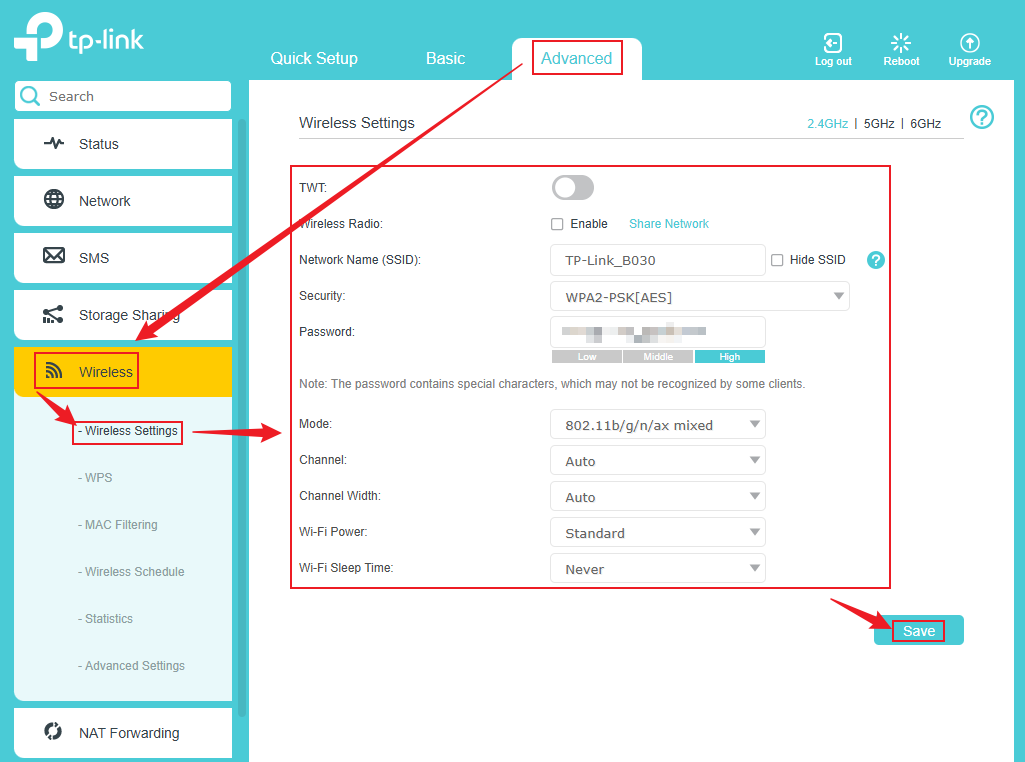
Step 1. After connecting your computer to the Mobile Wi-Fi Router’s network, open a web browser and enter http://tplinkmifi.net to access the web management interface.
Step 2. After logging in to the web management interface, navigate to Advanced > Wireless > Wireless Settings to view all available wireless configuration options. After making your desired changes, click the Save button to apply the new settings.
- TWT
Target Wake Time allows 802.11ax routers and clients to negotiate their periods for transmitting and receiving data packets. Clients wake up only during TWT sessions and remain in sleep mode for the rest of the time, significantly extending their battery life.
- Wireless Network Name (SSID)
SSID is the name of your wireless network. The default SSID for this device is TP-Link_XXXX (where “XXXX” represents the last four characters of its MAC address). You can customize it with up to 32 case-sensitive characters, after which it will appear in your device’s list of available networks.
- Wireless Band: 2.4GHz | 5GHz | 6GHz
Select 2.4 GHz, 5 GHz, or 6 GHz to change the corresponding settings. Different models support different bands.
- Wireless Radio
Tick this checkbox to turn on the wireless network.
- Wireless Mode
Wireless Mode selects the Wi-Fi protocol for your network band. Choose 11bgn mixed for 2.4 GHz or 11a/n/ac mixed for 5 GHz for broad compatibility, or select a specific mode (e.g., 11n only) to match your device’s wireless adapter for optimal performance.
- Wireless Security
Security Mode offers two options: Unsecured (open network) or WPA-PSK/WPA2-PSK, which provides strong encryption using a pre-shared password and is recommended for most home and small office users.
- Channel Width
Select a channel width (bandwidth) for the wireless network. If you are not sure, select Auto.
- Channel
Wireless Channel sets the specific frequency for your Wi-Fi band. Select “Auto” to let the device automatically choose the clearest channel, or manually select a channel only if you experience interference from nearby networks.
- Wi-Fi Power
Select either Balanced, Standard, or Boost to specify the data transmit power. The default and recommended setting is Standard. Changing the Power Saving Mode will also change the Wi-Fi Power.
- Wi-Fi Sleep Time
If no client is associated with the Wi-Fi for a certain period, the Wi-Fi will automatically be disabled. However, pressing the switch will turn it on again.
To learn more about each function and configuration, please visit the Download Center to download the manual for your product.
Looking For More
Is this faq useful?
Your feedback helps improve this site.
1.0_1559115206120f.jpg)


TP-Link Community
Still need help? Search for answers, ask questions, and get help from TP-Link experts and other users around the world.