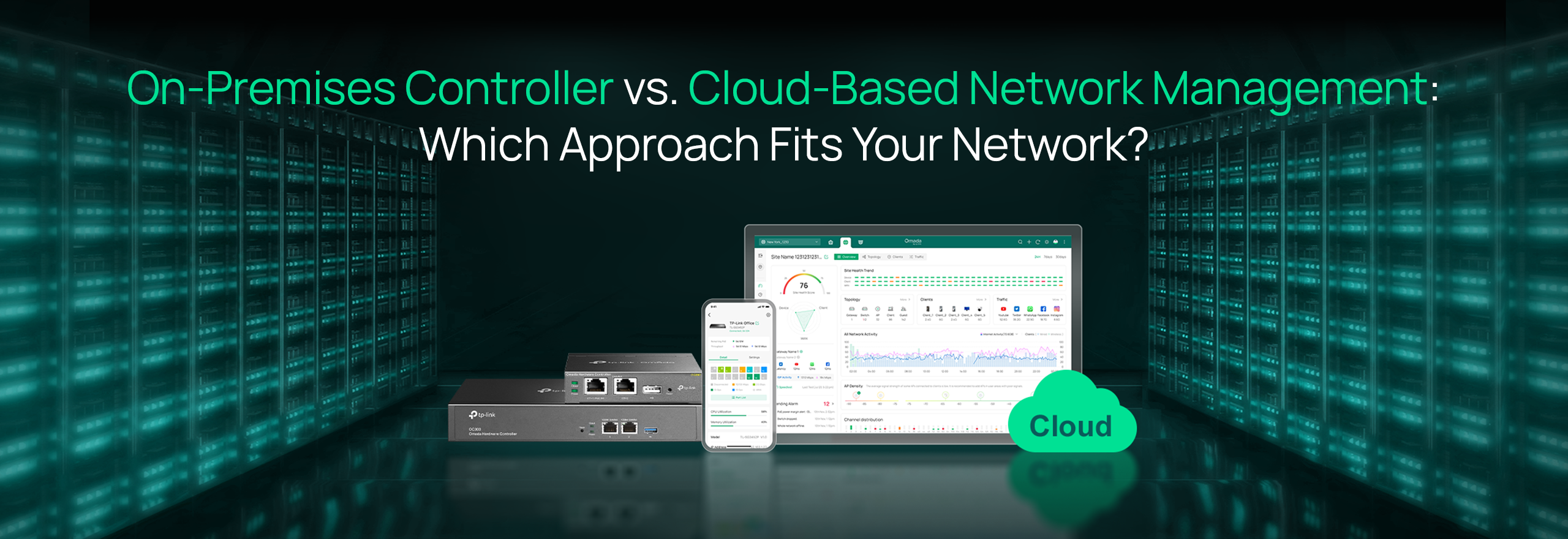
On-Premises Controller vs. Cloud-Based Network Management: Which Approach Fits Your Network?
As modern networks grow in size and complexity, how they’re being managed has become just as important as the hardware powering them. IT teams are tasked with supporting more devices, more users, and more locations than ever before, all while maintaining security, reliability, and performance.
To meet these challenges, centralized network management has become the standard.
Today, most solutions fall into one of *two categories, based on how the management platform is deployed:
1) Controller-based network management
2) Cloud-based network management
While both approaches aim to simplify operations and improve visibility, they differ notably in architecture, deployment, and day‑to‑day management.
Understanding these differences is key to choosing the right model for your organization.
*Omada also offers hybrid models: on‑prem controllers with optional cloud access and centralized portal visibility. You can read more about it here, as well as further below in this article.
What Is Controller-Based Network Management?
Controller-based network management relies on a centralized controller that is deployed and managed within the organization’s own environment. This environment may be on-premises, in a private data center, or deployed remotely, as long as the managed devices can communicate with the controller over layer 3 networking. This controller may be a dedicated piece of hardware or a software application running on a local server or virtual machine.
This flexibility in deployment allows for controller-based architectures to scale across single or multi-site environments while remaining fully customer-managed.
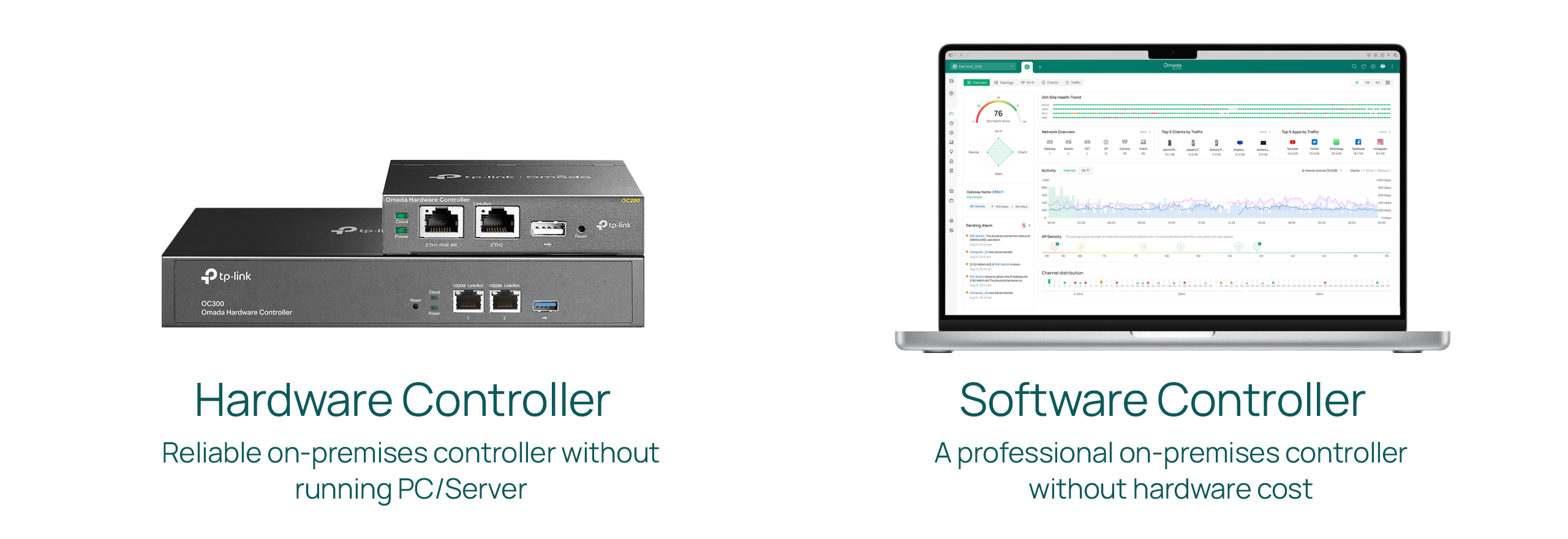
Network management via controller can come in two versions: 1) a hardware unit, and 2) a software version that runs on a local server or virtual machine. Omada offers both solutions, as well as hybrid (on-prem + cloud access) you can learn more about Omada hardware controllers here, and software controller here.
Network devices like access points, switches, and gateways, typically connect directly to the controller over the local area network or private environment. All configuration, monitoring, and policy enforcement is handled within this internal system.
Key Characteristics of Controller-Based Management
- Local control: All management functions remain on‑premises or within a private environment.
- Offline operation: Most controller-based networks can continue to function and be managed even if internet connectivity is lost.
- Data ownership: Network data, logs, and analytics remain in the organization’s infrastructure.
- Customizable deployment: IT teams can tune performance, storage, and access based on internal needs.
Controller-based architectures have long been favored in environments where data sovereignty, compliance, or operational independence are critical.
Pros and Cons of Controller-Based (On-Premises) Network Management
Advantages:
- Full data control: Network data, configurations, and logs remain within the organization’s environment
- Offline manageability: Core management functions can typically continue even if internet connectivity is unavailable.
- Customizable deployments: Supports hardware or software-based controllers deployed within customer-managed infrastructure.
- Compliance alignment: Well-suited for environments with strict data residency or regulatory constraints.
Disadvantages:
- Higher upfront investment: Requires hardware, server resources, or virtual infrastructure.
- Internal maintenance responsibility: IT teams must manage updates, backups, and system availability
- Scalability planning required: Expanding to additional sites or devices may require additional planning or resources.
What Is Cloud-Based Network Management?
Cloud-based network management uses a vendor-hosted cloud platform to centrally manage and monitor network devices. Instead of connecting to a local controller, devices securely communicate with the cloud platform over the internet.
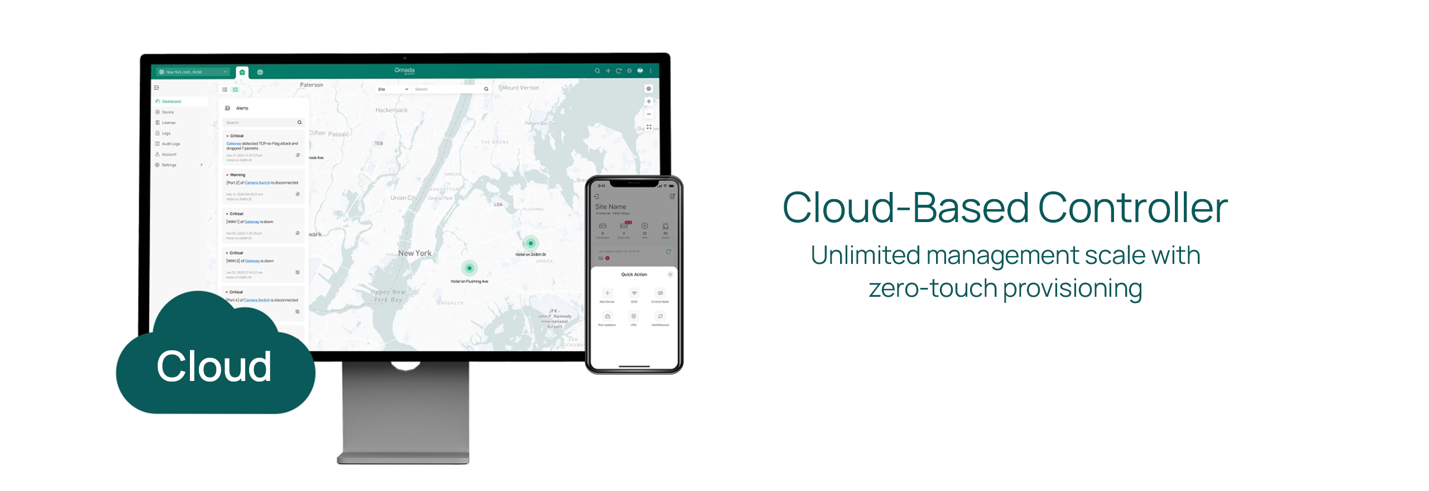
In cloud-based network management, network devices are managed through a vendor-hosted cloud platform that performs the controller functions remotely. Cloud-based control typically comes with a monthly subscription fee. [Some platforms offer tiered pricing: Omada provides a free cloud management tier (Essentials) for basic needs, alongside a licensed tier (Standard) with advanced features and support. This allows organizations to start with zero cost and scale as requirements grow].
Administrators access the network through a web-based dashboard or mobile app, allowing them to manage devices across one or many locations from virtually anywhere.
Key Characteristics of Cloud-Based Management
- No on‑premise controller required: The cloud platform handles infrastructure and scaling.
- Remote access: Networks can be monitored and managed from anywhere with internet access.
- Automatic updates: Platform improvements, security patches, and new features are handled by the vendor.
- Multi-site visibility: Ideal for organizations with distributed locations.
Cloud-based approaches are especially popular for organizations seeking simplicity, flexibility, and rapid deployment.
Pros and Cons of Cloud-Based Network Management
Advantages:
- Lower initial setup effort: No on‑premises controller hardware is required to start
- Remote accessibility: Networks can be monitored and managed from anywhere with internet access.
- Vendor-managed updates: Software updates, patches, and platform improvements are handled automatically.
- Multi-site visibility: Centralized dashboard simplifies management of distributed or growing networks.
Disadvantages:
- Internet dependency: Management access relies on stable internet connectivity.
- Subscription-based pricing: Typically licensed on an ongoing basis rather than a one-time purchase.
- Reduced direct control: Some aspects of infrastructure, updates, or data handling are managed by the vendor.
Key Differences at a Glance
While deployment location and connectivity are important considerations, the core difference between controller‑based and cloud‑based network management lies in responsibility.
Cloud vs On-Premise Comparison Chart
|
Cloud‑Based Management |
Controller‑Based (On‑Premises) Management |
|
|
Cost Structure |
Lower upfront costs; but may require subscription expenses |
Higher upfront investment; with internal operating costs |
|
Deployment Model |
Vendor‑hosted cloud platform |
Deployed within local or private infrastructure |
|
Internet Dependency |
Typically requires internet access for management |
Can be managed locally without internet access |
|
Security Management |
Vendor‑managed security and updates |
Internally managed security policies |
|
Data Control & Ownership |
Shared responsibility depending on vendor model |
Full control over data and configurations |
|
Compliance Alignment |
Relies on vendor compliance certifications |
Managed directly under internal governance |
|
Scalability |
Easily scales across multiple locations |
Scaling requires additional planning or hardware |
|
Customization |
Centrally managed with configurable features |
Highly customizable to internal requirements |
|
Implementation Time |
Faster deployment with minimal infrastructure |
Longer deployment requiring internal resources |
With controller‑based models, organizations manage the controller software, infrastructure, updates, and availability themselves. Cloud‑based platforms shift those responsibilities to the vendor, reducing operational overhead for IT teams.
- Deployment:
Controller-based systems require internal infrastructure, while cloud-based systems rely on vendor-hosted platforms. - Internet dependency:
Controller-based networks typically operate independently of the internet; while cloud-based management requires consistent connectivity. - Maintenance:
With controllers, internal IT teams manage upgrades and system health. Cloud platforms shift that responsibility to the vendor. - Scalability:
Cloud-based solutions scale easily across multiple sites, while controller-based systems may require additional planning or hardware as networks grow.
Neither approach is inherently better. Each serves different operational priorities.
Security, Control, and Compliance Considerations
Security is often one of the most important factors when choosing a network management strategy.
Controller-based management offers organizations full ownership and control over their network data. Logs, client information, and configurations remain within the local environment, which is appealing for industries with strict compliance requirements or internal security policies. Additionally, offline operation can be a critical advantage in sensitive or isolated deployments.
Cloud-based management, on the other hand, emphasizes vendor-managed security. Leading platforms use encrypted communications, hardened data centers, and continuous monitoring, often delivering rapid security updates faster than many internal teams can manage alone. For many organizations, this model reduces risk by offloading responsibility to a specialized provider.
Ultimately, both approaches can be secure when implemented correctly. The right choice depends on organizational risk tolerance, regulatory requirements, and governance policies.
Cost and Operational Impact
Cost considerations extend beyond initial pricing and should be viewed through the lens of total cost of ownership (TCO).
Controller-based solutions may require:
- Upfront investment in hardware or server resources
- IT time dedicated to installation, updates, and maintenance
- Planning for redundancy and backups
Cloud-based platforms often feature:
- Lower upfront costs
- Ongoing subscription or licensing *fees
- Reduced internal operational overhead
Rather than focusing solely on cost savings, organizations should consider how each model aligns with their internal resources, staffing, and long-term growth plans.
*Omada provides a free cloud management tier (Essentials) for basic needs, alongside a licensed tier (Standard) with advanced features and support. This allows organizations to start with zero cost and scale as requirements grow.
Which Approach Is Right for Your Organization?
Choosing between controller-based and cloud-based management ultimately comes down to fit.
Controller-Based Management May Be Ideal If:
- You require full local control of data and infrastructure
- Regulatory compliance limits cloud usage
- Internet connectivity is unreliable or restricted
- You have in-house IT expertise to manage infrastructure
Cloud-Based Management May Be Ideal If:
- You manage multiple locations or distributed networks
- Remote access and centralized visibility are critical
- You want rapid deployment with minimal infrastructure
- You prefer vendor-managed updates and maintenance
Understanding your operational priorities makes the decision far clearer than comparing features alone.
Hybrid Management: Local Control with Cloud Visibility
As networks evolve, many organizations are adopting hybrid management approaches that build on controller-based network management while adding optional cloud access. These solutions use an on-premises controller for core operations, and then optionally enable cloud access for remote monitoring or multi-site aggregation.
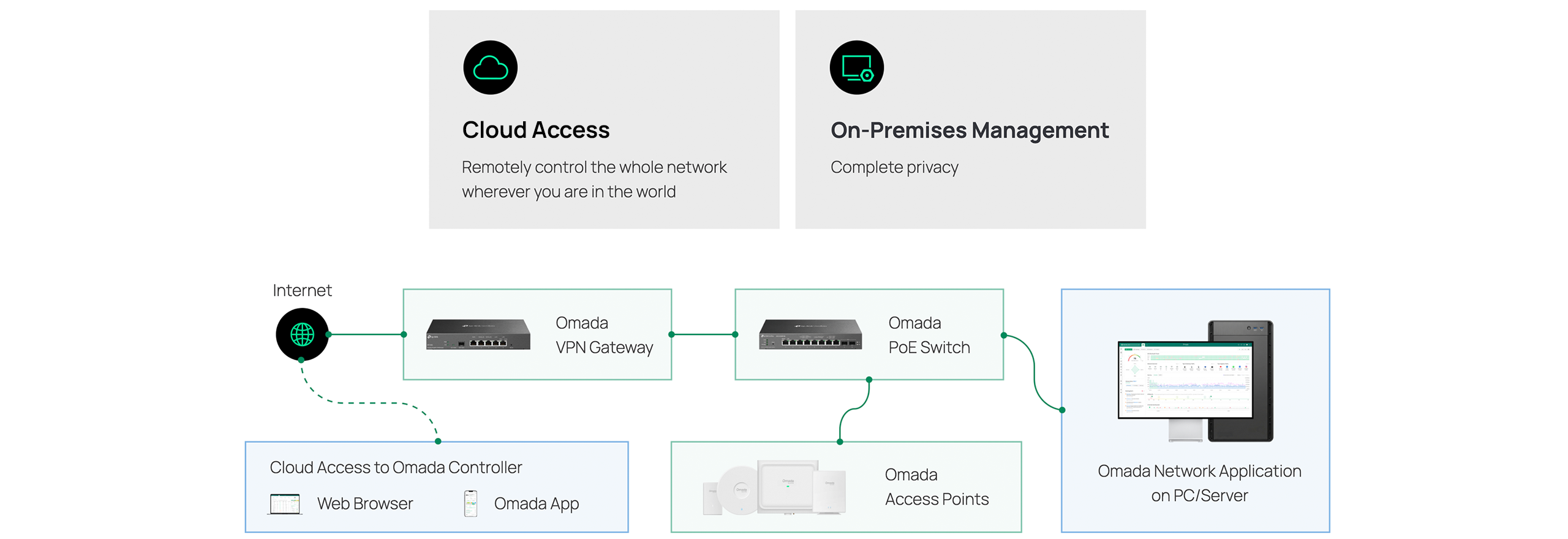
Omada offers hybrid management solutions, allowing for both local control and remote visibility and management.
Hybrid models provide flexibility for growing organizations, enabling them to start with one approach and adapt as needs change without having to redesign their overall network architecture.
Final Thoughts
Controller-based and cloud-based network management solutions each offer distinct advantages. The best choice isn’t about following trends, it’s about selecting a management model that supports your organization’s security requirements, operational capabilities, and growth strategy.
By understanding the differences and evaluating your specific needs, you can build a network that’s not only easier to manage today, but also ready for what’s next.