


What Are Some Common Examples of Networking Solutions?
Building a network for your business or enterprise is a necessity in today’s age. But how can you be sure that your network is reliable?
A reliable network is now the foundation of how modern organizations run. So, whatever business you manage, whether it’s a small retail shop or a huge enterprise with branches across the country, having the right networking solutions keeps your operations secure, efficient and scalable.
But networking today goes far beyond “Wi-Fi” or “LAN cables.” Businesses now have access to a wide range of solutions that support mobility, cloud access, remote work, security, and multi-site management.
Let’s break down the most common networking solutions used today and show you how to choose the right mix based on your business needs.
Start with Your Business Needs: The Foundation of Any Network Strategy
If you’re trying to figure out how to choose the best solution for your business, you need to know what your business needs.
Industry experts recommend taking a business-first approach to network design. With this, you don’t just blindly choose the hardware available. You can find the network that aligns with how your company actually operates.
Here are the questions you need to answer:
-
How many users and devices will rely on the network?
-
Will the business grow or expand into new locations?
-
Do you need separate networks for staff, guests, and operations?
-
Do you operate a single site or multiple branches?
-
How sensitive is your data? What security requirements apply?
-
Do you have an internal IT team, or do you prefer cloud management?
Understanding these factors ensures your network remains reliable, secure, and ready for growth, whether you are an SMB or a large enterprise.
What Are Enterprise Networking Solutions?
Networking solutions for enterprises consist of the ensemble of technologies which include hardware, software, and services that were integrated and designed to create, control, protect, and enhance the communication networks of a large company.
Such solutions give the possibility to the companies to connect their workers, offices, data centers, cloud platforms, and devices in a reliable and secure way and also on a large scale.
Enterprise network solutions act as the enabler for successfully running their business, communicating without any difficulty, and carrying out security extremely well in the present age of connected and cloud-enabled businesses.
How Do Networking Solutions Work?
Networking solutions work by connecting thousands of devices using a combination of hardware, software, and protocols to allow communications and efficient data sharing. Devices such as computers, smartphones, and servers send and receive information over networks via switches, access points, and routers, which direct data to the correct location.
Data transmission occurs via cables, fiber optics, or wireless signals and protocols such as TCP/IP to organize, transmit, and receive data in a specific standard. Network management software should diagnose and ameliorate performance issues, secure connection performance, and optimize traffic opportunities for seamless accessibility, productivity, and communicational relationships between individuals and teams.
Common Networking Solutions Businesses Use Today
Below are the most widely used networking solutions. Each plays a different role in supporting operations, productivity, and security.
Local Area Network (LAN)
A LAN connects computers, servers, printers, and internal systems within a single location. This network is best for a small-scale connection. It's ideal for offices, retail back-office operations, hospitality administrative areas and schools and clinics.
If you have a strong LAN, you can expect to have high-speed internal communication with low latency and stable connectivity for wired devices. The TP-link Omada can provide one-stop access to high-quality services and high performance for small and medium-sized businesses.
Wireless LAN (WLAN) / Business Wi-Fi
WLAN delivers wireless connectivity for employees, guests, and devices across your business environment.
WLAN is perfect for mobility, where your wireless gadgets can stay connected. Guests can easily connect to your network, which improves satisfaction. Even with more users, this network is less messy, with reduced cables to connect, creating a cleaner space and less clutter.
The advanced wireless features of TP-link Omada EAPs include a seamless roaming function, which helps you switch quickly to another AP when your signal gets weaker. Its band steering function can avoid overloading of wireless networks, leading dual-band users to connect to another network with higher priority.
You can also expect a smooth connection with the load balancing feature, which prevents the congestion of internet traffic across multiple WAN connections. TP-link Omada also offers the latest generation of Wi-Fi technology, Wi-Fi 6 and Wi-Fi 7, with faster speeds and lower latency that supports multiple connected gadgets.
Wide Area Network (WAN) / Multi-Site Connectivity
A WAN connects multiple sites into one unified network. This system is best for retail branches, hotel chains, regional offices, or warehouses.
For enterprises and growing businesses, it can share resources across sites while enabling consistent security. It also supports remote access and cloud applications, where a single administrator can deploy new sites almost instantaneously. It has centralized operations and IT management to manage and monitor each network infrastructure from a single, unified location.
TP-Link Omada devices like the TL-ER605 and ER7212PC provide multiple gigabit WAN or LAN ports, enabling robust internet redundancy and performance.
Cloud-Managed & Software-Defined Networking (SDN)
Modern networks are shifting toward cloud-based management and SDN architectures, allowing businesses to control the entire network from one platform.
Administrators can troubleshoot remotely and monitor each network in real time without having to physically be present on-site. With zero-touch deployment (ZTD), devices automatically set up company settings, apps, and security policies, including automatic updates.
The TP-link Omada Cloud software-defined networking (SDN) provides 100% cloud management, giving you a unified visibility across multiple sites, which is essential for enterprises. This setup has been increasingly valuable for SMBs that have no in-house IT teams.
VPN and Secure Remote Access
A VPN allows employees or branch sites to securely connect to your internal network from outside locations. It provides an extra layer of protection for user privacy and online security.
Enterprises and businesses are vulnerable to threats. But with encryption, your online activity can stay hidden from hackers, ISPs and other prying eyes.
It’s now common for workers to work remotely. But this setup can be a problem without secure remote access to your company files and data. With VPNs, the company network allows employees to work remotely while maintaining cyber-protection. It provides a secure connection between users within the connected network.
The Full Network Ecosystem: More Than Just Wi-Fi or LAN
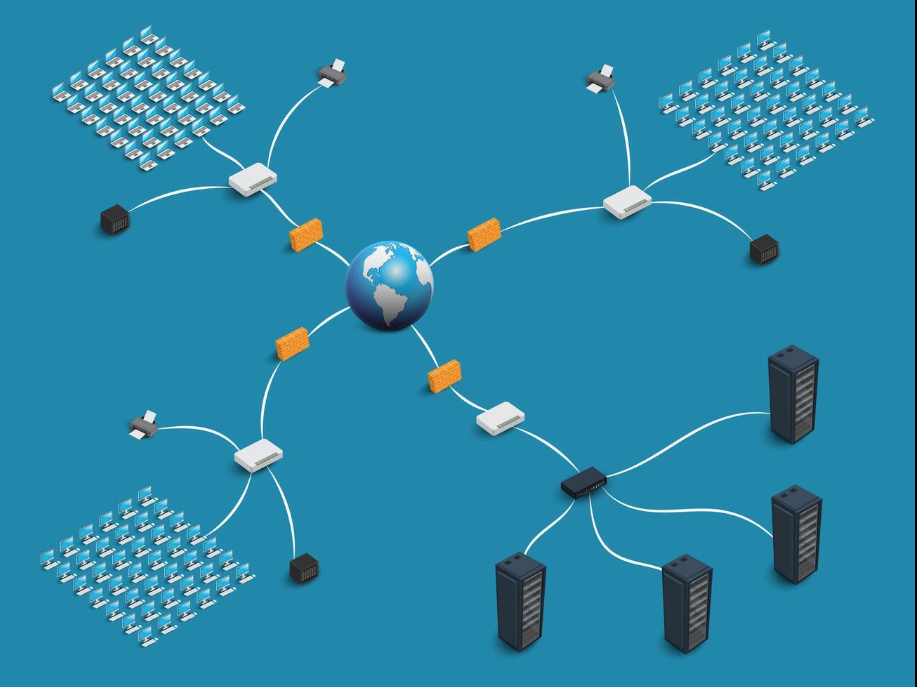
Businesses and enterprises need to create an ecosystem that is thriving and sustainable. Omada's Software Defined Network (SDN) platform is a modern network that integrates interconnected components for a smooth and manageable ecosystem.
It can sustain components such as:
-
Routers & gateways. Routers are responsible for receiving, analyzing and forwarding data packets to other networks, while gateways act as an entrance for enabling traffic flow within your network. The Omada Gigabit AX3000 WiFi 6 VPN Gateway has a flexible Wi-Fi coverage for your stores, which can load up to 5 WAN ports. It has a centralized management, enabling you to monitor it in real time.
-
Switches (L2/L3, PoE/PoE++) are used to segment the network into different subnetworks called LAN segments or subnets. Omada Switches is a core component of the Omada Software-Defined Networking (SDN) platform with robust performance and advanced security.
-
Firewalls are your first line of defense in a network system. They are like a security device that monitors traffic to and from your network, allowing you to block any traffic based on a defined set of security rules.
-
Access Points (APs) enable wireless devices to connect to your wired networks. They act as transmitters and receivers of wireless signals to manage the flow of data within the network so all connected devices can communicate with each other.
-
Endpoints are the physical devices that connect to your network system. This can be your PC, printer, or mobile devices. Endpoints also include the Internet of Things (IoT) devices like badge readers, security cameras, and even your fish tank thermostat.
-
Servers & cloud applications. Servers act as the lynchpin in a networking system that keeps all connected devices and data working together to run smoothly. It is the central hub in your network that manages communication and data exchange between different connected devices. You can manage the network resources and services within a cloud computing environment. Virtual technologies such as Virtual Private Clouds (VPCs) and Omada's Software-Defined Networking (SDN) can help distribute workloads evenly to provide safe, flexible, and effective connections between cloud systems and
A true networking solution considers the entire ecosystem that is sustainable and amplifies efficiency. You need to ensure that every element performs reliably and securely.
How to Choose the Right Networking Solution for Your Business
Businesses can take all your time working with several factors you need to consider to ensure safety, without compromising quality and functionality. But if you want to be efficient without wasting too much time and effort making several decisions, you need to find the right networking solution that best fits your business goals.
Here are the most important factors to evaluate:
Coverage & Scale
For small- to medium-sized businesses, you may consider a single-site coverage, enough for a small team and customer-facing spaces.
For a bigger scale like an enterprise, consider the size or the network coverage. You may find a network big enough for multi-floor campuses and large user bases with multiple branches.
Performance Requirements
Look for a system with higher user density. Consider the number of users or clients that will use the server. A high-density wi-fi provides pervasive connectivity even with a high number of users.
Consider what applications the users will be using. There are applications that require significant data transmission capacity that often lead to high network traffic. Streaming sites and online gaming are examples of bandwidth-intensive applications. These may potentially slow down the speed of data flow as they consume large amounts of bandwidth.
There are also several applications that require low latency to improve user experience. Low latency is needed for minimal lag time when you are using these applications. Such applications are those usually hosted in the cloud, online meeting applications, or mission-critical computation applications.
IT Resources Available
-
In-house IT team. For bigger-scale businesses, having a dedicated in-house IT team to manage the technology of your company.
-
External MSPs are widely used for a variety of organizations that don't have an in-house IT team. This is like an outsourced team of IT experts, specifically for managing day-to-day management responsibilities.
-
For small business models, they might prefer cloud-managed simplicity. Small to medium businesses with a small network will find having Omada's Software-Defined Networking (SDN) perfect for monitoring using a single interface.
Security Needs
Part of what you need to consider in choosing the perfect networking solutions for your business is its security features.
With guest segmentation, you can create separate, isolated network zones for clients. It improves monitoring and controlling the flow of network traffic between subnets. This means that guests can still access the internet, but they are prevented from accessing sensitive internal company resources. With access control, only authorized users can have access to a private network through identity authorization.
There should also be regulatory requirements or mandatory rules set by the government/bodies demanding security protocols. These are encryptions, access controls, segmentation and incident responses for networks to protect data and prevent breaches.
For users working remotely, it's essential to have reliable security integrated into your security stack. Organizations should consider using a network system that protects identities, secures sensitive data, and manages access to diverse locations and devices.
Growth & Flexibility
Networks should expand easily as your business evolves—without major redesigns. With the growth of your business, you need a cost-effective system that grows with you.
The TP-Link's Omada Software Defined Networking (SDN) is designed to be a highly scalable solution that meets the needs of an expanding business.
Total Cost of Ownership (TCO)
Consider hardware, maintenance, upgrades, and operational efficiency—not just upfront cost. A strategic approach makes your network future-ready, more secure, and easier to manage over time.
Why a Unified, Cloud-Managed Platform Like Omada Makes Sense
Omada combines wireless, switching, security, and cloud management into one solution—making it easier for businesses of all sizes to run reliable, scalable, and secure networks.
Benefits for SMBs
The Omada SDN is easy to set up even for first-time users. With its centralized control, the administrator will find it easy to monitor and manage even without extensive IT knowledge. Plus, the system has lower maintenance requirements because of its centralized management, remote operations and automation.
The Omada devices are designed to minimize network disruptions and downtime. It can quickly recover in cases when some operations, like significant configuration changes, cause a brief period of connection loss.
With the seamless roaming function of Omada, it allows client devices to automatically switch access points for a smooth internet experience.
And as the business grows, there is no need to change the system because of its scalable feature. It greatly supports growth, giving you adjustable room for expansion and adding branches as needed.
Benefits for Enterprises
Enterprises need a robust network system to ensure connectivity, productivity and security in today's increasingly digital world. The Omada SDN's cloud-managed platform offers centralized control to manage all connected devices from a single cloud-based dashboard.
This central management is also perfect for monitoring multiple locations from one unified interface, which is ideal for distributed businesses. Plus, you can remotely deploy and configure new sites without sending on-site personnel, reducing cost and manpower.
It can sustain a strong Wi-Fi connection even in a dense network environment with advanced features like MU-MIMO, Airtime Fairness, and Beamforming for stable, fast wireless. On top of that, it is designed to enforce consistent security policies across all integrated network devices and locations.
The system supports growth through its scalable network, which can easily expand alongside your business. Whether you're managing a single café or dozens of corporate sites, Omada delivers the control, reliability, and intelligence needed to support your business.
Emerging Trends Businesses Should Watch
With the networking landscape evolving quickly, it’s important to follow the trends that can influence future deployments.
-
Network-as-a-Service (NaaS): Subscription-based networks that reduce upfront cost and offload maintenance.
-
Hybrid On-Prem + Cloud Architectures: Combines local performance with cloud flexibility.
-
Advanced SDN & Automation: Networks that automatically optimize performance and security.
-
Integrated Network + Security Ecosystems: Unified solutions that combine Wi-Fi, switching, gateways, and surveillance (like Omada + VIGI).
Staying ahead of these trends ensures your infrastructure remains competitive and future-proof.
Conclusion
Networking solutions are essential to how modern businesses operate. From LAN and Wi-Fi to cloud-based SDN and secure remote access, the right mix ensures your organization stays productive, secure, and ready to grow.
By focusing on your business needs—and choosing solutions that scale with you—you can build a network that supports daily operations while preparing for the future.
A unified platform like Omada gives SMBs and enterprises the tools to simplify management, strengthen security, and deliver powerful, reliable connectivity across every site.
Frequently Asked Questions
1. What are common examples of networking solutions?
Common examples include routers, switches, firewalls, wireless access points, VPNs, and network management software.
2. What is the role of routers and switches in networking?
Routers connect different networks, while switches connect devices within the same network to manage data traffic efficiently.
3. How do wireless networking solutions work?
Wireless solutions use Wi-Fi access points and controllers to provide secure, high-speed internet access without physical cables.
4. Who needs networking solutions?
Businesses of all sizes, schools, hospitals, and government organizations rely on networking solutions for daily operations.
_20260112111606z.jpg)
_(1)_(1)_20250819012423b.png)
_20240830071121x.jpg)