


Motion Sensor Technology: PIR, Microwave, and AI Compared
Published: August 10, 2026 | Last Updated: August 10, 2026
Quick Answer
- A passive infrared sensor does not sense movement. It senses a change in the pattern of heat in front of it, which is why sunlight on a wall, an aircon vent, or a cat can all set one off.
- Dual-technology sensors only cut false alarms when they are configured so that both sensors must agree. The same device can be set so either one alone can raise the alarm, which makes it more sensitive and more talkative, not less.
- Camera-based detection classifies the object before deciding, so leaves and animals can be filtered out. That classification can run on the camera or on the recorder, and where it runs decides whether you can add it to cameras you already own, though the recorder route caps out at four channels.
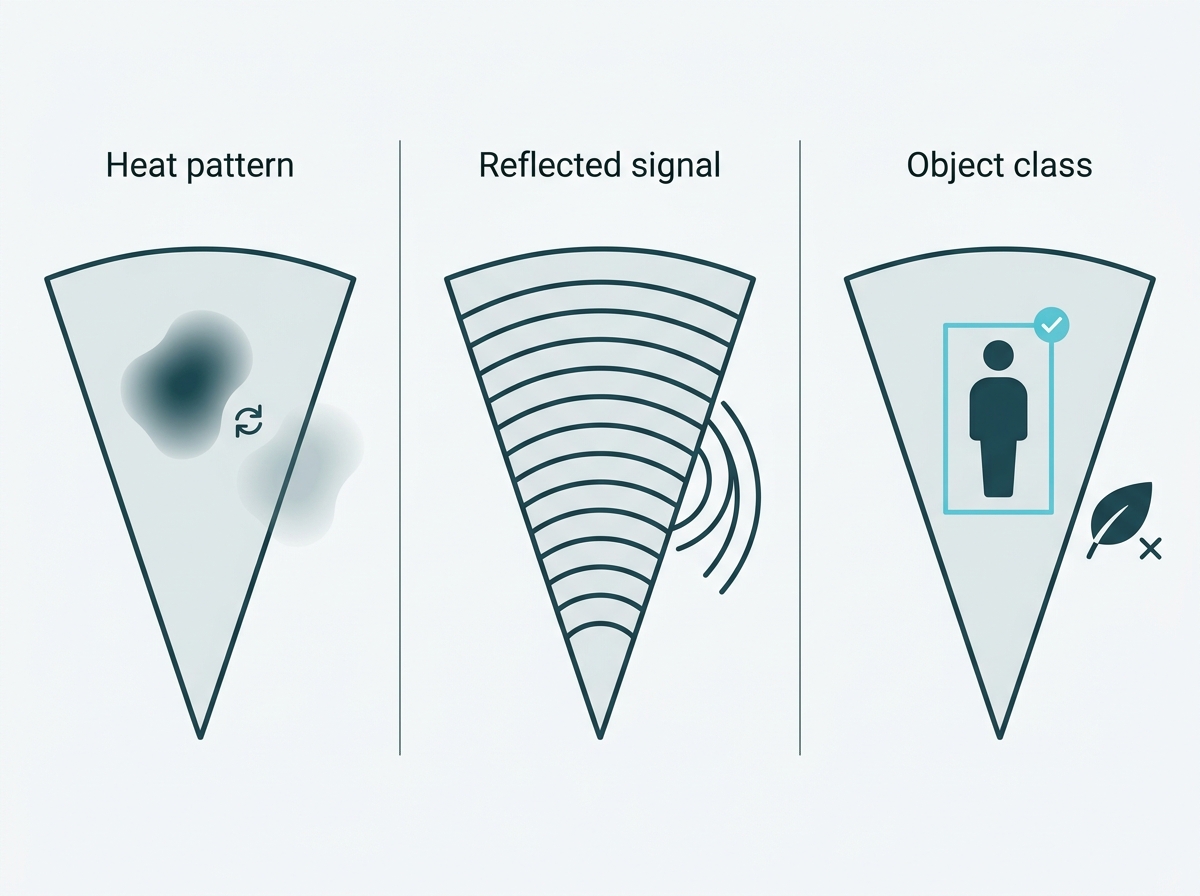
A motion sensor that alerts every time a moth crosses the porch light is not protecting anything. It is training its owner to swipe the notification away. Whether that happens comes down to what the device is actually sensing: heat, a reflected radio signal, or the shape of the object itself. The first two register that something in view changed. The third asks what the thing was, and only alerts if the answer is a person or a vehicle. That difference is why two devices sold as motion detectors can behave nothing alike on the same driveway.
Table of Contents
How Does a PIR Motion Sensor Detect Movement?
How Does a Microwave Motion Sensor Work?
Do Dual-Technology Sensors Actually Cut False Alarms?
How Is Camera-Based AI Detection Different?
Does the Classification Run in the Camera or the Recorder?
Is It a Settings Problem or a Hardware Problem?
What Can Motion Detection Not Do?
How Does a PIR Motion Sensor Detect Movement?
It does not detect movement. It detects a change in the pattern of infrared energy, which is to say heat, arriving at the sensor from whatever is in front of it.
PIR stands for passive infrared, and passive is the important word. The sensor emits nothing. Every warm object gives off infrared radiation, including people, animals, engines, and sun-warmed concrete, and the sensor sits there watching the pattern of that radiation across its field of view. When a warm body crosses a cooler background, the pattern shifts. If the shift is large enough and fast enough to clear the sensor's threshold, the device reports motion.
That is why PIR is cheap, needs very little power, and is in nearly every alarm system ever installed. It is also why it can be set off by things that are not people. Sunlight moving across a wall changes the heat pattern. An aircon unit cycling on changes it. So does a dog, a rat in the ceiling, and a curtain moving in front of a warm window. The sensor is not making a mistake when this happens. It is reporting exactly what it was built to report, which is that the heat pattern changed. It has no way of knowing what caused the change.
What it means for you: if your existing sensor fires on sunny afternoons or at the same time every day, that is a heat source in its view, not a fault. Moving it out of direct sun or away from a vent solves more of these than turning the sensitivity down does.
How Does a Microwave Motion Sensor Work?
It emits low-power microwave signals continuously and watches how they come back. When something moves in the covered area, the returning signal pattern changes, in the same broad way radar detects a moving aircraft.
Because the sensor is generating its own signal rather than waiting for one, it does not depend on a temperature difference between the subject and the background. It usually covers a larger area than a PIR of the same size, and it keeps working in conditions that flatten a heat pattern, such as a hot room where a person is close to the ambient temperature.
The trade-off is what microwave passes through. Microwave energy travels through many non-metallic materials, including plasterboard partitions, glass, and thin doors. So a sensor aimed at a stockroom can respond to someone walking past on the other side of the wall, or to traffic through a window, without anything having entered the room at all. That is not a defect either. It is the same property that makes the sensor useful, arriving somewhere unhelpful.
What it means for you: a microwave sensor is a good choice where heat detection struggles and a poor choice against an interior partition or a window onto a busy street. Check what is on the far side of every surface it points at, not just what is in the room.
Do Dual-Technology Sensors Actually Cut False Alarms?
Only when they are configured so that both sensors have to agree. The same hardware can usually be set the other way, and set that way it produces more alerts, not fewer.
The logic behind dual-tech is sound. A PIR and a microwave sensor fail for unrelated reasons. Sunlight fools the PIR and not the microwave. A moving branch behind a partition fools the microwave and not the PIR. Requiring both to register at the same instant means a single unrelated cause is no longer enough to raise an alarm, and that is where the reputation for fewer false alerts comes from.
The catch is that this is a mode. The European standard covering these devices, EN 50131-2-4 for combined passive infrared and microwave detectors, applies its requirements to detectors where both technologies must be active to generate an alarm, and states that where a detector can be configured so each technology can raise an alarm independently, the separate PIR and microwave standards apply instead. This is not a theoretical distinction: detectors certified to EN 50131-2-4 Grade 2 ship with the choice exposed as a dip switch, selecting AND or OR operation of the two sections. So "dual-tech" on the box tells you the device contains two sensors. It does not tell you how they are wired together, and a unit set to alarm on either input behaves like two twitchy sensors sharing a housing.
Requiring both sensors to agree has its own cost, and it is the reason higher-grade detectors carry anti-masking. If an alarm needs both technologies active, then blocking or covering one of them stops the device from being alarmed at all. That is a security trade rather than a false-alarm one, and it is why detectors specified for higher grades add active anti-mask circuitry that raises a separate alert when a sensor is obstructed.
One more limit worth knowing before you mount one outside: that standard covers detectors installed in buildings and explicitly excludes detectors intended for outdoor use. Its grades and environmental classes were not written for a gate post in the rain.
What it means for you: if you buy dual-tech, confirm at installation which logic it is set to, and ask specifically rather than assuming the default. If the answer is that either sensor can trigger it, you have not bought the false-alarm benefit. If it is set to require both, ask whether it has anti-masking, because that configuration is the one a covered sensor defeats.
How Is Camera-Based AI Detection Different?
It changes the question. A PIR or microwave sensor asks whether something in view changed. A camera with detection built in asks what the thing that moved actually was, and alerts only if the answer is on your list.
That is possible because a camera already has an image, which a sensor does not. Integrated processing on the camera analyzes what is in the frame and classifies it, which is the feature VIGI publishes as human and vehicle classification: humans and vehicles are distinguished from other moving objects such as animals and falling leaves, and alarm rules can be set to fire only on the categories you care about. A classified object is also something rules can be built on, which is what the wider Smart Detection feature set does, though the individual event types are a subject of their own.
The follow-on benefit shows up after an incident rather than during one. Because each clip is already labeled with what caused it, recorded footage can be sorted into human, vehicle, and event categories and searched by attributes, instead of scrubbing through a night of recording looking for the moment. A motion sensor gives you a timestamp. A classifying camera gives you a filter.
Feature-to-Benefit: Motion Detection Technologies Compared
|
Technology |
What it senses |
Where it is strong |
What it misses |
|
PIR (passive infrared) |
Change in the heat pattern in view |
Cheap, low power, works in total darkness, covers a volume rather than an image |
Cannot tell a person from a pet or from sunlight on a wall |
|
Microwave |
Change in a reflected signal it emits |
More extensive coverage, unaffected by a subject close to ambient temperature |
Passes through partitions and glass, so it sees motion you did not intend to cover |
|
Dual-tech (PIR and microwave) |
Both of the above |
Requiring agreement removes single-cause false triggers |
Only if configured to require both. Standards for it cover indoor use |
|
Camera-based classification |
What the moving object is |
Filters out animals, leaves, and light changes, and makes footage searchable afterwards |
Needs the subject inside the frame and large enough to classify |
A PIR watches heat and cannot identify what warmed up, a microwave sensor watches its own reflected signal and cannot tell which side of a wall the movement happened on, a dual-tech unit combines them and delivers fewer false alarms only in the mode where both must agree, and a classifying camera works out what the object was but only for objects inside its field of view and close enough to resolve.
What it means for you: if your problem is alerts about things that are not people, classification is the only one of the four that addresses the cause rather than the symptom. If your problem is coverage in a dark space with no camera, a sensor is still the right tool.
Does the Classification Run in the Camera or the Recorder?
Either, and the answer decides whether you can add classification to cameras you already own. This is the section for a business with an existing fleet rather than a single camera.
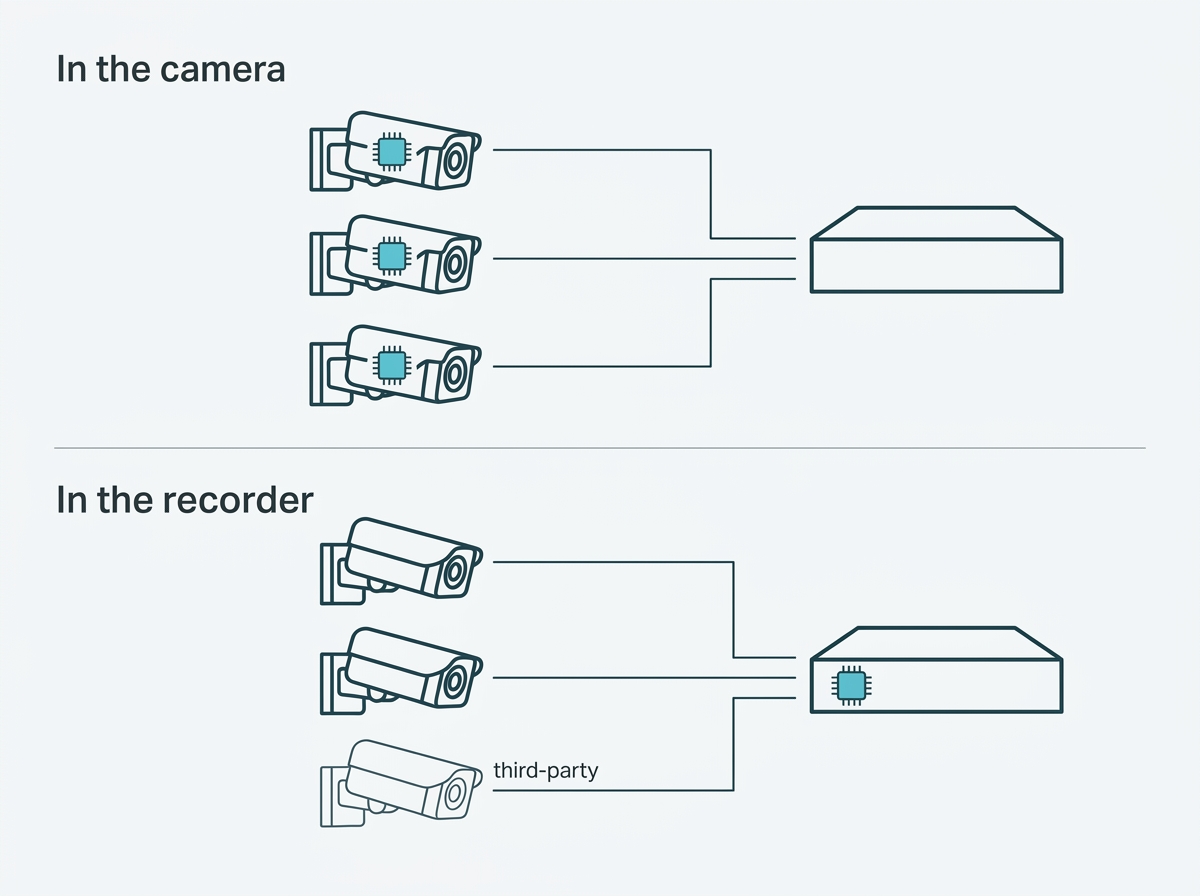
The usual arrangement puts the processing on the camera. VIGI cameras carry integrated AI chips that classify in the device, which means detection keeps working whether or not the internet is up, and each camera arrives with the capability already in it.
The alternative puts it on the recorder. TP-Link Philippines documents an AI by NVR feature in which the network video recorder runs the algorithms against the incoming video streams, so cameras without their own AI, including third-party cameras added over the ONVIF protocol, can perform intelligent detection once they are connected to it. For anyone holding a working set of older cameras, that is the difference between an upgrade and a replacement.
It comes with documented limits, and they matter at the planning stage rather than after. AI by NVR supports a narrower set of events than an AI camera does, covering motion detection, line-crossing detection, and intrusion detection. Up to four channels can run it at once, so on an eight- or sixteen-channel recorder this is a way to bring classification to a few chosen positions rather than to the whole fleet, and TP-Link notes that detection is more stable with fewer channels enabled than with all four. Enabling it also reduces the recorder's available receive bandwidth, in TP-Link's own example from 320 Mbps to 160 Mbps. TP-Link further states it is not recommended with pan and tilt cameras, fisheye cameras, dual-lens cameras, or where corridor mode is enabled, corridor mode being the rotated portrait view used for narrow spaces such as aisles and hallways. There is a configuration detail worth knowing too: the sub-stream resolution should be set higher than 640 by 360 for reliable detection, because the recorder analyzes the sub-stream rather than the main one.
So a site whose cameras are mostly pan-tilt units, or whose aisle cameras are rotated, is not a good candidate, and neither is one hoping to classify on twelve channels at once. That is worth knowing before the recorder is ordered.
What it means for you: count what you already own before shopping, then count how many positions actually need classification. A handful of fixed cameras at the entrances is a strong case for putting the intelligence in the recorder. A whole site, or a fleet of pan-tilt or rotated cameras, is a case for classification on the cameras instead.
Is It a Settings Problem or a Hardware Problem?
Work that out before you spend anything, because the two have completely different fixes and most people reach for the expensive one first.
The test is what the false alerts have in common. If they cluster at a time of day, they are almost certainly environmental and a scheduling or sensitivity change addresses them. If they come from one part of the view, such as a road or a neighbor's frontage that the camera happens to take in, they are a coverage problem and narrowing what the device watches addresses them. Both of those are settings; they cost nothing, and every camera system offers them in some form.
What settings cannot fix is a device answering the wrong question. If the alerts are spread evenly through the day and across the whole view, and they are caused by animals, foliage, or shifting light rather than by anything arriving, then the device is doing its job correctly and its job is the wrong one. Turning sensitivity down on a PIR that cannot distinguish a cat from a person does not make it distinguish them. It makes it miss the person too. That is the point at which classification, in the camera or the recorder, is the answer rather than a tuning session.
There is a second reason to narrow what a camera watches, if you are a business. NPC Circular 2024-02 requires that CCTV be used to monitor only the intended spaces, so keeping coverage off a neighbor's frontage or a public sidewalk is a privacy obligation as well as a false-alarm fix. The Circular also defines video analytics to include artificial intelligence algorithms and facial recognition, and asks for a privacy impact assessment where those are in use. Classification and facial recognition are not the same feature, and only the second raises the harder questions.
What it means for you: log a week of your false alerts before shopping. Clustered in time or in one part of the frame means you have a configuration problem and a free fix. Spread across both means you have the wrong detection technology, and no amount of tuning will change that.
What Can Motion Detection Not Do?
Three things, and knowing them prevents the disappointment that usually follows a first system.
It cannot classify what it cannot resolve. Camera-based classification needs the person or vehicle to occupy enough of the frame. A figure at the far end of a long yard may be plainly visible to you on the recording and still be too small for the camera to categorize, so no alert is generated. This is a distance and lens question rather than a software one.
It cannot see outside the frame. A sensor covers a volume and reacts to anything in it, including movement behind the camera or below it. A camera only knows about what is in its field of view. Replacing sensors with cameras one for one usually leaves gaps that nobody notices until something happens in one.
Classification is not identification. Knowing that the moving object was a person is a different thing from knowing which person. Telling one individual from another is a matter of how much detail the camera resolves at that distance, and where facial recognition is involved, of a separate set of features and obligations. A camera that alerts you accurately can still produce footage that identifies nobody. How much detail a camera resolves at a given distance is a selection question rather than a detection one, and our CCTV and security camera buying guide covers it alongside the rest of the specification.
What it means for you: treat detection and identification as two separate requirements when you plan. The detection settings decide what reaches your phone. The camera and lens decide whether the recording is any use afterwards.
To compare cameras by the detection features they carry, browse VIGI cameras, where AI, Smart Detection, and human and vehicle classification are all filters. For choosing the camera itself, see our guides to choosing the right camera for the space and keeping a home secure with smart cameras, or explore VIGI's surveillance solutions.
Frequently Asked Questions
What is the difference between PIR and microwave motion sensors?
A passive infrared sensor emits nothing and watches for changes in the pattern of heat reaching it, so it needs a temperature difference between the subject and the background. A microwave sensor emits its own signal and watches how the reflection changes, so it works regardless of temperature but also passes through partitions and glass. They fail for unrelated reasons, which is why some devices combine them.
Why do motion sensors trigger false alarms?
Because a traditional sensor reports a change in a signal, not the arrival of a person. Sunlight moving across a wall, an air conditioning unit cycling on, a pet, or movement on the far side of a thin wall can each produce exactly the signal change the sensor was built to report. Nothing has gone wrong with the device when this happens.
Do dual-technology motion sensors reduce false alarms?
Only in the configuration where both the infrared and the microwave sensor must register at the same moment, and that is a setting rather than a property of the product, exposed on many certified detectors as a dip switch selecting AND or OR operation. EN 50131-2-4, the standard for combined detectors, distinguishes the two modes and applies its requirements only to the first. Confirm which one yours is set to at installation, and note that AND mode can be defeated by obstructing one sensor, which is why higher-grade detectors add anti-masking.
How is AI motion detection different from a traditional motion sensor?
A traditional sensor detects a change in a physical signal and can say only that something happened. A camera with AI detection analyzes the image to classify what caused the movement, such as a human or a vehicle, and can be set to alert only on those categories, so animals, falling leaves, and changing light can be filtered out before anything reaches your phone.
Can I add AI detection to security cameras I already own?
Sometimes, by moving the processing to the recorder. TP-Link documents an AI by NVR feature where the network video recorder runs the detection on incoming streams, which brings intelligent detection to cameras without their own AI, including third-party cameras added over ONVIF. It supports a narrower event set, runs on a maximum of four channels at once, and is not recommended with pan-tilt, fisheye, or dual-lens cameras, or where corridor mode is enabled.
Does AI motion detection need an internet connection?
Not for the detection itself. VIGI cameras carry integrated AI chips that classify on the device, and the detection settings live on the camera, so classification and local recording continue during an outage. An internet connection is needed for push notifications and for viewing or reviewing footage remotely.
Can settings fix a false alarm problem on their own?
Sometimes, and what the alerts have in common tells you which case you are in. Alerts clustered at a particular time of day or coming from one part of the view are environmental or a coverage issue, and adjusting what the device watches and when will address them. Alerts spread evenly through the day and across the whole view, caused by animals or foliage rather than by anything arriving, mean the device cannot tell the difference in the first place, and only classification changes that.
Final Thoughts
The four technologies in this article are not four grades of the same product. A passive infrared sensor watches heat, a microwave sensor watches its own reflected signal, a combined unit watches both and only helps if it is set to require agreement, and a camera with classification works out what the object actually was. Each answers a different question, and the reason motion detection has a reputation for being annoying is that the first three are usually asked to answer the fourth one's question.
For most people whose complaint is alerts about things that are not people, the fix is classification, either in the camera or in the recorder. For anyone whose alerts cluster at a time of day or in one corner of the view, the problem is not the technology and the fix costs nothing.
If you want a straight answer on which applies to you, bring three things to a VIGI specialist: what your current alerts are actually being triggered by, how many cameras you already own and whether any are pan-tilt or rotated into corridor mode, and the distance from each camera to the spot where you need it to notice someone. You will get back a recommendation on whether the classification belongs in the camera or the recorder, which of your existing cameras can be kept, and which positions need a different lens before detection will work reliably at all.