


What Is SDN? Software-Defined Networking for Business
Published: August 4, 2026 | Last Updated: August 4, 2026

Software-defined networking, or SDN, is an approach to running a network where the decision-making logic is separated from the hardware that moves traffic. Instead of each switch and access point holding its own configuration, a central controller holds the policy and the devices carry it out. For a business, the practical result is that changes are made once and applied everywhere, rather than device by device. The value grows with the number of devices and locations, which is why the businesses that feel it first are usually the ones with the smallest IT teams, not the largest.
Quick Answer
- SDN splits the control plane, which decides what happens, from the data plane, which moves the packets. The controller holds the intelligence and the hardware follows instructions.
- The practical gain is set once, applied everywhere. A policy change that would mean fifty logins across fifty access points becomes one change in a dashboard.
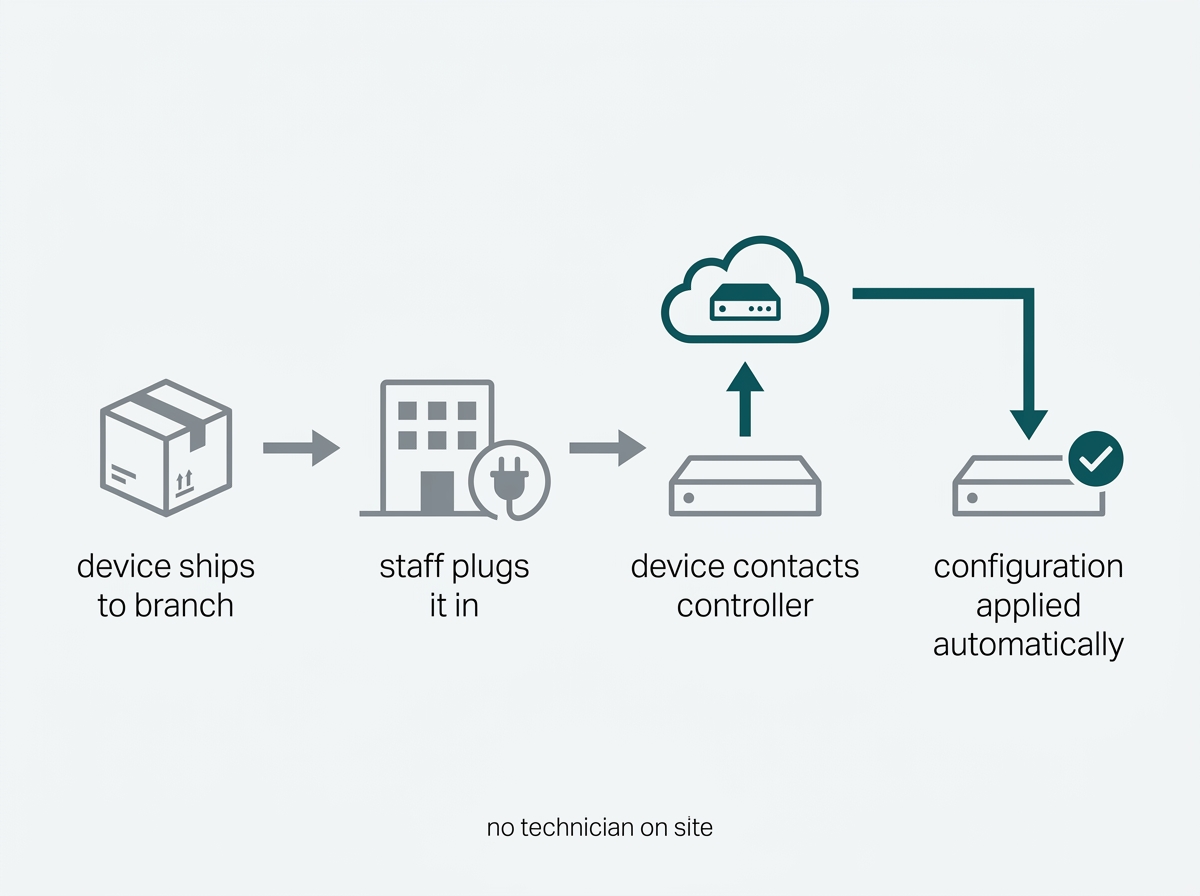
- The feature that decides whether a multi-site rollout works is zero-touch provisioning, where a device ships to a branch, someone non-technical plugs it in, and it pulls its configuration from the controller automatically.
Table of Contents
What Is Software-Defined Networking?
How Do the Control Plane and Data Plane Divide the Work?
How Is SDN Different From Traditional Networking?
Which Businesses Actually Benefit From SDN?
What Is Zero-Touch Provisioning?
What Does Network Downtime Actually Cost?
Is SDN Only for Large Enterprises?
What Is Software-Defined Networking?
Software-defined networking is an approach to managing a network where the decision-making logic, called the control plane, is separated from the physical devices that forward traffic, called the data plane.
In a traditional network, every switch and router makes its own forwarding decisions based on rules configured directly on that device. In an SDN architecture, a central controller makes those decisions and the switches, access points, and gateways carry out instructions. The Open Networking Foundation, which originated the term, defines SDN as the physical separation of the network control plane from the forwarding plane, with one control plane directing several devices, and describes the resulting architecture as directly programmable and centrally managed.
One point of precision, because it is where most explanations of SDN quietly overreach. The Open Networking Foundation's definition is a strict one, built around open standards and the OpenFlow protocol, and aimed originally at carrier and data center infrastructure. Commercial platforms sold to businesses under the SDN label, including Omada, apply the same core principle of centralized control decoupled from hardware, without necessarily implementing OpenFlow. The industry has broadened the term over time. That is worth knowing so that a vendor's use of "SDN" is understood as centralized controller-based management rather than assumed to mean standards-based control plane separation.
What it means for you: when a vendor says SDN, the question to ask is what the controller can actually do across your devices, not whether the word applies. The label has stretched. The capability is what you are buying.
How Do the Control Plane and Data Plane Divide the Work?
The control plane decides. The data plane does. Keeping them separate is what makes one dashboard capable of running many devices.
Picture a hotel with fifty rooms, a lobby, and a restaurant, each needing Wi-Fi. In a traditional setup, an administrator logs into each access point individually to set the network name, the security settings, and the guest policy. Changing that policy means fifty separate logins. Under SDN, the controller holds the policy once, every access point receives it automatically, and a change made centrally reaches all fifty rooms without anyone touching a device.
The data plane, meaning the radios and switch ports actually moving packets, stays deliberately simple. All the intelligence sits at the controller, which is also why adding hardware later means assigning it to an existing profile rather than configuring it from scratch.
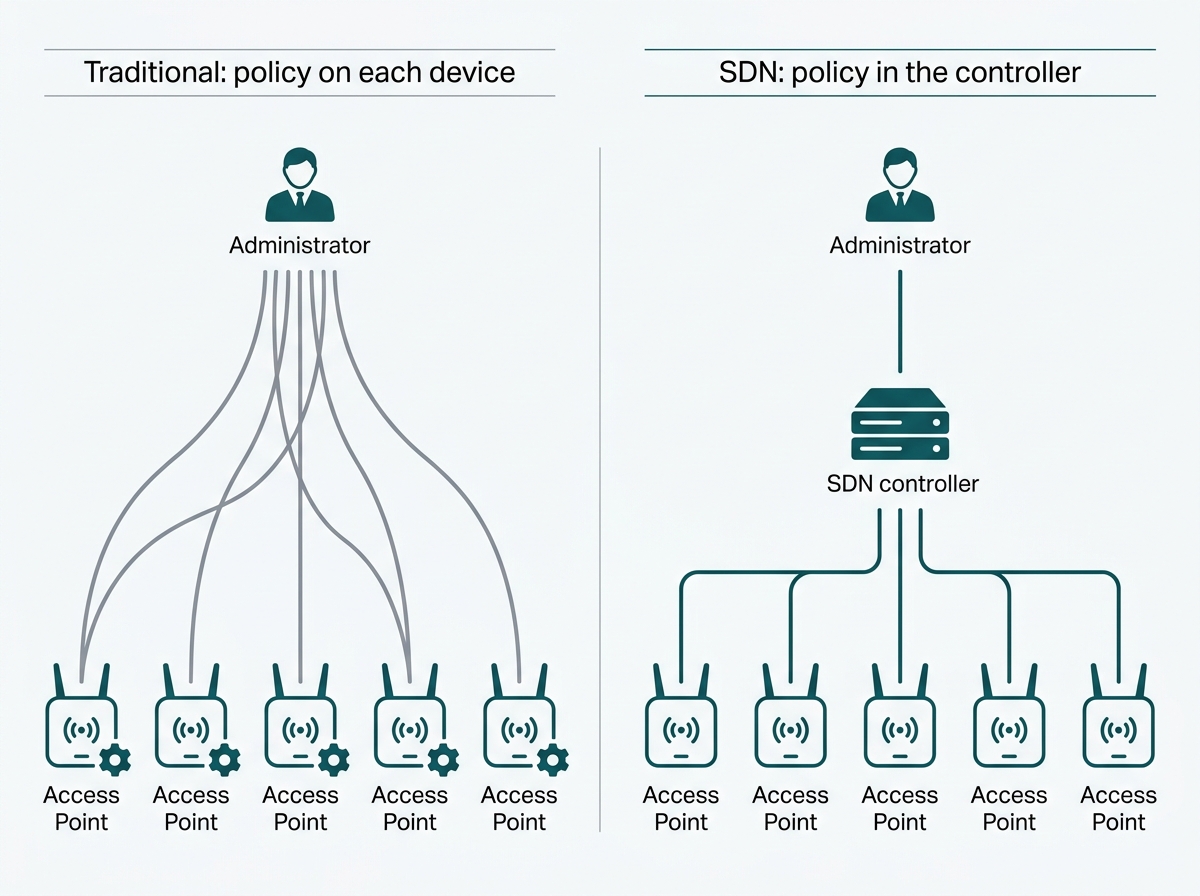
What it means for you: the test of whether this matters to you is simple. Count how many devices you would have to log into individually to change your guest Wi-Fi password today.
How Is SDN Different From Traditional Networking?
Feature-to-Benefit: Traditional Networking vs SDN
|
|
Traditional Networking |
Software-Defined Networking |
What this means in practice |
|
Control location |
On each device |
Central controller |
Decides whether policy lives in one place or fifty |
|
Configuration changes |
Manual, per device |
Set once, pushed to all devices |
Determines whether a policy change is an afternoon or a minute |
|
Adding new hardware |
Full manual setup on site |
Provisioned from a saved profile |
Decides whether a new branch needs a technician on the ground |
|
Visibility |
Device by device, no unified view |
Single dashboard across all sites |
Determines whether you find a fault or wait to be told about it |
|
Troubleshooting |
Hop by hop, check each device |
Central logs and diagnostics |
Decides how long an outage lasts, not whether it happens |
Traditional networking keeps control on each device, requires manual per-device configuration, needs full setup on site for new hardware, offers no unified view, and is troubleshot hop by hop. SDN centralizes control in a controller, applies configuration once across all devices, provisions new hardware from a saved profile, presents a single dashboard across sites, and centralizes logs and diagnostics.
This is not a claim that traditional networking is obsolete. A single-location shop with three switches and two access points may never feel the difference. The gap widens as devices and sites multiply, which is why SDN adoption tracks with multi-site and multi-device operations rather than with company size on its own. The switching layer underneath still matters, and our guide to managed and unmanaged switches covers what a controller needs from the hardware to be useful.
What it means for you: if you have one site and five devices, the honest answer is that this is a nice-to-have. If you have three sites, it is already costing you time you are not counting.
Which Businesses Actually Benefit From SDN?
Businesses running more network devices across more locations than one person can configure by hand. That is the shared condition, and it shows up in offices, hotels, and retail chains for slightly different reasons.
An office needs staff Wi-Fi, guest Wi-Fi, VoIP, and CCTV coexisting on the same switches without interfering with each other. A hotel needs guest room Wi-Fi, lobby coverage, and back-of-house systems segmented and monitored from one place, often across separate buildings. A retail chain with branches in different cities needs every location running an identical security policy without dispatching a technician to each one.
In each case, the business problem is the same: too many devices across too many locations, and not enough hours to touch each one.
What it means for you: the threshold is not revenue or headcount. It is the number of devices multiplied by the number of places they sit, divided by the number of people who can configure them.
What Is Zero-Touch Provisioning?
Zero-touch provisioning is the ability to ship a switch or access point directly to a site, have a non-technical person plug it in, and let the device pull its full configuration from the controller automatically.
Most SDN evaluations focus on the dashboard and the feature list. The bottleneck businesses actually hit when scaling past one site is rarely the hardware or the interface. It is getting a new location online without sending someone who knows the network, and zero-touch provisioning is the specific capability that removes that constraint.
The mechanism is worth understanding, because it is what centralized control makes possible rather than a separate feature bolted alongside it. Because the configuration lives in the controller rather than on the device, a new switch or access point does not need to arrive pre-loaded with anything. It needs only to reach the controller, identify itself, and receive the profile it has been assigned. That is the control plane and data plane split doing its practical work: the hardware is interchangeable because the intelligence was never on it.
What this is worth in a real rollout, including the per-branch assessment it does not remove and how it changes the economics of opening a location in another region, is covered in our multi-site network management guide.
What it means for you: when comparing platforms, ask what specifically happens when a device is plugged in at a site with nobody technical present. The answer separates the demonstrations from the deployments.
What Does Network Downtime Actually Cost?
More than most businesses estimate, though the honest answer is that the number is specific to you and the widely quoted figures are not.
Published estimates for small and mid-sized businesses range from around 8,000 US dollars an hour at the low end to over 100,000 at the high end, depending on who ran the survey and which businesses answered it. That spread is not a detail to average out. It is the finding. The studies are measuring different industries, different company sizes, and in some cases downtime caused by ransomware rather than by network faults, so no single figure travels well to a specific business, and none of them were measured in the Philippines.
Which makes the useful exercise of calculating your own. Take the hourly payroll of everyone who cannot work during an outage, add the revenue of the transactions you cannot process in that hour, and add what emergency support costs when it is unplanned rather than scheduled. For a retail branch that cannot take payments, or a hotel that cannot check guests in, the number usually surprises people. It is also defensible in a budget conversation in a way that a borrowed benchmark is not.
Centralized visibility does not prevent outages. What it changes is how long they last, because a single dashboard shows which device or site is failing instead of requiring someone to work through hardware one piece at a time. That difference is what your own hourly figure gets multiplied against.
What it means for you: work out your hourly downtime cost before evaluating any platform. It is the number that tells you what faster fault-finding is worth, and without it every vendor comparison is guesswork.
Is SDN Only for Large Enterprises?
No, and the assumption gets the direction backward. The businesses that benefit most from centralized management are frequently the ones with the smallest IT teams.
A single administrator managing Wi-Fi, switches, and gateways across a handful of retail branches or hotel properties has no time to visit each site for routine changes. That is precisely the constraint centralized control removes. Platforms built for commercial deployment, as distinct from carrier-grade infrastructure, are designed so that one person can manage dozens of sites from a laptop.
The technology did originate at carrier and data center scale, and then scaled down. What reached the commercial market is the centralized management principle rather than the full standards-based architecture, which is why it fits a business with one IT person and forty devices rather than requiring a network operations team.
What it means for you: if you have been assuming this is above your level, the test is not company size. It is whether you can currently see all your network devices in one place.
Get in touch with Omada to talk through what centralized management would look like for your specific mix of offices, sites, or properties.
Frequently Asked Questions
What is the difference between SDN and SD-WAN?
SDN is the broader architecture for centralizing control over switches, access points, and gateways within and across sites. SD-WAN applies the same principle specifically to optimizing the wide-area connections between locations. Most commercial SDN platforms include SD-WAN-style capabilities as one component of a larger management system.
Is SDN the same thing as cloud networking?
Not exactly. SDN describes how control is centralized and separated from hardware. Cloud networking describes where that control lives, typically in a vendor-hosted cloud rather than on local hardware. Most modern SDN platforms are cloud-based, though SDN itself can also run on an on-premises controller.
Do I need a dedicated IT team to run an SDN platform?
No. Commercial SDN platforms are built so a single administrator can manage many devices and locations without specialized networking certifications. Zero-touch provisioning and template-based configuration exist specifically to reduce the staffing requirement rather than assume one.
Can SDN reduce network management costs for a small business?
Primarily through labor time rather than hardware savings. Centralizing configuration and monitoring cuts the hours spent on per-device changes and on-site troubleshooting, which is usually where the bulk of network management cost actually sits.
What happens if the SDN controller goes offline?
It depends on the platform, and it is worth asking directly. On most cloud-based systems, devices continue operating on their last known configuration if the controller connection drops, while administrators temporarily lose the ability to push changes or view live status until connectivity returns.
Does every vendor mean the same thing by SDN?
No. The Open Networking Foundation's original definition is strict and standards-based, built around OpenFlow and vendor neutrality. Commercial platforms marketed as SDN generally implement centralized controller-based management without that full architecture. Both centralize control away from individual devices, so compare what a controller can actually do rather than whether the label applies.
Does SDN work for a business with only one physical location?
Yes, though the benefit is smaller. A single site with a handful of devices may stay manageable without centralized control. The value grows directly with the number of devices and locations, which is why it is most commonly adopted by businesses already running multiple sites or planning to.
Final Thoughts
Every business running more than a handful of network devices eventually meets the same wall: per-device configuration does not scale, and the ones who feel it first are usually those with the smallest IT teams rather than the largest. SDN addresses that directly by moving control into a central dashboard, so adding a site or changing a policy stops being a per-device task and becomes a single action.
The pattern holds whether the business runs one office, a hotel property, or a chain of branches. More devices across more sites make centralized control worth more, not less. And the feature that decides whether it works in practice is rarely the dashboard. It is whether a device can be shipped to a site and configure itself when someone non-technical plugs it in.
If you are weighing this up, two numbers make the conversation concrete: how many devices you would have to log into individually to change one policy today, and what an hour of network downtime costs your operation. Bring those, along with how many sites you run and how many you expect to run in two years, and talk to an Omada network specialist. You will get back a straight answer on whether centralized management is worth it at your current size, what it would take to migrate the hardware you already own, and what a branch rollout would actually look like without sending anyone.